Friday, January 26, 2007

Questions on Centre of Mass

The following question involving the motion of centre of mass is worth noting:
Two spheres of masses m1 and m2 (m1>m2) respectively are tied to the ends of a light, inextensible string which passes over a light frictionless pulley. When the masses are released from their initial state of rest, the acceleration of their centre of mass is
(a) [(m1–m2)/(m1+m2)]g
(b) [(m1–m2)/2(m1+m2)]g
(c) [(m1–m2)/4(m1+m2)]g
(d) [(m1–m2)/(m1+m2)]2g
(e) [4(m1–m2)/(m1+m2)]g
If r1 and r2 are the position vectors of the centres of the spheres, the position vector of their centre of mass is given by R = (m1r1 + m2r2)/(m1+m2). The acceleration of the centre of mass is therefore given by
a = d2R/dt2 = (m1d2r1/dt2 + m2 d2r2/dt2)/(m1+m2).
But d2r1/dt2 and d2r2/dt2, which are the accelerations of the masses m1 and m2 have the same magnitude (m1–m2)g/(m1+m2). If we take the acceleration of m1 (which is downwards) as positive, that of m2 is negative.
Therefore, a = [m1(m1–m2)g/(m1+m2) – m2(m1–m2)g/(m1+m2)] /(m1+m2).
On simplifying, this yields a = [(m1–m2)/(m1+m2)]2g. [Option (d)].
The following MCQ has been popular among question setters:
In the HCl molecule, the separation between the nuclei of the two atoms is about 1.27 Ǻ. The approximate distance of the centre of mass (from the hydrogen atom) of the HCl molecule, assuming the chlorine atom to be about 35.5 times as massive as the hydrogen atom is
(a) 0.27 Ǻ
(b) 0.56 Ǻ
(c) 1 Ǻ
(d) 1.24 Ǻ
(e) 2.26 Ǻ
The centre of mass of this two particle system is on the line joining the two atoms and in between these atoms. If ‘x’ is the distance of the centre of mass from the hydrogen atom, we have x = (1×0 + 35.5×1.27)/ (1+35.5) = 1.24 Ǻ, approximately.
Note that the equation giving the value of ‘x’ is the usual equation for the position vector of the centre of mass: R = (m1r1 + m2r2)/(m1+m2). We have taken the origin to be at the centre of the hydrogen atom so that r1 = 0 and r2 = 1.27 Ǻ.
[You can easily find the centre of mass of two particle systems by equating the ‘moments’ of the masses about the centre of mass. In the present case, 1×x = 35.5(1.27–x) from which x = 1.24 Ǻ].
Now consider the following simple question:
A proton and an electron, initially at rest, are allowed to move under their mutal attractive force. Their centre of mass will
(a) move towards the proton
(b) move towards the electron
(c) remain stationary
(d) move in an unpredictable manner.
The correct option is (c) because you require an external force to move the centre of mass of a system of particles. The mutual force of electrical attraction is an internal force which can not affect the position of the centre of mass of the system.

Tuesday, January 23, 2007

Two more Questions on Spherical Mirrors

The following question is quite simple, but many among you will find it confusing:
The sun subtends an angle of 0.5° on the earth’s surface. What is the diameter of the image of the sun, produced by a concave mirror of radius of curvature one metre?(a) 8.8mm (b) 6.4mm (c) 5mm (d) 4.4mm (e) data insufficient for arriving at an answer
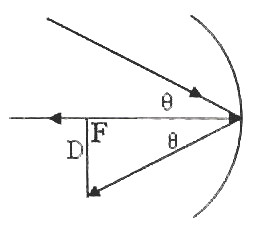
In the figure θ is the angle subtended by the sun at the pole of the mirror. The real image of the sun is obtained at the focus of the mirror and this image also subtends the same angle θ at the pole of the mirror. Since the real image of the sun is obtained at the focus of the mirror, we have D/50 = 0.5×π/180 where D is the diameter of the image of the sun. [Note that the focal length of the mirror is 50cm and we have converted the angle of 0.5° in to radian].
From the above equation we obtain D = 0.44 cm (approximately) = 4.4mm.
The following question also is simple, but be careful while applying the signs in accordance with the Cartesian convention.
An erect image three times the size of a real object is formed with a concave mirror of radius of curvature 36cm. The distance of the object from the mirror is
(a) 24cm (b) 20cm (c) 16cm (d) 12cm (e) 8cm
Evidently, the signs of ‘f’ and ‘u’ are negative. Since the image is erect, it must be formed behind the mirror (virtual image) and the sign of ‘v’ is positive. Further, the image is magnified 3 times so that v=3u. Substituting these in the equation, 1/f = 1/u + 1/v, we have –1/18 = –1/u +1/3u from which u =12 cm.

Monday, January 22, 2007

Two Questions on Spherical Mirrors

Multiple Choice Questions on Spherical Mirrors
The following question pertains to the formation of a real image when a real object is kept in front of a concave mirror:
A bright rod of length 12 cm lies along the axis (parallel to the axis) of a concave mirror of radius of curvature 30 cm, the nearer end of the rod being at 30 cm from the mirror. The size of the image of the rod will be
(a) 20cm (b) 30.5cm (c) 40cm (d) 50.4cm (e) 60cm
The law of distances for a mirror is 1/f = 1/u + 1/v.
According to the Cartesian sign convention (see the post dated 22nd November 2006), the sign of the focal length (f) of a concave mirror is negative. The sign of the object distance ‘u’ also is negative since it has to be measured (from the pole), opposite to the direction of propagation of the incident ray.
Since the radius of curvature is 30cm, the focal length is 15cm. The image of the nearer end of the rod will be at a distance ‘v’ given by
– 1/15 = – 1/18 + 1/v. Note that we are not bothered about the sign of ‘v’ since it is an unknown quantity whose sign has to come out from the solution. We obtain v = – 90cm. The negative sign just means that this distance is measured opposite to the direction of propagation of the incident ray.
The distance of the image of the farther end of the rod can be obtained by putting u = – 30cm. In this case you will obtain the image distance as –30cm. [You can get it immediately without writing any equation if you remember that in the cse of a real object at 2f, the image is real and it will coincide with the object].
So, the size of the image is 90 – 30 = 60cm.
[Since you know that a concave mirror will form a real image when a real object is placed at a distance more than the focal length, u,v and f are all negative so that you could have worked out the above problem by treating all quantities as positive. But this method can be adopted only in special situations. Treating the known quantities with their proper signs is always the fool proof method].
Now, consider the following question which appeared in Kerala Engineering 2003 question paper:
An infinitely long rod lies along the axis of a concave mirror of focal length ‘f’. The nearer end is at a distance x > f from the mirror. Then the length of the image of the rod is
(a) f2/(x+f) (b) f2 /x (c) xf/(x–f) (d) xf/(x+f) (e) f2 /(x–f)
We have 1/f = 1/u + 1/v. The focal length ‘f’ and the object distance u = x are negative. Since ‘v’ is unknown we don’t bother about its sign and write, –1/f = –1/x + 1/v and obtain v = fx/(f–x). [This is a negative quantity since f is less than x as given in the question]. This gives the distance of the image of the nearer end of the rod. The distance of the image of the farther end of the rod is obtained by putting u = ∞ in the above equation. You will get the image distance as – f.
The length of the image of the rod is – f – [fx/(f–x)] = –f2 /(f–x) = f2 /(x–f).

Friday, January 19, 2007

Questions on Electrostatics

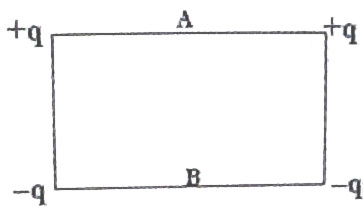
Charges +q, +q, –q and –q coulomb are arranged at the corners of an imaginary rectangle of sides 6m and 4m, as shown in the adjoining figure. A and B are the mid points of the longer sides. The potential difference between A and B is (in volts)
(a) 2.4×10⁶q (b) 4.8×10⁶q (c) 2.4×10⁹q (d) 4.8×10⁹q (e) 9.6×10⁹q
The potential at A due to the charges +q and +q is 2×(1/4πε0)(q/3) and the potential at the same point due to the charges –q and –q is 2×(1/4πε0))(–q/5). The resultant potential at A is 2×(1/4πε0)[(q/3)–(q/5)] = 2×(1/4πε0) (2q/15)= (1/4πε0) (4q/15).
Similarly, the resultant potential at B is 2×(1/4πε0)[(q/5) – (q/3)] =
2×(1/4πε0) (–2q/15) = (1/4πε0)(–4q/15).
The potential difference between points A and B is (1/4πε0))[(4q/15) – (–4q/15)] = (1/4πε0)×(8q/15). You should remember that 1/4πε0= 9×10⁹. Therefore, the P.D. is 9×109×(8/15)q = 4.8×10⁹q volts.
The following question appeared in Punjab CEET 2003 question paper:
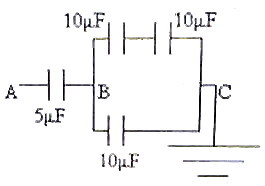
As shown in figure, if the point C is earthed and the point A is given a potential of 2000 volt, then the potential at B will be
(a) 400 V (b) 500 V (c) 1000 V (d) 1300 V

The effective capacitance between the points B and C is 15 μF because 10μF and 10μF in series in the upper branch make 5μF and this is in parallel with 10μF in the lower branch. So, in effect 2000 V is applied across the series combination of 5μF and 15μF connected between A and C. Since the potential difference across capacitors connected in series is inversely proportional to the capacitance, the applied P.D. of 2000 volts get divided in the ratio 3: 1 across 5μF and 15μF [1500 V : 500V]. The potential at B with respect to the grounded point C is therefore 500V.
Now consider the following question which appeared in IIT 2002 question paper:
Two identical capacitors have the same capacitance C. One of them is charged to potential V1 and the other to potential V2. The negative ends of the capacitors are connected together. When the positive ends are also connected, the decrease in energy of the combined system is
(a) ¼ C(V12 – V22) (b) ¼ C(V12 + V22) (c) ¼ C(V1 – V2)2 (d) ¼ C(V1 + V2)2
The initial energy of the system is ½ CV12 + ½ CV22 = ½ C(V12+V22).
On connecting the capacitors (in parallel), the net capacitance of the system is 2C and the net voltage across the combination is ½ (V1+V2). [The total charge is C(V1+V2) so that the net voltage is C(V1+V2)/ 2C = (V1+V2)/2].
Therefore, final energy of the system is(½) × 2C[(V1+V2)/2]2 = ¼ C(V12+V22 +2V1V2).
On subtracting the final energy from the initial energy, we obtain the decrease in energy as ¼ C(V1–V2)2, given by option (c).
You will find more multiple choice questions on Electrostatics with solution in the post dated 9th October 2006.

Thursday, January 11, 2007

Multiple Choice Questions on Wave Optics

Consider the following MCQ which is meant for gauging your grasp of the principle of superposition of waves:Two laser beams of the same wave length and intensities 9I and I are superposed. The minimum and maximum intensities of the resultant beam are:
(a) 8I and 10I (b) 0 and 10I (c) 4I and 16I (d) 0 and 16I (e) 4I and 10I
Since the intensity is directly proportional to the square of the amplitude, the minimum and maximum intensities are[√(9I) – √I]2 and [√(9I) + √I]2 respectively, which are [2√I]2 and [4√I]2. So, the correct option is 4I and 16I.
Diffraction at single slit deserves your special attention since questions involving it are often seen in Medical and Engineering entrance test papers. Here is a question which appeared in Kerala Engineering Entrance 2006 question paper:
The width of a single slit if the first minimum is observed at an angle 2º with a light of wave length 6980 Ǻ is
(a) 0.2 mm (b) 2×10⁻⁵ mm (c) 2×105 mm (d) 2 mm (e) 0.02 mm

The angular position of the first minimum is λ/a. Therefore, λ/a = 2×(π/180), on converting the angle in degrees to the angle in radian. This gives a = 180 λ/2π
= 180×6980×10–10/2π = 0.02×10⁻³ m = 0.02 mm.
Here is a question which may easily mislead you:
In a double slit experiment, the separation between the slits is 1 mm and the distance between the double slit and the screen is 1m. If the slits are illuminated by monochromatic light of wave length 6000 Ǻ, what is the separation between the 2nd dark bands on either side of the central band?
(a) 0.9 mm (b) 1.2 mm (c) 1.8 mm (d) 3 mm (e) 4.2 mm
As you know, the central band in Young’s double slit experiment is bright. The distance from the centre of this bright band to the centre of the first dark band (on one side) is half a band (fringe) width. The distance from the centre of the first dark band to the centre of the second dark band is one band width. So, the distance between the centre of the central band and the second dark band on one side is one and a half times the band width. The distance between the second dark bands on either side is therefore three times the band width.
Now, band width, β = λD/d where λ is the wave length of light used, D is the distance of the screen from the double slit and ‘d’ is the separation between the two slits. The answer to the question is 3β = 3 λD/d =3×6000×10–10×1/(1×10–3) = 1.8×10⁻³ m = 1.8 mm.
The following MCQ appeared in AIEEE 2004 question paper:The maximum number of possible interference maxima for slit separation equal to twice the wave length in Young’s double slit experiment is
(a) infinite (b) five (c) three (d) zero
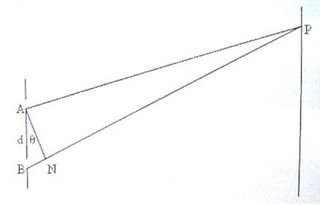
If ‘d’ is the slit separation (AB in fig.), the path difference between the waves reaching a point P on the screen is BP – AP = dsinθ and the condition to produce the nth maximum (bright fringe) at P is
d sinθ = nλ = nd/2.
Therefore, n = 2 sinθ. Since ‘n’ must be an integer, the allowed values are 2,1,0, –1 and –2 because the values of sinθ lie between +1 and –1. So, there can be, at the most, 5 bands only (including the central band.
Now, consider the following MCQ involving interference of light reflected from a thin film:
A transparent film of refractive index 1.5 is viewed in reflected monochromatic light of wave length 6000 Ǻ. If the angle of refraction in to the film is 60º, what is the smallest thickness of the film to make it appear dark?
(a) 4×10⁻⁴ mm (b) 5×10⁻⁴ mm (c) 6×10⁻⁴ mm (d) 7×10⁻⁴ mm (e) 8×10⁻⁴ mm
In the reflected system, the condition for darkness is 2μtcosr = nλ where μ is the refractive index, ‘t’ is the thickness (of the film), ‘r’ is the angle of refraction in to the film, ‘n’ is the order of the interference band and λ is the wave length of the light used.
Since the minimum thickness is required, n =1 so that 2μtcosr = λ from which t = λ/2μcosr = 6000×10–10/(2×1.5×0.5) = 4×10⁻⁷m = 4×10⁻⁴ mm.
(Note that the condition for darkness in the reflected system is 2μtcosr = nλ [and not (2n+1)λ/2] because of the phase change of π (equivalent to a path change λ/2) when reflection occurs at a denser medium for light traveling through a rarer medium).
The following MCQ which appeared in IIT 2001 entrance test paper is worth noting:
Two beams of light having intnsities I and 4I interfere to produce a fringe pattern on a screen. The phase difference between the beams is π/2 at point A and π at point B. Then the difference between the resultant intensities at A and B is
(a) 2I (b) 4I (c) 5I (d) 7I
Since the wave amplitudes are added vectorially to produce the resultant intensity at any point, the resultant intensity at A = I + 4I + 2√I×√(4I)cos(π/2) = 5I. [Note that the amplitude is directly proportional to the square root of intensity].
Similarly, resultant intensity at B = I + 4I + 2√I×√(4I)cosπ = I.
The difference between the rresultant intensities is 5I–I = 4I.
Now consider the following question which involves the measurement of refractive index using interference fringe shift:
When a thin sheet of transparent material of thickness 4×10⁻³ mm is placed in the path of one of the interfering beams in Young’s double slit experiment, it is found that the central bright fringe shifts through a distance equal to four fringes. What is the refractive index of the transparent material? (Wave length of light used is 5893 Ǻ).
(a) 1.378 (b) 1.432 (c) 1.523 (d) 1.546 (e) 1.589
Before introducing the transparent sheet, the path difference between the beams arriving at the centre of the fringe system is zero. When the sheet of thickness ‘t’ is introduced with its plane normal to one of the beams, a path difference equal to μt – t = (μ–1)t is produced. [Note that a path length ‘t’ in a medium of refractive index μ is equivalent to a path length μt in air because of the shrinkage of the waves].
Therefore we have (μ–1)t = nλ so that μ = (nλ/t) +1 = (4×5893×10–10)/(4×10–6) + 1 = 1.5893.

Monday, January 01, 2007

Additional Multiple Choice Questions on Simple Harmonic Motion

The following post is in continuation of the post ‘Multiple Choice Questions on Simple Harmonic Motion’, dated 19th October 2006:
Let us consider the following MCQ which appeared in Kerala Engineering Entrance 2005 question paper:
A particle starts SHM from its mean position. Its amplitude is ‘a’ and total energy is ‘E’. At one instant its kinetic energy is 3E/4. Its displacement at that instant is
(a) a/√2 (b) a/2 (c) a/√(3/2) (d) a/√3 (e) a
The equation of the simple harmonic motion is y = A sinωt with usual notations. The total energy is (½) m ω2a2 and the kinetic energy is (½)m ω2(a2 –y2).
Therefore we have (½) m ω2a2 = E and
(½)m ω2( a2 –y2) = 3E/4.
Dividing the second equation by the first, 1 – y2/a2 = ¾, from which y = a/2.
The following question will be interesting to you:
Two discs A and B of masses m and 2m respectively are connected by a light spring and placed on a table (Fig.) so that the disc B is on the table and the disc A is resting on the spring. If the frequency of oscillation of the spring on slightly depressing and releasing the disc A, is ‘f’, the frequency of oscillation on suddenly removing the table is (a) f/2 (b) f/√2 (c) f (d) √(2/3) f (e) √(3/2) f
When disc B is resting on the table, disc A functions as the oscillating mass in a spring-mass system and the period of oscillation, as usual, is given by T = 2π√(m/k) where ‘k’ is the spring constant. The frequency of oscillation is f = (1/2π)√(k/m).
When the table is removed, the system falls freely and both discs are free to oscillate. The reduced mass (μ) of the vibrating system is given by μ = m×2m/(m+2m) = (2/3)m.
The frequency of vibration in this case is obtained by replacing ‘m’ in the above expression for frequency by (2/3)m so that the new frequency is (1/2π)√[k/(2/3)m] = (1/2π)√(k/m) ×√(3/2) = f ×√(3/2) [Option (e)].
Now, consider the following question:
The kinetic energy and potential energy of a simple harmonic motion (of amplitude ‘A’ ) will be equal when the displacement is
(a) A/√2 (b) A√2 (c) A/2 (d) A/3 (e) A/√3
Equating the kinetic energy to the potential energy, we have ½ m ω2( A2 –y2) = ½ m ω2y2, from which ( A2 –y2) = y2. Therefore, y = A/√2.
Consider the following MCQ:
Two light springs of force constants k1 and k2, loaded with equal masses undergo vertical oscillations. If the maximum velocities of the masses are the same, the ratio of the amplitudes of oscillations is
(a) k1 /k2 (b) 1 (c) k1 2 /k2 2 (d) k2 /k1 (e) √(k2 /k1 )
If A1 and A2 are the amplitudes of oscillations of the first and the second system respectively and ω1 and ω2 their angular frequencies, we have ω1 A1 = ω2 A2 , since the maximum velocities are equal. Therefore, A1 /A2 = ω21 .
But ω = √(k/m) for linear simple harmonic motion so that A1 /A2 = √(k2 /m2 )/ √(k1 /m1 ) = √(k2 /k1 ) since the masses are equal.
[Even if you don’t remember the relation, ω = √(k/m), you can work out this since the maximum potential energy (and maximum kinetic energy) of an oscillating spring is ½kA2 . Since the maximum velocities are equal (as specified in the question), the maximum kinetic energies are equal so that we have, ½k1 A1 2 =½k2 A2 2 , from which A1 /A2 = √(k2 /k1 )].

Tuesday, December 26, 2006

Additional MCQ on Bohr Model of Hydrogen Atom

The following questions are in continuation of the post dated August 26, 2006 (Questions on Bohr Atom Model):
(1) Suppose the energy required to remove all the three electrons from a lithium atom in the ground state is ‘E’ electron volt. What will be the energy required (in electron volt) to remove two electrons from the lithium atom in the ground state?
(a) 2E/3 (b) E – 13.6 (c) E – 27.2 (d) E – 40.8 (e) E – 122.4
The energy of the electron in a hydrogen like atom in the ground state is – 13.6Z2 electron volt. Therefore, after removing two electrons from the lithium (Z=3) atom, the third electron has energy equal to – 13.6×32 eV = 122.4 eV. The energy needed to remove two electrons from the lithium atom in the ground state is therefore equal to (E –122.4) eV.
(2) How many revolutions does the electron in the hydrogen atom in the ground state make per second? (h = 6.63×10⁻³⁴ Js, mass of electron = 9.11×10⁻³¹ kg, Bohr radius = 0.53 A.U.)
(a) 6.55×10⁻¹⁵ (b) 3.28×10⁻¹⁵ (c) 3.28×10⁻¹⁶ (d) 1.64×10⁻¹⁵ (e) 9.11×10⁻¹⁵
The angular momentum (Iω) of the electron is an integral multiple of h/2π. Therefore, Iω = nh/2π, from which, for the first orbit (n=1), ω = h/2πI = h/2πme r2 . The orbital frequency of the electron is given by f = ω/2π = h/4π2m r2 = 6.55×10⁻¹⁵ per second, on substituting for h, m and r.
(3) The ionisation energy of the hydrogen atom is 13.6 eV. If hydrogen atoms in the ground state absorb quanta of energy 12.75 eV, how many discrete spectral lines will be emitted as per Bohr’s theory?
(a) 1 (b) 2 (c) 4 (d) 6 (e) zero
On absorbing 12.75 eV, the energy of the electron in the hydrogen atom will become (–13.6 + 12.75) eV which is – 0.85 eV. This is an allowed state (with n=4) for the electron, since the energy in the 4th orbit is – 13.6/n2 = – 13.6/42 = 0.85 eV. From the 4th orbit, the electron can undrego three transitions to the lower orbits (4→3, 4→2, 4→1). From the third orbit, the electron can undergo two transitions (3→2 and 2→1). The electron in the second orbit can undergo one transition (2→1). So, altogether 6 transitions are possible, giving rise to 6 discrete spectral lines [Option (d)].
You can work it out as n(n–1)/2 = 4(4–1)/2 =6.
(4) The electron in a hydrogen atom makes a transition from an excited state to the ground state. Which of the following siatements is true?
(a) Its kinetic energy increases and its potential and total energies decrease.
(b)Its kinetic energy decreases, potential energy increases and its total energy remains the same.
(c) Its kinetic and total energies decrease and its potential energy increases.
(d) Its kinetic, potential and total energies decrease.
This question appeared in IIT 2000 entrance test paper. The correct option is (a). You should note that the kinetic energy is positive while the potential energy and total energy are negative. Further, the kinetic energy and total energy are numerically equal and the numerical value is equal to half the potential energy.
The total energy is –13.6 Z2/n2. In lower orbits (with smaller n), the potential energy is smaller since it has a larger negative value. The total energy also is therefore smaller. But, the kinetic energy is greater since it has a larger positive value.
(5) If the binding energy of the electron in a hgydrogen atom is 13.6 eV, the energy required to remove the electron from the first excited state of Li++ is
(a) 122.4 eV (b) 30.6 eV (c) 13.6 eV (d) 3.4 eV
Questions of this type often appear in entrance test papers.
Since Li++ is a hydrogen like system with a single electron revolving round a nucleus of proton number Z = 3, the energy of the electron in orbit of quantum number n is
E = –13.6 Z2/n2 eV.
The energy in the first excited state (second orbit) is – 13.6×9/4 eV = – 30.6 eV. The energy to be supplied to the electron to remove it from the first excited state is therefore + 30.6 eV [Option (b)].
(6) The wave lengths involved in the spectrum of deuterium (1D2) are slightly different from that of hydrogen spectrum, because
(a) the attraction between the electron and the nucleus is different in the two cases
(b) the size of the two nuclei are different
(c) the nuclear forces are different in the two cases
(d) the masses of the two nuclei are different.
This MCQ appeared in AIEEE 2003 questionn paper. The answer to this will not be easy if you stick on to the elementary theory of the Bohr model in which the energy (En) of the electron of quantum number n (nth orbit) is given by
En = – me4/8ε0n2h2 where m is the mass of the electron, e is its charge, ε0 is the permittivity of free space and h is Planck’s constant.
In the elementary theory we take ‘m’ as the mass of the electron on the assumption that the nucleus has a very large mass compared to the mass of the electron and hence the electron is moving round with the nucleus at the centre. The real situation is that both the electron and the nucleus are moving along circular paths with the centre of mass as the common centre. Instead of the actual mss of the electron, the reduced mass of the electron and the nucleus is to be substituted in the expression for energy. The modified form of the expression is
En = – μ e4/8ε0 n2h2 where μ is the reduced mass of electron and the nucleus, given by
μ = Mme/(M+me), M and me being the masses of the nucleus and the electron respectively. [Generally, for a hydrogen like system with proton number Z, the expression for energy is En = – μ Z2e4/8ε0n2h2 ].
The nucleus of deuterium contains a proton and a neutron and has very nearly twice the mass of the hydrogen nucleus (proton). So, the reduced mass and the energy levels of deuterium are slightly greater than those of hydrogen and this is the reason for the difference in wave length. [The wave lengths are slightly shorter].The correct option is (d).
************************************************************************
An important point you should remember in the light of the above discussion is the drastic change in the energy levels and the spectrum of positronium compared to hydrogen. Positronium is a highly unstable neutral atom with an electron revolving round a positron. [ You can as well say, a positron revolving round an electron!]. The concept of reduced mass is absolutely necessary in this case since the positron has the same mass as that of the electron so that the reduced mass of positronium is mm/(m+m) = m/2 where ‘m’ is the mass of positron as well as the electron.
Now consider the following MCQ:
A positronium atom undergoes a transition from the state n = 4 to n = 2. The energy of the photon emitted in this process is
(a) 1.275 eV (b) 2.55 eV (c) 3.4 eV (d) 5.1 eV (e) 13.6 eV
The expression for energy of positronium is En = – μ e4/8ε0n2h2 where μ is the reduced mass of positron and electron, given by μ = mm/(m+m) = m/2. Therefore, the mass of the electron (m) used in the expression for the energy of a hydrogen atom (Bohr’s theory) is to be replaced by m/2. All energy levels are therefore reduced to half of the hydrogen levels. Since the energies for states n=4 and n=2 for hydrogen are –13.6/16 eV(=
0.85 eV) and –13.6/4 eV (= –3.4 eV) respectively, the energy of the photon emitted in the case of hydrogen is [(–0.85) – (3.4)] eV = 2.55 eV. In the case of positronium, the energy will be half of this. So, the answer is 2.55/2 eV = 1.275 eV.

Sunday, December 24, 2006

Graduate Record Examinations (GRE) -- Physics Test

Many of you might have already noted that the posts here are useful for preparing for the GRE Physics Test which consists of about 100 multiple choice questions with 5 options. The needs of the GRE Physics Test takers will be considered while discussing questions here. You may make use of the facility for comments for communications in this context.

Wednesday, December 20, 2006

Birla Institute of Technology & Science (BITS)-- BITSAT-2007 Online Tests

The BITSAT-2007 Online tests (for admission to the academic year 2007-08) will be conducted during 7th May - 10th June 2007. These tests are for admitting students to the Integrated First Degree Programmes of BITS, Pilani, Rajasthan, at Pilani Campus and Goa Campus. You will find details here

Tuesday, December 19, 2006

Multiple Choice Questions from Nuclear Physics

Questions in Nuclear Physics at the level expected of you are simple and interesting. You should be careful not to omit questions from this section. Consider the following MCQ which appeared in Kerala Medical Entrance 2000 test paper:
A radioactive isotope has a half life T years. The time after which its activity is reduced to 6.25% of its original activity is
(a) 2T years (b) 4T years (c) 6T years (d) 8T years (e) 16T years
Since the activity of a sample is directly proportional to the number of nuclei present at the instant, we can express the activity ‘A’ after ‘n’ half lives in terms of the initial activity ‘A0’ as,
A = A0/2n.
[The well known radioactive decay law is, N = N0e-λt where N0 is the initial number of nuclei, N is the number remaining undecayed after time ‘t’ and λ is the decay constant. This equation, modified in terms of half life can be written as N = N0/2n where N is number of nuclei remaining undecayed after ‘n’ half life periods. Since the activity, A = dN/dt = -λN, it follows that the activity also can be expressed in the same manner as we express N. Therfore, A = A0/2n].
Therefore, we have, 6.25 = 100/2n, taking initial activity as 100. This yields n = 4, which means that 4 half lives have been elapsed to reduce the activity to 6.25% of the initial activity. The time required is therefore 4T, given in option (b).
Let us discuss another MCQ:
Out of 10 mg of a radio active sample, 1.25 mg remains undecayed after 6 hours. The mean life of the sample in hours is
(a) 0.693 (b) 2/0.693 (c) 4/0.693 (d) 0.693/4 (e) 0.693/2
We have, N = N0/2n so that 1.25 = 10/2n, from which 2n = 8 and n = 3. So, 3 half life periods is 6 hours so that the half life of the sample is 2 hours.
Mean life, T = 1/λ = Thalf /0.693 = 2/0.693 [Option (b)].
Let us consider one more question involving radio activity:
The half life of a radioactive sample is 3.02 days. After how many days 10% of the sample will remain undecayed?
(a) 10 (b) 12.5 (c) 15 (d) 20 (e) 25
Using the relation, N = N0/2n where ‘n’ is the number of half life periods in which the sample decays from N0 to N, we have, 10 = 100/2n. From this, 2n = 10. Taking logarithms, n log 2 = log 10.
You can work this out even if you don’t have a calculator or logarithm tables since you definitely remember that log 2 is 0.3010. Therfore, n = 1/0.3010 = 3.32.
So you require 3.32 half lives or, 3.32×3.02 days = 10 days for the sample to decay to 10%.
Now consider the following question:
The density ‘d’ of nuclear matter varies with nucleon number ‘A’ as
(a) d α A-1 (b) d α A-2 (c) d α A (d) da A2 (e) d α A0
The correct option is (e).
The mass of a nucleus is directly proportional to the number (A) of the nucleons. The volume of the nucleus is (4/3)πR3 where R is the nuclear radius. But, R = 1.1×10⁻¹⁵A. So, the volume of the nucleus also is directly proportional to the nucleon number A. Since density is the ratio of mass to volume, it follows that the density of nuclear matter is independent of the nucleon number A.* * * * * * * * * * * * * * * * * * * * * * * * * * * * * * * * * * * * * * * * * * * *
You can easily show that the density of nuclear matter is of the order of 1017 kg/m3 as follows:
Mass of nucleus = 1.67×10⁻²⁷×A since the mass of a nucleon is approximately 1.67×10⁻²⁷ kg
Volume of nucleus = (4/3)πR3 where R is the nuclear radius.
But, R = 1.1×10⁻¹⁵A metre so that density of nuclear matter,
d = (1.67×10⁻²⁷×A) /[(4/3)π×(1.1×10-15 × A)3. This works out to approximately 3×10¹⁷ kg/m3.
The following simple MCQ appeared in AIEEE 2004 question paper:
A nucleus disintegrates into two nuclear parts which have their velocities in the ratio 2:1. The ratio of their nuclear sizes will be
(a) 2:1 (b) 1:2 (c) 3½:1 (d) 1:3½
Since the momenta of the parts have to be equal in magnitude in accordance with the law of consevation of momentum, we have, m1v1 = m2v2 so that m1 /m2 = v2/v1 =1/2. The masses being directly proportional to the volumes, and the volumes being directly proportional to the cube of the radii, the radii (sizes) are directly proportional to the cube root of the masses. So, the answer is 1:2.
* * * * * * * * * * * * * * * * * * * * * * * * * * * * * * * * * * * * * * * * *
Suppose a radioactve mother nucleus emits a β-particle. Are the mother and daughter nuclei isotones or isobars?
When a nucleus emits a β-particle, a neutron in the nucleus becomes a proton and hence the neutron number is changed. So the mother and daughter are not isotones. The mass number is not changed but the proton number (atomic number) is changed. So they are isobars.
* * * * * * * * * * * * * * * * * * * * * * * * * * * * * * * * * * * * * * * * * * *
Take note of the following question on calculation of the activity of a sample:
Half life of radium (88Ra 226 ) is 1620 years. What is the activity of 2gram of radium? (a) 3.6×10¹⁰ Bq (b) 7.2×10¹⁰ Bq (c) 1.44×10¹¹ Bq (d) 2.88×10¹¹ Bq (e) 5.76×10¹¹ BqNote that becquerel (Bq) is the unit of radioactivity in SI and is equal to one disintegration per second.
Number of nuclei (or, atoms) in 2 gram of radium is (2/226)×NA = (2/226)×6.025×1023 = 5.33×10²¹. [NA is the Avogadro number, 6.025×10²³].
Activity = λN = (0.693/Thalf)×N = [0.693/(1620×3.16×107)] × (5.33×10²¹).
Note that we have converted the half life in years into seconds. [ 1 year = 365.25×24×60×60 seconds = 3.16×10⁷ s].
The activity works out to 7.2×10¹⁰ becquerel.
Now consider the following MCQ which involves Einstein’s mass- energy relation:
How much mass has to be converted into energy to produce electric power of 100 MW for one hour? (Assume that the conversion efficiency is 100%).
(a) 1mg (b) 2 mg (c) 4 mg (d) 20 mg (e) 40mg
At the rate of 100 MW, total energy produced for 1 hour is, P×t = (100×106) ×(60×60) joule = 3.6×10¹¹ J
[We have converted megawatt into watts and hour into seconds].
Since this is equal to mc2 in accordance with Einstein’s mass energy relation, we have,
m = (3.6×10¹¹)/(3×108)2 = 4×10⁻⁶ kg = 4 mg.
Here is a question involving relativistic increase of mass:
The rest mass of a proton is ‘m0’. Its linear momentum when it moves with half the speed of light ‘c’ in free space is
(a) 3m0c/4 (b) m0c/2 (c) m0c (d) 2m0c/√3 (e) m0c/√3
The mass of the proton while moving with velocity ‘v’ is given by
m = m0/√[1- v2/c2] so that when v = c/2, m = m0/√[1- ¼] = 2m0/√3.
The momentum of the proton is mc/2 = m0c/√3.

Tuesday, December 12, 2006

Multiple Choice Questions from Electronics

Questions in Electronics are simple at the Higher Secondary/Plus two level. Many of you might be interested in Electronics and your attitude towards this subject will make it seem to be simpler!
Consider the following MCQ which appeared in AIEEE 2003 question paper:
The difference in the variation of resistance with temperature in a metal and a semiconductor arises essentially due to the difference in the
(a) variation in the scattering mechanism with temperature (b) crystal structure (c) variation in the number of charge carriers with temperature (d) type of bonding
The correct option is (c). On raising the temperature of a semiconductor, more charge carriers are produced by the breaking of the covalent bonds, unlike in the case of a metal. Therefore, as you might have noted, semiconductors have negative temperature coefficient of resistance.
Now, consider the following question:
In an npn power transistor, the collector current is 20 mA. If 98% of the electrons injected in to the base region reach the collector, the base current in mA is nearly
(a) 2 mA (b) 1 mA (c) 0.5 mA (d) 0.4 mA (e) 0.2 mA
Since 98% of the electrons reach the collector, the collector current is 98% of the emitter current and the base current is 2% of the emitter current. As the collector current is nearly equal to the emitter current, the base current is 2% of the collector current. Therefore, base current = 20×2/100 = 0.4 mA [Option (d)].
The following question involving the common base current transfer ratio (current gain) α also is simple:
The current gain α of a transistor is 0.995. If the change in emitter current is 10 mA, the change in base current is
(a) 50 μA (b) 100 μA (c) 500 μA (d) 25 μA (e) 5 μA
We have ∆IB = ∆IE-∆IC where ∆IB, ∆IE and ∆IC represent the changes in the base current, emitter current and the collector current respectively.
Since α = ∆IC/∆IE, we have, ∆IC = α∆IE = 0.995 ×10 = 9.95 mA.
Therefore, change in base current, ∆IB = 10 – 9.95 = 0.05 mA = 50 μA
The following question is designed to check whether you have grasped the method of transistor biasing in the simplest possible practical circuit:
In the common emitter amplifier circuit shown, the transistor has a current gain β equal to 400. The collector load resistor RL = RC =3kΩ. If the collector-to-emitter voltage under no-signal (quiescent) condition is to be equal to half of the supply voltage VCC, what should be the value of the base biasing resistor RB? (Neglect the base to emitter voltage drop)

(a) 2.4 MΩ (b) 1.2 MΩ (c) 120 kΩ (d) 6 MΩ (e) 600 kΩ
In the circuit, the supply voltage used is 12 volts and half of it (6V) should appear between the collector and emitter. The remaining half (6V) should appear across the 3 kΩ collector load resistor, on account of the collector current flowing through it.
Therefore, collector current, IC = 6V/3kΩ = 2 mA. [Note that we have substituted the resistance in kilo ohm itself to obtain the collector current in milliampere].
We have IB = IC/β = 2 mA/400 = 0.005 mA = 5 μA.
Therefore, 5 μA should flow through the base biasing resistor RB. Since the base to emitter voltage drop is allowed to be neglected in the question, the voltage across RB is the full supply voltage, 12V. [If you cannot neglect the base to emitter voltage, you will have 11.3 volts instead, in the case of a silicon transistor, since you will have to subtract the forward voltage of 0.7 volts].Therefore, RB = 12V/5μA = 2.4 MΩ [Option (a)].
[Note that we substituted the current in microampere itself to obtain the resistance in megohm (mega ohm).
Now,
what is the function of the capacitors on the input side and the output side of the amplifier circuit shown above?
Note that they are meant for preventing the direct biasing voltages from reaching the signal source and the load and for allowing the varying signal voltages to pass through.
Let us consider another question:
In a common emitter amplifier circuit drawing a quiescent collector current of 1 mA, the input resistance of the transistor is 1.2 kΩ and the collector load resistance is 3 kΩ. If the common emitter current gain of the transistor is 400, what is the voltage gain of the amplifier?
(a) 500 (b) 600 (c) 700 (d) 800 (e) 1000
The quiescent collector current of 1 mA given in this question is just a distraction.
The voltage gain (or, voltage amplification, Av) of a common emitter amplifier is given by Av = βRL/Ri where RL is the load resistance and Ri is the input resistance of the amplifier. Therefore, voltage gain = 400×3/1.2 = 1000. [Note that we have substituted the resistance value in kilohm (kilo ohm) itself since we have a ratio of resistances in the expression].
Consider now the following three questions which appeared in Kerala Engineering Entrance 2006 test paper:
(1) If α and β are the current gains in the CB and CE configurations respectively of the transistor circuit, then (β – α)/αβ =
(a) ∞ (b) 1 (c) 2 (d) 0.5 (e) zero
We have, β = α/(1- α). Therefore, the given ratio, (β – α)/αβ = [α/(1- α) – α]/αβ = [1/(1- α) -1]/β = [1-(1- α)]/(1-α)β = α/(1- α)β = β/β =1. Therefore, the correct option is (b).
(2) The number densities of electrons and holes in pure germanium at room temperature are equal and its value is 3×10¹⁶ per m3. On doping with aluminium the hole density increases to 4.5×10²² per m3. Then the electron density in doped germanium is
(a) 2×10¹⁰m-3 (b) 5×10⁹m-3 (c) 4.5×10⁹m-3 (d) 3×10⁹m-3 (e) 4×10¹⁰m-3
This is a very simple question based on the law of mass action, NeNh = Ni2 , where Ne and Nh are the number densities (number per unit volume) of the electrons and holes respectively in the doped semiconductor and Ni is the number density of electrons as well as holes in the intrinsic (pure) semiconductor.
Therefore, Ne = Ni2/Nh = (9×1032)/(4.5×1022) = 2×10¹⁰ m-3.
(3) The input resistance of a CE amplifier is 333 Ω and the load resistance is 5 kΩ. A change of base current by 15 μA results in the change of collector current by 1 mA. The voltage gain of the amplifier is
(a) 550 (b) 51 (c) 101 (d) 501 (e) 1001
The current gain of the transistor used, in the common emitter configuration is β = ∆IC/∆IB = (1000 μA)/(15 μA) = 1000/15. [Note that we have converted the collector current into micro ampere since the base current is in micro ampere].
The voltage gain of the amplifier is βRL /Ri = (1000/15) ×(5000/333) = 1001.
Here is a question which appeared in IIT 1998 entrance test paper:
In a p-n junction diode not connected to any circuit,
(a) the potential is the same everywhere
(b) the p-type side is at higher potential than the n-type side
(c) there is an electric field at the junction directed from the n-type side to the p-type side
(d) there is an electric field at the junction directed from the p-type side to the n-type side.
Even if no voltages are applied to a junction diode, the n-side is at a higher potential (of a few hundred millivolts, the exact value depending on the type of the semiconductor) compared to the p-side. This results due to the diffusion of electrons from the n-side to the p-side and similarly, the diffusion of holes from the p-side to the n-side. The n-side is therefore left with a net positive charge and the p-side is left with a net negative charge. This inherent reverse bias across the junction therefore produces an inherent electric field at the junction, directed from the n-type side to the p-type side[Option (c)].

Friday, December 08, 2006

More Multiple Choice Questions on Rotational Motion & Moment of Inertia

Here is an interesting question which appeared in
Kerala Engineering Entrance - 2006 test paper
( and also in IIT screening 2000 question paper):
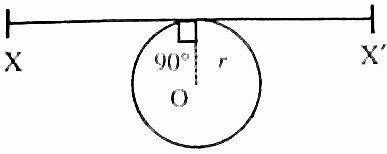
A thin wire of length ‘L’ and uniform linear mass density ρ is bent into a circular loop with centre at O and radius ‘r’ as shown. The moment of inertia of the loop about the axis XX’ is
(a) 3ρL3/8π2 (b) ρL3/16π2 (c) 3ρL3/8π2r (d) ρL3/8π2r (e) 3ρL3/16π2
The moment of inertia of a circular ring about a diameter is ½ mr2, with usual notations. The axis of rotation in the question is a tangent to the ring. The moment of inertia of the ring about the tangent is ½ mr2 + mr2 = (3/2)mr2, on applying the parallel axis theorem. Now, m= ρL and the radius ‘r’ is given by 2πr = L, from which r = L/2π
On substituting for ‘m’ and ‘r’, moment of inertia = (3/2) Lρ×L2/ 4π2 = 3ρL3/8π2, given in option(a).
The following simple question appeared in Kerala Medical Entrance 2006 test paper:
Moment of inertia of a body does not depend upon its
(a) mass (b) axis of rotation (c) shape (d) distribution of mass (e) angular velocity
The correct option, as you might be knowing, is (e). Occasional simple questions like this will help you in saving your time for spending on other difficult questions. Good question setters will usually include a few simple questions for boosting your morale!
The following MCQ which also appeared in Kerala Medical Entrance 2006 test paper is worth noting:
A solid cylinder rolls down an inclined plane of height 3m and reaches the bottom of the plane with angular velocity of 2√2 rad.s-1. The radius of the cylinder must be
(a) 5 cm (b) 0.5 m (c) √10 m (d) √5 m (e) 10 cm
The initial gravitational potential energy (Mgh) of the cylinder is converted to rotational and translational kinetic energy when the cylinder reaches the bottom of the plane so that we can write,
Mgh = ½ Iω2 + ½ Mv2 where M is the mass, ‘v’ is the linear velocity, I is the moment of inertia and ‘ω’ is the angular velocity of the cylinder.
Since v = ωR and I = ½ MR2, the above equation becomes
Mgh = ½ ×(½ MR2) ω2 + ½ Mω2R2, which yields R = √[4gh/3ω2] = √5, on substituting for g,h and ω.
Now see whether you can solve the following problem in a minute:
A solid sphere rolls (without slipping) down a plane inclined at 30˚ to the horizontal. The distance traveled in √7 seconds after starting from rest is (g = 10 ms-2)
(a) 5.5 m (b) 6.25 m (c) 12.5 m (d) 15 m (e) 17.5 m
If you remember that the acceleration of a body rolling down an incline of angle θ is (gsinθ)/[1+ (k2/R2), where ‘k’ is the radius of gyration and R is the radius of the rolling body, you will be able to solve this in one minute. The radius of gyration of a solid sphere about its diameter is (2/5)R2 since its moment of inertia, I = (2/5)MR2, which can be equated to Mk2. Therefore, k2/R2 = 2/5 for a solid sphere. Its acceleration = (g sin30˚)/[1+(2/5)] = (10×½)/(7/5) = 25/ 7.
We have s = ut + ½ at2 = 0 + ½ ×(25/7) ×7 = 12.5 m [Option (c)].
You will find more multiple choice questions (with solution) on rotational motion here.

Wednesday, December 06, 2006

Additional Questions (MCQ) on Properties of Fluids

Even though you have been studying basic properties of fluids from lower classes, questions based on them are repeatedly found in Medical and Engineering Entrance Examinations. Here are some questions which may be interesting and useful to you:
(1) A cubical block of wood with a glass bead placed on it, is floating in water contained in a beaker. The height of water column in the beaker in this condition is ‘h’ and the extent to which the wooden block is within water is ‘d’. If the glass bead is gently transferred to the water in the beaker,
(a) ‘h’ will increase and ‘d’ will decrease (b) ‘h’ will decrease and ‘d’ will increase (c) ‘h’ and ‘d’ will be unchanged (d) ‘h’ and ‘d’ will increase (e) ‘h’ and ‘d’ will decrease
The glass bead can displace more water when it is resting on the wooden block since a floating body will displace a volume of liquid having the weight of the floating body. Inside the water, it can displace water having its own volume only. This volume is less since the density of glass is greater than that of water. Therefore, ‘h’ is decreased on transferring the glass bead to the water in the beaker.
The extent (d) to which the wooden block is within water also is decreased since the weight of the glass bead is relieved from the block. So, the correct option is (e).
(2) A tank is filled with water up to height ‘H’. A hole is made on the side of the tank at a distance ‘h’ below the level of water. What will be the horizontal range of the water jet?
(a) 2√[h(H-h)] (b) 4√[h(H+h)] (c)2√[h(H-h)]
(d) 2√[h(H+h)] (e) √[h(H+h)]
The water jet at the hole on the side of the tank will be directed horizontally with a velocity (of efflux) equal to √(2gh), as given by Torricelli’s theorem. The vertical fall of the jet is through the distance (H-h) and the time of fall (t) is √[2(H-h)/g], given by the equation of linear motion, H-h = 0 + ½ gt2.
The horizontal range R = Horizontal velocity × Time = √(2gh) ×√[2(H-h)/g] = 2√[h(H-h)].
So, the correct option is (c). [ It is interesting to note that this is independent of g so that the range on the moon will be the same as that on the earth for given values of H and h].
By putting dR/dh equal to zero, you can show that the horizontal range ‘R’ is maximum when h = H/2, which means that the hole should be at the middle of the water column.
(3) Two identical cylindrical vessels with base area ‘A’ containing a liquid of density ‘ρ’ are placed on a horizontal table. The heights of liquid column in them are h1 and h2. If they are connected by a narrow pipe to make the liquid levels in them same, the work done by gravity is
(a) ½ Aρg(h1+h2) (b) ½ Aρg(h1+h2)2 (c) ½ Aρg(h1 - h2)2
(d) ¼ Aρg(h1 + h2)2 (e) ¼ Aρg(h1 - h2)2
The work done in obtaining a cylindrical liquid column of height ‘h’ and cross section area ‘A’ is ½Aρgh2 and this is stored as potential energy in the liquid column. [ You can easily obtain this by integrating Aρgxdx between limits 0 and h. Note that (Adxρg) is the weight of liquid column (slice) of small height dx and hence (Adxρg)x is the work done against gravity to lift this liquid slice through a height x. The total work done is the integral between the limits 0 and h].
[Alternatively, you can get it by arguing that the weight of the entire liquid column is Ahρg and its centre of gravity has been raised through a height h/2 so that the work done against gravity is Ahρg(h/2), which is equal to ½Aρgh2].
The work done by gravity on equalizing the levels in the cylinders is the difference between the initial and final potential energies of the two liquid columns.
Therefore, work done = (½Aρgh12 + ½Aρgh22) - 2×½Aρg [(h1+ h2)/2]2. Note that finally the two liquid columns have the same height [(h1+ h2)/2].
The above expression for work done simplifies to (¼)Aρg(h1 - h2)2 given in option (e).
Let us now discuss the following MCQ which appeared in Har PMT 2000 question paper:
When a bubble rises from the bottom of a lake to the surface, its radius doubles. The atmospheric pressure is equal to that of a column of water of height H. The depth of the lake is
(a) 8H (b) 2H (c) 7H (d) H
This simple question involves the application of Boyle’s law: P1V1 = P2V2 with usual notations. The initial pressure is the total pressure due to the atmosphere and the water column of height ‘h’ in the lake. So, the initial pressure of the bubble is equivalent to that due to water column of height H+h. If the initial volume is V, the final volume is 8V since the radius of the bubble is doubled. The final pressure is the atmospheric pressure ‘H’.
Expressing the pressures in terms of height of water column itself, we have,
(H+h)V = H×8V, from which h = 7H [Option (c)].
You will find more questions (with solution) on properties of fluids here as well as here.

Friday, December 01, 2006

All India Engineering/Architecture Entrance Examination (AIEEE) 2007

Application Form and the Information Bulletin in respect of the All India Engineering/Architecture Entrance Examination 2007 to be conducted by Central Board of Secondary Education (CBSE) on 29th April 2007 will be distributed from 1-12-2006 to 5-1-2007. The Information Bulletin and the Application Form can be obtained personally from designated branches of Syndicate Bank/Institutions and Regional Offices of CBSE. Designated branches of Syndicate Bank in Kerala are:
(1) Thiruvananthspuram- Syndicate Bank, Co-operative Agriculture and Rural Development Bank Building, P .B.No.314, Thiruvananthapuram-695001
(2) Ernakulam- Syndicate Bank, Pioneer Towers, First Floor, P.B.No.2616, Shanmugham Road, Ernakulam-682031
(3) Kozhikode- Syndicate Bank, P.B.No.61, Cherootty road, Kozhikode-673001
(4) Kottayam- Syndicate Bank,, P.B.No.121, Baker Junction, Kottayam-686001
(5) Trichur- Syndicate Bank, Palace Road, Trichur-680020
The Information Bulletin and the Application form can be obtained by post from the Joint Secretary (AIEEE), Central Board of secondary Education, 17, Rouse Avenue, Institutioal Area (Near Bal Bhavan), New Delhi-110002.
The cost of Information Bulletin containing the Application Form, inclusive of the examination fee for BE/B.Tech. only or B.Arch/B.Planning only is Rs.300/- and Rs.150/- for General and SC/ST candidates respectively. Candidates appearing for both BE/B.Tech and B.Arch/B.Planning together should send their application form along with additional fee in the form of Demand Draft of Rs.200/- for General and Rs.100/- for SC/ST candidates in favour of Secretary, CBSE, payable at Delhi/New Delhi.
To obtain Information Bulletin containing Application Form by post, candidates should send their request to The Joint Secretary (AIEEE), Central Board of Secondary Education, 17, Rouse Avenue, Institutional Area (Near Bal Bhavan), New Delhi-110002, along with a bank draft of Rs.350/- for General Category and Rs.200/- for SC/ST candidates in favour of The Secretary, CBSE, payable at Delhi/New Delhi and a self addressed envelope of 12”×10”.
Important information at a glance in this context:
(1)
a. Sale of AIEEE Information Bulletin containing Application Form - 01.12.2006 to 05.01. 2007
b. Online submission of application on website
www.aieee.nic.in/ - 01.12.2006 to 05.01.2007
(2) Last date for
a. Receipt of request for Information Bulletin and Application Form by Post at CBSE Office, Shiksha Sadan, 17, Rouse Avenue, Institutional Area, (Near Bal Bhawan), New Delhi-110002 - 25.12.2006
b. Sale of Information Bulletin at designated branches of Syndicate Bank, Regional Offices of the CBSE and designated institutions - 05.01.2007
c. Online submission of applications - 05.01.2007
d. Receipt of complete applications “by post” including Registration Forms with Bank Draft at AIEEE Unit, CBSE, Shiksha Sadan, 17, Rouse Avenue, Institutional Area, (Near Bal Bhawan), New Delhi – 110002 -
10.01.2007
(3)
Date of dispatch of Admit Card - 09.03.2007 to 26.03.2007
(4) Issue/dispatch of duplicate admit card(on request only with fee of Rs. 50/- + postal charges of Rs. 30/- extra for out station candidate). - 10.04.2007 to 29.04.2007 (By Hand)
- 10.04.2007 to 20.04.2007 (By Post)
(5) Dates of Examination
PAPER–1: 29.04.2007 (0930-1230 hrs) PAPER–2: 29.04.2007 (1400-1700 hrs)
By visiting the site www.aieee.nic.in complete information in this regard can be obtained. Make it a point to visit the site to be informed of information updates.
Details of ‘Online’ application and extra information for candidates opting for examination centres in foreign countries also can be obtained from the site.

Wednesday, November 29, 2006

Multiple Choice Questions on Doppler Effect

Questions on Doppler Effect in sound often appear in Medical and Engineering Entrance tests. The general expression for the apparent frequency (n') is
n' = n(v+w-vL)/(v+w-vS) where ‘v’ is the velocity of sound, ‘w’ is the wind velocity ‘vL’ is the velocity of the listener, ‘vS’ is the velocity of the source of sound and ‘n’ is the real frequency of the sound emitted by the source. You should clearly note that all the velocities in this expression are in the same direction and the source is behind the observer.
It will be helpful to remember that if the source moves towards the listener or the listener moves towards the source, the apparent frequency increases. If they move away, the apparent frequency decreases.
You may find questions on Doppler Effect in light occasionally. As light and other electromagnetic radiations do not require a medium for their transmission, the velocity (w) of the medium will be absent in the expression for the apparent frequency. Instead of the speed of sound ‘v’ you will have the constant speed ‘c’ of light. The expression for the apparent frequency is
n' = n(c-vL)/(c-vS)
Doppler Effect in light is used to calculate the recessional velocities of stars and galaxies by measuring the ‘red shift’. When the star moves away from the observer, as is the case with our expanding universe, the wave length of the light emitted by the star appears to be increased (shifted towards red colour). From the above expression for apparent frequency, the shift in frequency which is equal to (n-n') is related to the recessional velocity vS by the equation.
vS = c( n-n' )/n'
The above expression can be written in terms of the shift in wave length as
vS = c(λ'-λ)/λ
This relation is often written as v = zc where z =(λ'-λ)/λ which may be called the ‘spectral shift’ or ‘Doppler shift’.
If a star moves towards the observer, as in the case of a member of a binary stars system, the shift is ‘blue shift’ and the two expressions for the velocity of the star are
vS = c(n'-n)/n' and
vS = c( λ-λ' )/λ
You may get questions involving the calculation of the recessional velocities of stars using the red shift. Questions involving blue shift as well as red shift may be asked for calculating the velocity of aircraft and automobiles which reflect microwaves transmitted by a radar.
Since the speed of light is much greater than the speed of material bodies, the Doppler shift for a given relative velocity is the same, whether the source moves or the observer moves.
Now consider the following MCQ which appeared in Kerala Engineering Entrance 2002 test paper:
A person carrying a whistle, emitting continuously a note of frequency 272Hz is running towards a reflecting surface with a speed of 18km/hour. The speed of sound in air is 345m/s. The number of beats heard by him per second is
(a) 4 (b) 6 (c) 8 (d) 3 (e) zero
Beats are produced here because of the superposition of the direct sound of actual frequency n (equal to 272Hz) from the whistle and the reflected sound of apparent frequency n’, given by n’ = n(v+w-vL)/(v+w-vS). [Note that The frequency of the direct sound is unchanged since both the source and listener are moving together and there is no relative velocity between them].
In the expression for the apparent frequency of the reflected sound, the wind velocity (w) is zero. The velocity of source (vS) is positive since the source is the reflected sound image of the whistle and this image moves towards the listener. The velocity of the listener is negative since he is moving towards the reflected image serving as the source. Therefore, n' = n(v+vL)/(v-vS) = 272(345+5)/(345-5) =280Hz. [Note that 18km/hour = 5m/s].
Number of beats per second = 280-272 = 8.
The following MCQ appeared in Kerala Engineering Entrance 2006 test paper:
The apparent frequency of the whistle of an engine changes in the ratio 9:8 as the engine passes a stationary observer. If the velocity of the sound is 340ms-1, then the velocity of the engine is
(a) 40 m/s (b) 20 m/s (c) 340 m/s (d) 180 m/s (e) 50 m/s
Problems of this type are often found in entrance test papers. When the engine approaches the observer, the apparent frequency is v/(v-vS) and when it moves away from the observer, the apparent frequency is v/(v+vS). The frequency therefore changes in the ratio (v+vS)/(v-vS). We have therefore, (v+vS)/(v-vS) =9/8 from which the velocity of the source, vS = v/17 = 340/17 = 20m/s.
Now consider the following question:
Two trains A and B approach a station from opposite sides, sounding their whistles. A stationary observer on the platform hears no beats. If the velocities of A and B are 15m/s and 30m/s respectively and the real frequency of the whistle of B is 600 Hz, the real frequency of the whistle of A is ( Velocity of sound = 330m/s)
(a) 660 Hz (b) 630 Hz (c) 600 Hz (d) 570 Hz (e) 540 Hz
This is a case increase in apparent frequency due to the motion of the source. Since there are no beats, the apparent frequency [v/(v-vS)]n of the whistle of A is the same as that of B so that we have, [330/(330-15)]n = [330/330-30)]×600 so that n/315 = 600/300 from which n = 630 Hz.
The following MCQ appeared E.A.M.C.E.T. (Med.) A.P. 2003 question paper:
A radar sends a radio signal of frequency 9×10⁹ Hz towards an aircraft approaching the radar. If the reflected wave shows a frequency shift of 3×10³ Hz, the speed with which the aircraft is approaching the radar in m/s is (velocity of radio signal is 3×10⁸ m/s)
(a) 150 (b) 100 (c) 50 (d) 25
The source of waves in this problem is the reflected image of the radar, the aircraft functioning as a mirror. The velocity of the reflected image is twice the velocity of the ‘mirror’(aircraft).You have to note this while calculating the velocity (vS) of the source using the equation involving ‘blue shift’ discussed in the beginning of this post:
vS = c(n'-n)/n' = 3×10⁸(3×10³)/(9×109) = 100 m/s.
The velocity of aircraft is half that of the reflected image (source). So the answer is 50 m/s.
Now consider the following question:
A spectral line of wave length 5000 A.U. in the light coming from a distant star is observed to be shifted to 5004 A.U. The component of the recessional velocity of the star along the line of sight is
(a) 1.4×10⁵ m/s (b) 1.8×10⁵ m/s (c) 2.0×10⁵ m/s (d) 2.4×10⁵ m/s (e) 1.4×10⁴ m/s
We have v = zc where z = (λ'-λ)/λ. Therefore, the recessional velocity = [(5004-5000)/5000] ×3×108 = (4×3×108)/5000 = 2.4×10⁵ m/s.
Note that you can substitute the wave length in the given unit itself since z is a ratio of wave lengths.
The following MCQ appeared in IIT-JEE 2003 question paper:
A police car moving at 22 m/s, chases a motor cyclist. The police man sounds his horn at 176 Hz while both of them move towards a stationary siren of frequency 165 Hz. Calculate the speed of the motor cyclist, if it is given that he does not hear any beats. (Velocity of sound = 330 m/s)
(a) 33 m/s (b) 22 m/s (c) zero (d) 11 m/s
Since the motor cyclist does not hear any beats, the apparent frequency of the horn of the police car (as heard by the motor cyclist) is the same as the apparent frequency of the stationary siren. Therefore, we have,
n(v-vL)/(v-vS) = n'(v+vL)/v where v is the velocity of sound, vL is the velocity of the motor cyclist, vS is the velocity of the police car and n and n' are the frequencies of the police car horn and the stationary siren respectively. Substituting for the velocities, we obtain
176(330-vL)/(330-22) = 165(330+vL)/330, from which vL = 22 m/s.

Wednesday, November 22, 2006

Questions (MCQ) on Refraction at Spherical Surfaces

Some of you might be scared of questions on reflection and refraction at spherical surfaces. This unnecessary fear is due to your confusion about the inevitable sign convention used while discussing spherical mirrors and lenses.
The sign convention used widely in Optics is the Cartesian sign convention. The ray incident on the curved surface is to be considered as proceeding in the positive X-direction and you have to measure all distances from the pole, which is supposed to be the origin.
Often you may be given a ray diagram in which the incident ray may be proceeding in the negative X-direction. To avoid confusion, imagine that the direction of the incident ray is still in the positive X-direction. You can even redraw the diagram to make the incident ray proceed from left to right if you want. The signs given to the distances are as in the Cartesian coordinate system: Distances measured from the pole towards right are positive and distances measured from the pole towards left are negative. Similarly, distances measured (from the pole) upwards are positive and those measured downwards are negative. Normally you will encounter problems involving leftward and rightward measurements.
While solving problems, apply signs to all known quantities in accordance with the sign convention. Leave the unknown quantities as they are in the formulae. You will be able to arrive at conclusions by interpreting the sign of the unknown quantity you arrive at finally as the answer. For instance, if the distance of an image is obtained as negative, you will immediately understand that the image is on the same side of the curved surface as the object is. If the focal length of a lens is obtained as negative, you will understand that it is a concave lens. If the focal length or the radius of curvature of a mirror is obtained as positive, you will understand that it is a convex mirror.
Here are the essential formulae you have to remember in connection with refraction at spherical surfaces:
(1) Law of distances in the case of refraction at a spherical interface between two media of refractive indices
n1 and n2:
n2 /v – n1/u = (n2 – n1)/R where ‘v’ is the image distance, ‘u’ is the object distance and ‘R’ is the radius of curvature of the refracting surface.
(2) Lens maker’s equation: 1/f = (n2/n1 – 1)(1/R1 – 1/R2) where ‘f’ is the focal length of the lens, R1 and R2 are its radii of curvature, n2 is its refractive index and
n1 is the refractive index of the medium in which the lens is placed.
If the lens is placed in air or vacuum, lens maker’s equation becomes 1/f = (n – 1)(1/R1 – 1/R2) where 'n' is the refractive index of the lens. [It is better that you remember the general Lens maker’s equation since you will encounter questions in which the lens is placed in liquids such as water].
(3) Law of distances (Lens formula): 1/f = 1/v - 1/u where ‘f’ is the focal length of the lens, ‘v’ is the image distance and ‘u’ is the object distance.
(4) Focal length (F) of the combination of two or more lenses in contact:
1/F = 1/f1 + 1/f2 + 1/f3 + …etc. where f1,f2,f3...etc. are the focal lengths of the individual lenses. [ Note that this is a power equation since the reciprocal of focal length is the power (focal power) of the lens].
(5) Focal length of the combination of two lenses separated by a distance:
1/F = 1/f1 + 1/f2 – d/f1f2 where ‘d’ is the separation.
(6) Formula for calculating the focal length by displacement method (conjugate position method): f = (D2 – d2)/4D where D is the distance between the object and the screen (image) and ‘d’ is the displacement (distance between conjugate positions).
(7) Linear magnification, m = size of image/size of object = v/u [Note that by ‘size’ we mean linear size].
(8) Areal magnification = Area of image/Area of object = m2
(9) Condition for achromatic doublet (achromatic combination of two lenses):
ω1/f1 + ω2/f2 = 0 where ω1 and ω2 are the dispersive powers of the materials of the lenses. This can be written as ω1/f1 = -ω2/f2 indicating that one lens is converging while the other is diverging.
[Note that crown glass and flint glass lenses are used for achromatic doublets and if you require a converging doublet, the converging lens is to be made of crown glass since the dispersive power of crown glass is less than that of flint glass. You will then have smaller focal length for the converging lens to make the achromatic combination converging].
Let us now consider the following multiple choice question on refraction at a spherical surface:
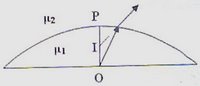
A thick plano convex lens made of crown glass (refractive index 1.5) has a thickness of 3cm at its centre. The radius of curvature of its curved face is 5cm. An ink mark made at the centre of its plane face, when viewed normally through the curved face, appears to be at a distance ‘x’ from the curved face. Then, x is equal to
(a) 2cm (b) 2.1cm (c) 2.3cm
(d) 2.5cm (e) 2.7cm
The ray of light from the object O
(ink mark) gets refracted at the
interface between lens and air and
therefore appears to start from the
point I (Fig). So, I is the refracted
image of the object O. The object distance 'u' is PO and the image distance ‘v’ is PI. [P is the pole of the spherical surface].
We have, n2 /v – n1/u = (n2 – n1)/R so that 1/v – 1.5/(-3) = (1- 1.5)/(-5).
Note that we did not bother about the sign of the unknown quantity ‘v’. [In this problem we could have put negative sign for ‘v’ since the image I is on the same side as the object. Since we don’t apply sign to the unknown quantity ‘v’, we will obtain a negative value for ‘v’ on solving the problem]. The sign of ‘u’ is negative in accordance with the Cartesian convention. Since the incident ray is encountering a concave surface the radius of curvature is negative, in accordance with the convention.
Rearranging the above equation, we obtain 1/v = 0.5/5 – 1.5/3 = -6/15 from which v = -2.5cm.
Let us consider another MCQ:
An object is placed in front of a screen and a convex lens is placed at a position such that the size of the image formed is 9cm. When the lens is shifted through a distance of 20cm, the size of the image becomes 1cm. The focal length of the lens and the size of the object are respectively,
(a) 7.5cm and 3.5cm (b) 7.5cm and 4cm (c) 6cm and 3cm (d) 7.5cm and 3cm (e) 6cm and 2.5cm

If h1 and h2 are the sizes of the of the image in the two conjugate positions, the size of the object is given by h = √(h1h2) = √(9×1) = 3cm.
Considering the formation of the image in the first case, we have v/u = 9/3 so that v = 3u. Also, v = 20+u since v and u interchange in the conjugate positions. Therefore, 3u = 20+u from which u = 10cm. v = 20+u = 30cm.
Focal length f = uv/(u+v), since v is positive and u is negative in the equation, 1/f = 1/v - 1/u. Therefore, f = 10×30/(10+30) = 7.5cm.
[Note that the answer is positive as expected for a convex lens].
The correct option is (d).
The following simple question appeared in Kerala Medical Entrance 2001 test paper:
The focal length of an equi-convex lens in air is equal to either of its radii of curvature. The refractive index of the material of the lens is
(a) 4/3 (b) 2.5 (c) 0.8 (d) 1.25 (e) 1.5
You should note that the radius of curvature of an equi-convex (or equi-concave) lens is equal to its focal length if the refractive index is 1.5. You can check it by substituting R1 = R2 = f in the lens maker’s equation: 1/f = (n – 1) [1/f – 1/(-f)] = (n – 1)×2/f, from which n = 1.5. So the correct option is (e).
You should also note that the focal length of a plano-convex or plano-concave lens is twice the radius of its curved face if the refractive index is 1.5.
The following MCQ appeared in IIT 1999 question paper:
A concave lens of glass, refractive index 1.5, has both surfaces of same radius of curvature R. On immersion in a medium of refractive index 1.75, it will behave as a
(a) convergent lens of focal length 3.5R (b) convergent lens of focal length 3.0R (c) divergent lens of focal length 3.5R (d) divergent lens of focal length 3.0R.
On substituting the given quantities in the lens maker’s equation, 1/f = (n2/n1 – 1)(1/R1 – 1/R2), we have 1/f = [(1.5/1.75)-1] [1/(-R) – 1/R)] = (-0.25/1.75) (-2/R) = 0.5/1.75R, from which f = 3.5R.
You should ensure that all your doubts on applying the sign convention are cleared before proceeding to the next question. In the lens maker’s equation, we applied negative sign to the radius of curvature (R) of the first surface since the concave lens presents a concave surface to the incident ray (and hence the centre of curvature is on the same side of the pole as the object is). The sign of the radius of curvature of the second surface is positive since it presents a convex surface to the ray proceeding towards it after the refraction at the first surface. We did not bother about the sign of the focal length of the lens, since it is the unknown quantity in this problem. The sign turns out to be positive, indicating that the concave lens behaves as a converging lens on immersing it in a denser liquid. The correct option therefore is (a).
You should note that a divergent lens becomes convergent (and a convergent lens becomes divergent) on immersing in a denser medium (of greater refractive index).
Let us consider a numerical example in this context:
A convergent lens made of crown glass (refractive index 1.5) has focal length 20cm in air. If it is immersed in a liquid of refractive index 1.60, its focal length will be
(a) 160cm (b) 100cm (c) -80cm (d) -100cm (e) -160cm
When the lens is in air, we have (from lens maker’s equation),
1/20 = [(1.5/1) – 1] (1/R1- 1/R2).
We are not bothered about the signs of R1 and R2 since they are unknown quantities.
Even though we know that the convergent lens will become divergent in the denser medium, we write lens maker’s equation without bothering about the sign of its unknown focal length in the liquid. If ‘f’ is the focal length in the liquid, we can write,
1/f = [(1.5/1.6) – 1] (1/R1 – 1/R2).
Dividing the first equation by the second, we obtain f/20 = 0.5×1.6/(-0.1) from which f = -160 cm [Option (e)].
Consider now the following MCQ:
The plane face of a plano-convex lens of focal length 20cm is silvered. The lens will then behave as a concave mirror of focal length
(a) 5cm (b) 10 cm (c) 20cm (d) 40cm (e) 80cm
When you direct a ray of light (through the un-silvered surface) in to this lens, the ray will be reflected by the silvered face. Therefore, the ray undergoes refraction twice at the lens and the effect is to make the lens a biconvex one, as though we are keeping two identical plano-convex lenses in contact, the only difference being that the ray is sent back. The focal length of the silvered lens therefore becomes half that of the un-silvered one. So, the answer is 10cm [Option (b)].
In this problem, the silvered surface, being plane, acts just to return the ray. If the curved surface were silvered, it would have acted as a spherical mirror complicating the problem. But, there is no significant complication and you can tackle the problem using the general expression for the resultant focal length (F) given by 1/F = 1/f + 1/fm + 1/f.
Or, 1/F= 2/f + 1/fm. Here ‘f’ is the focal length of the un-silvered lens while fm is the focal length of the mirror.
The power of the un-silvered lens appears twice and the power of the mirror appears once in this equation.
When you use this equation for solving the above question, the mirror term will vanish since the focal length of a plane mirror is infinite and you get F = f/2.
The following simple question appeared in Kerala Medical Entrance 2000 test paper:
A convex lens of focal length 40cm is in contact with a concave lens of focal length 25cm. The power of the combination in dioptre is
(a) -6.5 (b) -1.5 (c) +1.5 (d) +6.5 (e) +6.67
As you know, the power (expressed in dioptre) is the reciprocal of the focal length in metre. A convex lens (or, generally a converging lens) has positive power while a concave lens (or, generally a diverging lens ) has negative power. When you combine lenses in contact, the net power (P) of the combination is equal to the algebraic sum of the individual powers: P = P1+P2+P3+….
In the present case, P = (1/0.4) + (-1/0.25) = 2.5 – 4 = -1.5 dioptre.
The following MCQ appeared in the IIT Screening 2005 question paper:
Concave and convex lenses are placed touching each other. The ratio of magnitudes of their powers is 2:3. The focal length of the system is 30cm. Then the focal lengths of individual lenses are
(a) -75cm, 50cm (b) -15cm, 10cm (c) 75cm, 50cm (d) 75cm, -50cm
This too is a simple question. The power of the combination is 1/0.3 dioptre. [Note that the power of the combination is positive since the focal length of the combination is positive]. The concave lens has therefore smaller power and since the ratio of magnitudes of powers is 2:3, we can write -2k+3k = 1/0.3 where ‘k’ is the constant of proportionality. From this, k = 1/0.3 so that the powers of the concave and convex lenses are respectively – (2/0.3) and +(3/0.3). Therefore, their focal lengths are – (0.3/2)m and +(0.3/3)m. The focal lengths in cm are -15 and +10 [Option (b)].