Showing posts with label rolling. Show all posts

Thursday, November 15, 2007

AP Physics Exam Resources- Two Questions (MCQ) on Moment of Inertia

Multiple choice questions discussed on this site will be useful for entrance examinations for admission to various degree courses including professional courses. They will be suitable for those preparing for AP Physics Examination, as can be judged by working out the following two questions:

(1) Three circular discs of radii R, R and 2R are cut from a metallic sheet of uniform thickness and the smaller discs are placed symmetrically on the larger disc as shown in the figure. If the mass of a smaller disc is M, the moment of inertia of the system about an axis at right angles to the plane of the discs and passing through the centre of the larger disc is

(a) 5MR2 (b) 7MR2 (c) 9MR2

(d) 11MR2 (e) 12MR2

The mass of the larger disc is 4M (since its radius is twice that of the smaller disc) and its moment of inertia is (4M)×(2R)2/2 = 8MR2.

The moment of inertia of each smaller disc about the axis passing through the centre of the larger disc (as given by the parallel axis theorem) is MR2/2 + MR2 = 3MR2/2.

Note that the moment of inertia is a scalar quantity. Therefore, the total moment of inertia of the system of three discs is 8MR2 + 2×3MR2/2 = 11MR2.

(2) A small body of regular shape made of iron rolls up with an initial velocity ‘v’ along an inclined plane. It reaches a maximum height of 7v2/10g where ‘g’ is the acceleration due to gravity. The body is a

(a) ring (b) disc (c) solid sphere

(d) hollow sphere (e) cylindrical rod

The initial kinetic energy of the body is ½ Mv2 + ½ I ω2 where M is its mass and I is its moment of inertia about its axis (of rolling). The first term is its translational kinetic energy and the second term is its rotational kinetic energy.

Since the entire kinetic energy is used in gaining gravitational potential energy, we have

½ Mv2 + ½ I ω2 = Mgh where ‘h’ is the maximum height reached.

Therefore, ½ Mv2 + ½ I v2/R2 = Mg×7v2/10g, from which

I = (2/5)MR2.

The body is therefore a solid sphere.

Saturday, May 26, 2007

MCQ on Rolling Bodies

The following question on rolling bodies will be worth noting since many among you will be able to correct certain misconceptions:

A disc made of iron rolling along a horizontal surface with a velocity ‘v’ encounters an inclined plane of inclination 30º as shown in the figure. It rolls up the plane (without slipping) and reaches a height ‘h’ before turning back. If a solid sphere made of iron were rolling up with the same initial velocity, the height reached before turning back would be (ignoring the loss of energy against friction)

(a) h (b) 7h/8 (c) 9h/10 (d) 12h/13 (e) 14h/15

The entire initial kinetic energy of the disc (or sphere) gets converted into gravitational potential energy on reaching the maximum height. Since this is a case of rolling, the kinetic energy is partly translational and partly rotational. In the case of the disc we have

½ Mv2+ ½ Iω2 = Mgh, where ‘M’ is the mass, ‘I’ is the moment of inertia, ‘ω’ is the angular velocity and ‘g’ is the acceleration due to gravity.

Since ω = v/R and I = MR2/2, this can be rewritten as

¾ Mv2 = Mgh, from which h = 3v2/4g

In the case of the solid sphere The energy equation, ½ Mv2+ ½ Iω2 = Mgh can be rewritten as

½ Mv2+ ½ (2/5)Mr2(v2/r2) = Mgh

We have used the symbol ‘r’ for the radius of the sphere. This simplifies to

(7/10)Mv2 = Mgx, where ‘x’ is the maximum height reached by the sphere.

Therefore, x = 7v2/10g = (7/10)(4/3)(3/4)v2/g = 14h/15, since h = 3v2/4g.

Whenever you solve problems, you should think of other possibilities. A question setter can modify the above question as follows:

A disc and a solid sphere made of the same material have the same mass but radii in the ratio 3:1. If they have the same initial velocity, the ratio of the maximum heights to which they can roll up an inclined plane of given inclination is (ignoring the work done against friction)

(a) 15/14 (b) 14/15 (c) 45/14 (d) 42/15 (e) 3

We have seen in the previous problem that the height is independent of the radius. The correct option is 15/14 (since we require the ratio h/x).

You should note that the two bodies need not be of the same material as the work done against friction can be ignored.

Friday, April 20, 2007

IIT-JEE 2007 Questions on Rotational Motion

The following straight objective type multiple choice question appeared in IIT-JEE 2007 question paper:

A small object of uniform density rolls up a curved surface with an initial velocity v. It reaches up to a maximum height of 3v2/4g with respect to the initial position. The object is

(a) ring (b) solid sphere (c) hollow sphere (d) disc

The body has translational and rotational kinetic energies and these are completely converted in to gravitational potential energy at the maximum height so that we can write

½ Mv2 + ½ Iω2 = Mgh Where M is the mass, I is the moment of inertia and ω is the angular velocity of the body and h is the maximum height reached. Since ω = v/R where R is the radius of the rolling body, the above equation can be rewritten as

½ Mv2 + ½ I(v2/R2) = Mg×(3v2/4g)

From this, I = MR2/2, which is the value for a disc [Option (d)].

The following three questions which appeared in IIT-JEE 2007 question paper are Linked Comprehension Type multiple choice questions:

Two discs A and B are mounted coaxially on a vertical axle. The discs have moments of inertia I and 2I respectively about the common axis. Disc A is imparted an initial angular velocity 2ω using the entire potential enargy of a spring compressed by a distance x1. Disc B is imparted an angular velocity ω by a spring having the same spring constant and compressed by a distance x2. Both the discs rotate in the clockwise direction.

Question(1):

The ratio x1/x2 is

(a) 2 (b) ½ (c) √2 (d) 1/√2

Equating the potential energies of the springs to the kinetic energies of the discs, we have

½ k x12 = ½ I×4ω2 and

½ k x22 = ½ ×2I×ω2 for the two cases. Here ‘k’ is the spring constant.

From these equations, x1/x2 = √2

Question 2:

When disc B is brought in contact with disc A, they acquire a common angular velocity in time t. The average frictional torque on one disc by the other during this period is

(a) 2Iω/3t (b) 9Iω/2t (c) 9Iω/4t (d) 3Iω/2t

Since the angular momentum is conserved, we have

I×2ω + 2I×ω = (I+2I)×ω’ where ω’ is the common angular velocity of the discs. [We have added the angular momenta since they are in the same direction].

From this, ω’ = (4/3)ω

Disc A will have an angular retardation of magnitude ‘α1’ during the time ‘t’ where as disc B will have an angular acceleration of different magnitude ‘α2’ during the time ‘t’.

Considering disc A, we have ω’ = 2ω α1t from which α1 = (ω’)/t = 2ω/3t since ω’ = (4/3)ω.

The average frictional torque exerted on A by B = Iα1 = 2Iω/3t

[An equal and opposite torque will be exerted on B by A. Check by finding α2 and hence 2Iα2].

Question 3:

The loss of kinetic energy during the above process is

(a) Iω2/2 (b) Iω2/3 (c) Iω2/4 (d) Iω2/6

Loss of kinetic energy = Initial kinetic energy – Final kinetic energy

= ½ I×(2ω)2 + ½ ×2I×ω2 – ½ ×3I×(4ω/3)2 = (Iω2)/3

Friday, December 08, 2006

More Multiple Choice Questions on Rotational Motion & Moment of Inertia

Here is an interesting question which appeared in
Kerala Engineering Entrance - 2006 test paper
( and also in IIT screening 2000 question paper):
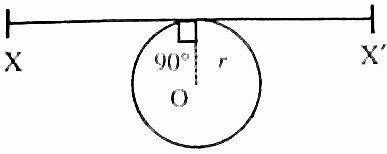
A thin wire of length ‘L’ and uniform linear mass density ρ is bent into a circular loop with centre at O and radius ‘r’ as shown. The moment of inertia of the loop about the axis XX’ is
(a) 3ρL3/8π2 (b) ρL3/16π2 (c) 3ρL3/8π2r (d) ρL3/8π2r (e) 3ρL3/16π2
The moment of inertia of a circular ring about a diameter is ½ mr2, with usual notations. The axis of rotation in the question is a tangent to the ring. The moment of inertia of the ring about the tangent is ½ mr2 + mr2 = (3/2)mr2, on applying the parallel axis theorem. Now, m= ρL and the radius ‘r’ is given by 2πr = L, from which r = L/2π
On substituting for ‘m’ and ‘r’, moment of inertia = (3/2) Lρ×L2/ 4π2 = 3ρL3/8π2, given in option(a).
The following simple question appeared in Kerala Medical Entrance 2006 test paper:
Moment of inertia of a body does not depend upon its
(a) mass (b) axis of rotation (c) shape (d) distribution of mass (e) angular velocity
The correct option, as you might be knowing, is (e). Occasional simple questions like this will help you in saving your time for spending on other difficult questions. Good question setters will usually include a few simple questions for boosting your morale!
The following MCQ which also appeared in Kerala Medical Entrance 2006 test paper is worth noting:
A solid cylinder rolls down an inclined plane of height 3m and reaches the bottom of the plane with angular velocity of 2√2 rad.s-1. The radius of the cylinder must be
(a) 5 cm (b) 0.5 m (c) √10 m (d) √5 m (e) 10 cm
The initial gravitational potential energy (Mgh) of the cylinder is converted to rotational and translational kinetic energy when the cylinder reaches the bottom of the plane so that we can write,
Mgh = ½ Iω2 + ½ Mv2 where M is the mass, ‘v’ is the linear velocity, I is the moment of inertia and ‘ω’ is the angular velocity of the cylinder.
Since v = ωR and I = ½ MR2, the above equation becomes
Mgh = ½ ×(½ MR2) ω2 + ½ Mω2R2, which yields R = √[4gh/3ω2] = √5, on substituting for g,h and ω.
Now see whether you can solve the following problem in a minute:
A solid sphere rolls (without slipping) down a plane inclined at 30˚ to the horizontal. The distance traveled in √7 seconds after starting from rest is (g = 10 ms-2)
(a) 5.5 m (b) 6.25 m (c) 12.5 m (d) 15 m (e) 17.5 m
If you remember that the acceleration of a body rolling down an incline of angle θ is (gsinθ)/[1+ (k2/R2), where ‘k’ is the radius of gyration and R is the radius of the rolling body, you will be able to solve this in one minute. The radius of gyration of a solid sphere about its diameter is (2/5)R2 since its moment of inertia, I = (2/5)MR2, which can be equated to Mk2. Therefore, k2/R2 = 2/5 for a solid sphere. Its acceleration = (g sin30˚)/[1+(2/5)] = (10×½)/(7/5) = 25/ 7.
We have s = ut + ½ at2 = 0 + ½ ×(25/7) ×7 = 12.5 m [Option (c)].
You will find more multiple choice questions (with solution) on rotational motion here.