Showing posts with label spherical mirror. Show all posts

Tuesday, January 23, 2007

Two more Questions on Spherical Mirrors

The following question is quite simple, but many among you will find it confusing:
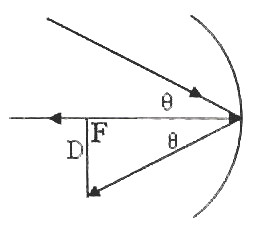
The sun subtends an angle of 0.5° on the earth’s surface. What is the diameter of the image of the sun, produced by a concave mirror of radius of curvature one metre?(a) 8.8mm (b) 6.4mm (c) 5mm (d) 4.4mm (e) data insufficient for arriving at an answer
In the figure θ is the angle subtended by the sun at the pole of the mirror. The real image of the sun is obtained at the focus of the mirror and this image also subtends the same angle θ at the pole of the mirror. Since the real image of the sun is obtained at the focus of the mirror, we have D/50 = 0.5×π/180 where D is the diameter of the image of the sun. [Note that the focal length of the mirror is 50cm and we have converted the angle of 0.5° in to radian].
From the above equation we obtain D = 0.44 cm (approximately) = 4.4mm.
The following question also is simple, but be careful while applying the signs in accordance with the Cartesian convention.
An erect image three times the size of a real object is formed with a concave mirror of radius of curvature 36cm. The distance of the object from the mirror is
(a) 24cm (b) 20cm (c) 16cm (d) 12cm (e) 8cm
Evidently, the signs of ‘f’ and ‘u’ are negative. Since the image is erect, it must be formed behind the mirror (virtual image) and the sign of ‘v’ is positive. Further, the image is magnified 3 times so that v=3u. Substituting these in the equation, 1/f = 1/u + 1/v, we have –1/18 = –1/u +1/3u from which u =12 cm.

Monday, January 22, 2007

Two Questions on Spherical Mirrors

Multiple Choice Questions on Spherical Mirrors
The following question pertains to the formation of a real image when a real object is kept in front of a concave mirror:
A bright rod of length 12 cm lies along the axis (parallel to the axis) of a concave mirror of radius of curvature 30 cm, the nearer end of the rod being at 30 cm from the mirror. The size of the image of the rod will be
(a) 20cm (b) 30.5cm (c) 40cm (d) 50.4cm (e) 60cm
The law of distances for a mirror is 1/f = 1/u + 1/v.
According to the Cartesian sign convention (see the post dated 22nd November 2006), the sign of the focal length (f) of a concave mirror is negative. The sign of the object distance ‘u’ also is negative since it has to be measured (from the pole), opposite to the direction of propagation of the incident ray.
Since the radius of curvature is 30cm, the focal length is 15cm. The image of the nearer end of the rod will be at a distance ‘v’ given by
– 1/15 = – 1/18 + 1/v. Note that we are not bothered about the sign of ‘v’ since it is an unknown quantity whose sign has to come out from the solution. We obtain v = – 90cm. The negative sign just means that this distance is measured opposite to the direction of propagation of the incident ray.
The distance of the image of the farther end of the rod can be obtained by putting u = – 30cm. In this case you will obtain the image distance as –30cm. [You can get it immediately without writing any equation if you remember that in the cse of a real object at 2f, the image is real and it will coincide with the object].
So, the size of the image is 90 – 30 = 60cm.
[Since you know that a concave mirror will form a real image when a real object is placed at a distance more than the focal length, u,v and f are all negative so that you could have worked out the above problem by treating all quantities as positive. But this method can be adopted only in special situations. Treating the known quantities with their proper signs is always the fool proof method].
Now, consider the following question which appeared in Kerala Engineering 2003 question paper:
An infinitely long rod lies along the axis of a concave mirror of focal length ‘f’. The nearer end is at a distance x > f from the mirror. Then the length of the image of the rod is
(a) f2/(x+f) (b) f2 /x (c) xf/(x–f) (d) xf/(x+f) (e) f2 /(x–f)
We have 1/f = 1/u + 1/v. The focal length ‘f’ and the object distance u = x are negative. Since ‘v’ is unknown we don’t bother about its sign and write, –1/f = –1/x + 1/v and obtain v = fx/(f–x). [This is a negative quantity since f is less than x as given in the question]. This gives the distance of the image of the nearer end of the rod. The distance of the image of the farther end of the rod is obtained by putting u = ∞ in the above equation. You will get the image distance as – f.
The length of the image of the rod is – f – [fx/(f–x)] = –f2 /(f–x) = f2 /(x–f).