Saturday, February 24, 2007

Questions (MCQ) on Tansmission of Heat

In this section you have to remember the following:

(1) The quantity (Q) of heat conducted through a rod of thermal conductivity ‘K’ and cross section area ‘A’ in time ‘t’ under a temperature gradient dθ/dx is given by

Q = KA(dθ/dx)t

(2) If ‘n’ conductors of the same area of cross section having lengths d1, d2, d3….. dn and thermal conductivities K1, K1, K3,….Kn are joined in series, the same quantity of heat will flow through them in a given time. The thermal conductivity of such a compound rod is given by K = (d1+ d2+ d3+….. +dn)/[(d1/K1)+ (d2/K2)+ (d3/K3)+…...+(dn/Kn)]

If two rods of the same length and the same area of cross section are joined in series, the equivalent thermal conductivity can be obtained from the above general expression as K = 2K1K2/ (K1+K2)

(3) Stefan’s law: Energy (E) radiated per second from a perfectly black body of surface area ‘A’ is given by E = AσT4 where ‘σ’ is Stefan’s constant equal to 5.57×10⁻⁸Wm–2K–4.

If the body is not a perfect black body, E = AeσT4 where ‘e’ is a dimensionless fraction called emissivity.

In the case of a perfectly black body at temperature T, with surroundings at temperature T0, the net rate of loss of radiant energy is E = Aσ(T4 T04), since the body emits energy AσT4 and absorbs energy AσT04 per second in accordance with Kirchhoff's law.

(4) Wein’s displacement law: λmT = constant (= 0.29cmK) where λm is the wavelength for which the energy radiated is maximum at temperature T. If the constant is taken as 0.29 cmK, the value of λm is to be substituted in cm.

(5) Newton’s law of cooling: The rate of cooling is directly proportional to the excess of temperature of the body over the surroundings if the excess of temperature is small compared to the temperature of the body (T) and the temperature (TS) of the surroundings: dT/dt α (T– TS)

Now consider the following MCQ which appeared in IIT screening 2002 question paper:

An ideal black body at room temperature is thrown in to a furnace. It is observed that

(a) initially it is the darkest body and at later times the brightest

(b) it is the darkest body at all times

(c) it cannot be distinguished at all times

(d) initially it is the darkest body and at later times it cannot be distinguished

A black body is a good emitter as well as a good absorber. Initially it will absorb energy and hence will appear dark. Once it attains the temperature of the furnace, it emits better than the other parts of the furnace and hence appears the brightest. So the correct option is (a).

Consider the following question:

Two copper spheres A and B having the same emissivity have radii 12 cm and 3 cm respectively . If they are maintained at temperatures 727°C and 1727°C respectively, the ratio of energy radiated by A and B is

(a) 0.032 (b) 0.12 (c) 0.48 (d) 1 (e) 2

Since the energy radiated per second is given by E = AeσT4 and the emissivities are equal, we have E1/E2 = (A1/A2)(T1/ T2 )4.

Since the radii of A and B are in the ratio 4:1, the surface areas are in the ratio 16:1. Since the temperatures are 1000K and 2000K, the ratio (T1/ T2 )4 = 1/16. Therefore, E1/E2 = 1.

Here is a simple question involving Wein’s displacement law:
On examining the spectrum of a star, it is found that mximum energy is emitted at a wave length of 5800 Ǻ. The surface temperature of the star is
(a) 4500 K (b) 5000 K (c) 5500 K (d) 6000 K (e) 6500 K
This question indicates how one can determine the temperature of a distant star from spectroscopic data. According to Wien’s law, we have λmT = 0.29cmK, from which T =0.29/(5800×10–8) = 5000K. [Note that we have substituted the wave length in cm].

Consider the following question involving heat conduction:

Three identical iron rods are welded together to form the shape of Y. The top ends of the ‘Y’ are maintained at 0°C and the bottom end is maintained at 600°C. The temperature of the junction of the three rods is

(a) 100°C (b) 200°C (c) 250°C (d) 300°C (e) 400°C

The quantity of heat conducted per second through the bottom rod making the ‘Y’ gets divided equally at the junction of the three rods. If ‘θ’ is the temperature of the junction, we have

KA(θ–0)/L = 2KA(600 – θ)/L where K is the thermal conductivity, A is the area of cross section and L is the length of the identical rods.

[ Note that the L.H.S. is the quantity of heat conducted through the lower single rod making the ‘Y’ and the R.H.S. is the sum of the quantities of heat conducted through the upper two rods].

The above equation yields θ = 400°C

Tuesday, February 20, 2007

Heat engine and Refrigerator

From the section Thermodynamics, you will usually get questions on heat engines or refrigerators. You will definitely remember the expression for the efficiency (η) of a Carnot engine: η = (Q1 –Q2)/Q1 = (T1–T2)/T1 where Q1 is the heat absorbed from the source at temperature T1 and T2 is the heat rejected to the sink at the lower temperature T2.
The coefficient of performance (β) of a refrigerator (heat pump) is given by
β = (Heat removed from the cold body) / (Work done by the pump)
= Q2/W = Q2/(Q1– Q2) = T2/(T1–T2)
Now consider the following simple question which appeared in AIEEE 2002 question paper:
Even Carnot engine cannot give 100% efficiency because we cannot
(a) prevent radiation (b) find ideal source
(c) reach absolute zero temperature (d) eliminate friction
The correct option is (c). The efficiency is given by the expression, η = (T1–T2)/T1. The percentage efficiency is [(T1–T2)/T1] ×100. This shows that the efficiency is 100% only if either the source temperature T1 is infinite or the sink temperature T2 is zero. Both are impossibilities.
Now see the following MCQ:
In a Carnot engine 800 J of heat is absorbed from a source at 400 K and 640 J of heat is rejected to the sink. The temperature of the sink is
(a) 320 K (b) 100 K (c) 273 K (d)250 K (e) 200 K
In a Carnot engine, Q1/T1 = Q2/T2 so that the temperature of the sink, T2 = T1Q2/Q1 = 400×640/800 = 320 K.
The following question appeared in Kerala Engineering Entrance 2000 question paper:
A heat engine undergoes a process in which its internal energy decreases by 400 J and it gives out 150 J of heat. During the process
(a) it does 250 J of work and its temperature rises
(b) it does 250 J of work and its temperature falls
(c) it does 550 J of work and its temperature rises
(d) it does 550 J of work and its temperature falls
(e) 250 J of work is done on the system
The internal energy of the system will decrease when the system does work and/or gives off heat. Since the heat given out is 150 J and the reduction in internal energy is 400 J, the work done by the engine is 400– 150 = 250 J.
When the internal energy is reduced, the system is cooled. So, the correct option is (b).
Now, consider the following question:
The temperature inside a refrigerator is 4°C and the room temperature is 27°C. How many joules of heat will be delivered to the room for each joule of electricity consumed by the refrigerator?( Treat the refrigerator as ideal).
(a) 1 J (b) 12 J (c) 8.3 J (d) 13 J (e) 6 J
The coefficient of performance of the refrigerator, β = Q2/W = Q2/(Q1– Q2) = T2/(T1–T2) = 277/(300–277) = 12. [Note that we have converted the temperature to the Kelvin scale].
Therefore, Q2 =12 W. Heat delivered to the room is Q1 = Q2+W = 12W+W = 13W. Here W is the work done by the pump. So for each joule of work done (for each joule of electricity consumed), the quantity of heat pumped out in to the room will be 13 joule.
Given below is a question of the type which often finds a place in Entrance test papers:
An ideal gas is taken through a cycle of operations shown by the indicator diagram. The net work done by the gas at the end of the cycle is
(a) 6P0V0 (b) 4P0V0 (c) 15P0V0 (d) 10P0V0 (e) 3P0V0
The work done in a cyclic process indicated by a PV diagram is the area enclosed by the closed curve. The area under the slanting curve showing the expansion of the gas from volume 2V0 to volume 5V0 gives the work done by the gas. This is greater than the area under the (horizontal) curve showing the compression of the gas (from volume 5V0 to volume 2V0), which gives the work done on the gas. The vertical portion of the curve is an isochoric (volume constant) change which involves no work since the area under it is zero. The area enclosed by the closed curve gives the net work done by the gas. The triangular area enclosed is ½ ×3V0×2P0 = 3P0V0 [Option (e)].
[ Note that in problems of the above type, the work is done by the gas if the arrow showing the cycle is clockwise. If the arrow is anticlockwise, work is done on the gas. In either case, the work done is the area enclosed by the curve].

Saturday, February 17, 2007

Questions on Isothermal and Adiabatic Changes

You can expect questions involving isothermal and adiabatic processes in most entrance examinations. Here is a typical question:
A gas at a temperature of 27°C inside a container is suddenly compressed to one sixteenths of its initial volume. The temperature of the gas immediately after the compression is (Ratio of specific heats of the gas, γ = 1.5)
(a) 19200 K (b) 1200°C (c) 927°C (d) 108°C (e) 19200°C

This is an adiabatic change since the compression is sudden so that the volume(V) and the temperature (T) are related as TVγ–1 = constant.
Therefore we have 300 V0.5 = T(V/16)0.5. Note that the temperature is to be substituted in Kelvin. The final temperature is given by T = 300×160.5 = 1200 K = 927°C.
The following MCQ is meant for testing your understanding of the work done in thermodynamic processes:
Starting from the same initial conditions an ideal gas expands from volume V1 to volume V2 in three different ways: (i) Adiabatically, doing work W1. (ii) Isothermally, doing work W2. (iii) Isobarically, doing work W3. Then,
(a) W1 = W2 = W3 (b) W1 > W2 > W3 (c) W3 > W2 > W1 (d) W2 > W1 > W3 (e) W1 > W3 > W2
Since the work done is the area under the corresponding curve in a PV diagram, you can easily verify that the work done is the largest in the isobaric case since it is a straight line parallel to the volume axis. The adiabatic curve is the steepest one so that the area under it is the smallest. The correct option therefore is (c).
You can easily show that the slope of the adiabatic curve is γ times the slope ofthe isothermal curve as follows:
In the case of an adiabatic change, the pressure and volume are related as PVγ = constant.
Differentiating, P γVγ–1 dV + VγdP = 0
Slope of adiabatic curve = dP/dV = (– γPVγ–1)/Vγ = – γP/V
In the case of an isothermal change, the pressure and volume are related as PV= constant.
Differentiating, PdV + VdP = 0.
Slope of isothermal curve = dP/dV = – P/V.
This show that the slope of the adiabatic curve is γ times the slope ofthe isothermal curve.
The following MCQ also pertains to adiabatic compression:
A gas having a volume of 800 cm3 is suddenly compressed to 100cm3. If the initial pressure is P, the final pressure is (γ = 5/3)
(a) P/32 (b) 24P (c) 32P (d) 8P (e) 16P
We have PVγ = constant so that P×8005/3 = P'×1005/3 from which P' = P×85/3 = P×25 = 32P.
Now, see this simple question:
An ideal gas expands isothermally from volume V1 to volume V2. It is then compressed to the original volume V1 adiabatically. The initial pressure is P1, final pressure is P2 and the net work done by the gas during the entire process is W. Then
(a) P1 = P2, W>0 (b) P1> P2, W>0 (c) P2 > P1, W>0 (d) P2 > P1, W=0 (e) P2 > P1, W<0
The adiabatic compression will increase the temperature of the gas so that the final pressure (P2) when the volume is restored to the value V1 is greater than the initial pressure P1. Since the pressure is greater during the adiabatic compression, more work has to be done on the gas. The work done on the gas is thus greater than the work done by the gas. In other words, the net work done by the gas during the entire process is negative. So, the correct option is (e).

Friday, February 09, 2007

Questions on Optical Instruments

The essential points you have to remember to work out questions on optical instruments are the following:
(1) Myopia (short sightedness) is corrected by a concave lens of focal length ‘d’ where ‘d’ is the distance of the far point in the case of the defective eye. [Note that for a normal eye the far point will be at infinity where as for the defective eye, it will be at a finite distance‘d’].
Therefore, f = –d
(2) Hypermetropia
(long sightedness) is corrected by a convex lens of focal length ‘f’ given by f = dD/(d – D) where ‘d’ is the distance of the near point for the defective eye and D is the least distance of distinct vision (25cm), [Note that for the normal eye, the near point will be at D and for the defective eye it will be at a greater distance ‘d’].
(3) Presbyopia is corrected by bifocal lens with the upper portion concave and the lower portion convex. [Note that for the defective eye in this case, the far point is nearer (and not at infinity) while the near point is farther away (and not at D)].
(4) Astigmatism is corrected by cylindrical lens.
(5) Magnifying power of a simple microscope M = 1+ D/f if the image is formed at the least distance of distinct vision ‘D’.
If the image is formed at infinity (normal setting or setting for relaxed eye), M= D/f .
(6) Magnifying power of compound microscope (M):
(i) M = (vo/uo)(1 + D/fe) if the final image produced by the eye piece is at the least distance of distinct vision ‘D’. Here uo is the distance of object from the objective, vo is the distance of the image produced by the objective and fe is the focal length of the eye piece.
(ii) If the final image is at infinity (normal setting or setting for relaxed eye),
M = (vo/uo)(1 + D/fe)
Approximate expressions
for the magnifying power of a compound microscope in the two cases are M = (L/fo)(1 + D/fe) and M = (L/fo)(D/fe) in the two cases respectively. Here L is the tube length of the microscope, which is the distance between the objective and the eye piece.
(7) (a)Limit of resolution (minimum separation between two point objects which can be resolved) of a microscope, dmin = λ /2n sinθ where λ is the wave length (in vacuum) of the light used for illuminating the object, ‘n’ is the refractive index of the medium between the object and the objective and θ is the semi angle of the cone of light proceeding from the object to the objective. This is Abbe’s expression for the resolving power when the object is not luminous and is therefore illuminated, as is usually the case. [Note that nsinθ is the numerical aperture]
(b) Resolving power of microscope = 1/dmin
(8) Magnifying power of telescope(M)
(i) M = β/α = fo/fe
for normal adjustment (image at infinity) where β is the angle subtended at the eye by the image, α is the angle subtended at the eye by the object, fo is the focal length of the objective and fe is the focal length of the eye piece.
(ii) M = (fo/fe)(1 + fe/D) if the final image is formed at the least distance of distinct vision ‘D’.
(9) Length of a telescope (in normal setting) = fo + fe
(10) Limit of resolution of telescope
(minimum angular separation between two point objects that can be resolved) dθ = 1.22λ/a where λ is the wave length of light proceeding from the object and ‘a’ is the aperture (diameter) of the objective.
(11) Resolving power of a telescope = 1/dθ = a/1.22λ
Now let us now consider the following MCQ:
The length of a microscope is 12 cm and its magnifying power is 25 for relaxed eye.The focal length of the eye piece is 4 cm. The distance of the object from the objective is
(a) 2 cm (b) 2.5 cm (c) 3 cm (d) 3.5 cm (e) 4 cm
The image produced by the objective is formed at the focus of the eye piece since the final image is formed at infinity (for relaxed eye). If vo is the distance of the image formed by the objective, the tube length of the microscope (distance between the objective and eye piece) is vo+ fe = vo+ 4 = 12 cm from which vo = 8 cm.
The magnifying power (for relaxed eye) is given by M = (vo/uo)(D/fe). Substituting the known values, 25 = (8/uo)(25/4) from which uo = 2 cm. [Option (a)].
The following question appeared in MPPMT 2000 question paper:
The length of the tube of a microscope is 10 cm. The focal lengths of the objective and eye lenses are 0.5 cm and 1 cm. The magnifying power of the microscope is about
(a) 5 (b) 166 (c) 23 (d) 500
The magnifying power, M = (L/fo)( D/fe) = (10/0.5)( 25/1) = 500.
Consider now the following MCQ which appeared in EAMCET 2000 question paper:
In a compound microscope, the focal lengths of two lenses are 1.5 cm and 6.25 cm. If an object is placed at 2 cm from the objective and the final image is formed at 25 cm from the eye lens, the distance between the two lenses is
(a) 6 cm (b) 7.75 cm (c) 9.25 cm (d) 11 cm
You should note that the focal length of the objective in a microscope is less than that of the eye piece. (In a telescope it is the other way round). Therefore, fo = 1.5 cm and fe = 6.25 cm.
The distance between the objective and the eye piece is the sum of the image distance(vo) for the objective and the object distance (ue) for the eye piece.
From the equation, 1/f = 1/v – 1/u as applied to the objective, we have
1/1.5 = 1/vo – 1/(–2).
Note that we have substituted the object distance as –2 in accordance with the Cartesian sign convention discussed in the post dated 22-11-06 (Questions (MCQ) on Refraction at Spherical Surfaces). This yields the image distance in the case of the objective as vo = 6 cm.The image distance for the eye piece is similarly given by
1/6.25 = 1/(–25) – 1/ue.
Note that the sign of the object distance is negative in accordance with the Cartesian sign convention. This equation yields ue = –5 cm. The negative sign just shows that the object distance for the eye piece is measured opposite to the direction of the incoming rays.In fact, we know that the real image (of the object) formed by the objective serves as the object for the eye piece and therefore its distance is negative. However, since ue is an unknown quantity, we did not bother about its sign. If we had substituted its sign as negative in the law of distances, we would have obtained the value as +5 cm.
The distance between the objective and the eye piece is 6+5 =11 cm.
Here is a simple question involving myopia:
A man who cannot see clearly beyond 10m wants to see stars clearly. He should use a lens of power (in dioptre)
(a) 10 (b) – 10 (c) –1 (d) 0.1 (e) – 0.1
His defect is myopia and hence he should use a concave lens of focal length equal to the distance of the far point, which is given as 10m. The power of the lens is 1/(–10) = – 0.1 dioptre.
Now consider the following question:
The near point of a person with defective eye is at 65 cm. To correct his defect, he should use spectacle lenses of focal length
(a) 65 cm (b) 55.6 cm (c) 50.6 cm (d) 45,5 cm (e) 40.6 cm
As his defect is hypermetropia (long sightedness), he should use convex lenses of focal length ‘f’ given by f = dD/(d – D) where ‘d’ is the distance of his far point and ‘D’ is the least distance of distinct vision. Therefore, f = 65×25/(65 – 25) = 40.6 cm.
Here is a typical simple question on telescopes:
The magnifying power of a small telescope is 25 and the separation between its objective and eye piece is 52 cm in normal setting. The focal lengths of its objective and eye piece are respectively
(a) 50 cm and 2 cm (b) 27 cm and 25 cm (c) 45 cm and 7 cm (d) 50.5 cm and 1.5 cm (e) 47 cm and 5 cm
We have magnifying power, M = fo/fe so that 25 = fo/fe, from which fo = 25 fe.
Sincethe length of the telescope = fo + fe, we have 52 = 25fe + fe = 26 fe so that fe = 2 cm and hence fo = 50 cm.
The following question pertains to the resolving power of a telescope:
The distance between the earth and the moon is nearly 3.8×10⁵ km. What is the separation of two points on the moon that can be just resolved using a 400 cm telescope, using light of wave length 6000 Ǻ?
(a) 46.5 m (b) 56 m (c) 69.5 m (d) 78.6 m (e) 85.5 m
The limit of resolution dθ = 1.22λ/a. This is the minimum angular separation between objects that can be just resolved.
The linear separation between the objects that can be just resolved is rdθ = 3.8×108×1.22×6000×10–10/4 = 69.5 m. [Note that we have converted all distances in to metre].
The following m.c.q. appeared in the MPPMT 2000 question paper:
The focal lengths of the eye piece and objective of a telescope are respectively 100 cm and 2 cm. The moon subtends an angle of 0.5º at the eye. If it is looked through the telescope, the angle subtended by the moon’s image will be
(a) 100º (b) 25º (c) 50º (d) 10º
the magnifying power of a telescope is given by M = β/α = fo/fe with usual notations. Therefore, β = α fo/fe = 0.5×100/2 = 25º [Option (b)].
Now Consider the following MCQ:
A telescope has an objective lens of focal length 1.5m and an eye piece of focal length 5 cm. If this telescope is used in normal setting to view a tower of height 100m located 3km away, what will be the height of the image of the tower?
(a) 10 cm (b) 15 cm (c) 20 cm (d) 25 cm (e) 50 cm
The angle subtended at the objective by the tower will be the same as the angle subtended (at the objective) by the image produced by the objective so that we have
100/3000 = h/1.5 where ‘h’ is the height of the image produced by the objective. [Note that this image is at the focus of the objective].
From the above, h = 0.05m = 5 cm.
The magnifying power of the eye piece in normal adjustment is D/fe = 25cm/5cm = 5.
The height of the final image = 5h = 25 cm.

Tuesday, February 06, 2007

Kerala Medical and Engineering Entrance Examinations- 2007

The Commissioner of Entrance Examinations (Govt. of Kerala) has invited applications for the Entrance Examinations for admission to the following Professional Degree courses in Kerala for 2007-08:
(a) Medical (i) MBBS (ii) BDS (iii) BPharm (iv) BSc (Nursing) (v) BSc (MLT) (vi) BAMS (vii) BHMS (viii) BSMS (Siddha) (ix) BSc–Nursing (Ayurveda) and (x) BPharm (Ayurveda) .
(b) Agriculture (i) BSc (Agriculture) (ii) BFSc (Fisheries) (iii) BSc (Forestry)
(c) Veterinary BVSc & AH
(d) Engineering B.Tech [including BTech (Agricultural Engg. / BTech (Dairy Sc. & Tech) courses under the Kerala Agr iculture University]
(e) Architecture B.Arch
Time Table for the Entrance Examinations:
The Entrance Examinations will be held in all the District Centres in Kerala, New Delhi and Dubai (UAE), on the dates mentioned below as per Indian Standard Time.
Engineering Entrance Examination (For Engineering courses except Architecture):
23-04-2007 Monday 10.00 A.M. to 12.30 PM Paper-I: Physics & Chemistry.
24-04-2007 Tuesday 10.00 A.M. to 12.30 PM Paper-II: Mathematics.
Medical Entrance Examination [For Medical (including B.Pharm), Agriculture and Veterinary Courses]:
25-04-2007 Wednesday 10.00 A.M. to 12.30 PM Paper-I: Chemistry & Physics.
26-04-2007 Thursday 10.00 A.M. to 12.30 PM Paper-II: Biology.
Appearance in the two papers of the concerned Entrance Examination is compulsory for being considered for inclusion in the Engineering/Medical rank lists (except Architecture)
Admission to the BPharm course will be based on a separate rank list prepared on the basis of the performance of candidates in the ‘Chemistry & Physics’ Paper of the Medical Entrance Examination. Those who wish to be considered for admission to the BPharm course should therefore appear for the Chemistry & Physics Paper of the Medical Entrance Examination.
Application Forms:
The application form and Prospectus will be sold from 07-02-2007 to 05-03-2007 through selected Canara Bank branches in Kerala and outside the State.
Cost of Application form: General candidates: Rs. 700/- ; SC/ST candidates : Rs. 350/- ( Candidates opting Dubai centre should enclose a bank draft for Rs 7000/- along with the application)
Last date and time for receipt of filled in Application Forms: The filled in Application Form along with the OMR DATA SHEET and other relevant documents to be submitted with the Application form is to be sent in the printed envelope bearing the address of the Commissioner for Entrance Examinations supplied along with the application form so as to reach him before 5 p.m. on 07.03 200 7, by Hand Delivery / Registered Post/ Speed Post.
Visit the site
www.cee-kerala.org for complete details about the eligibility for applying for the examinations, sale centres of application forms, provision for downloading the application form in the case of certain categories etc. Visit the site to be informed of the latest developments in this regard.

Sunday, February 04, 2007

New Template, New Look

After waiting for some time, I have switched over to the new version of Blogger today. The switch over was quite easy. I will have to spend some time on effecting a few changes in the lay out as well as the look of my blog. The priority will be in posting new questions and solution since examinations are fast approaching.
Thank you Blogger Staff for effecting the transition out of beta in a relatively short time span!

Friday, February 02, 2007

Multiple Choice Questions on Waves

The section on waves may appear to be somewhat boring and difficult to some of you. But you should not ignore this section because you will usually get a couple of questions from this. Remember the following important relations:
(1) Speed of transverse waves in a stretched string, v = √(T/m) where T is the tension and ‘m’ is the linear density (mass per unit length) of the string
(2) Frequency of vibration of a string, n = (1/2l)√(T/m) where ‘l’ is the length of the string.
Note that this is the frequency in the fundamental mode. Generally, the frequency is given by n = (s/2l)√(T/m) where s = 1,2,3,….etc. In the fundamental mode, s = 1.
(3) Speed of sound (v) in a medium is generally given by v = √(E/ρ) where E is the modulus of elasticity and ρ is the density of the medium.
(a) Newton-Laplace equation for the velocity (v) of sound in a gas:
v = √(γP/ρ) where γ is the ratio of specific heats and P is the pressure of the gas.
(b) Velocity of sound in a solid rod, v =√(Y/ρ) where Y is the Young’s modulus.
(4) Equation of a plane harmonic wave:
You will encounter the wave equation in various forms. For a progressive wave proceeding along the positive X-direction, the wave equation is
y = A sin [(2π/λ)(vt–x) +φ]
where A is the amplitude, λ is the wave length, v is the velocity (of the wave) and φ is the initial phase of the particle of the medium at the origin.
If the initial phase of the particle at the origin (φ) is taken as zero, the above equation has the following forms:
(i) y = A sin [(2π/λ)(vt–x)]
(ii)
Since λ = vT and 2π/T = ω, where T is the period and ω is the angular frequency of the wave motion, y = A sin [(2π/T)(t – x/v)] and
(iii) y = A sin ω(t–x/v)
(iv)
A common form of the wave equation (obtained from the above) is
y = A sin [2π(t/T – x/ λ)]
(v)
Another form of the wave equation is y = A sin (ωt – kx), which is evident from the form shown at (iii), where k = ω/v = 2π/λ.
Note that unlike in the case of the equation of a simple harmonic motion, the wave equation contains ‘x’ in addition to ‘t’ since the equation basically shows the variation of the displacement ‘y’ of any particle of the medium with space and time.
It will be useful to remember that the velocity of the wave,
v = Coefficient of t /Coefficient of x
(6)
Equation of a plane wave proceeding in the negative X-direction is
y = A sin [2π(t/T + x/ λ)] or
y = A sin [(2π/λ)(vt + x)] or
y = A sin ω(t + x/v) or
y = A sin (ωt + kx).
Note that the negative sign in the case of the equation for a wave proceeding along the positive X-direction is replaced with positive sign.
(7) Equation of a stationary wave is y = 2A cos(2πx/λ) sin(2πvt/λ) if the stationary wave is formed by the superposition of a wave with the same wave reflected at a free boundary of the medium (such as the free end of a string or the open end of a pipe).
If the reflection is at a rigid boundary (such as the fixed end of a string or the closed end of a pipe), the equation for the stationary wave formed is
y = – 2A sin(2πx/λ) cos(2πvt/λ).
Don’t worry about the negative sign and the inter change of the sine term and the cosine term. These occurred because of the phase change of π suffered due to the reflection at the rigid boundary.The important thing to note is that the amplitude has a space variation between the zero value (at nodes) and a maximum vlue 2A (at the anti nodes). Further, the distance between consecutive nodes or consecutive anti nodes is λ/2.
Now consider the following MCQ:
The equation, y = A sin [2π/λ(vt – x)] represent a plane progressive harmonic wave proceeding along the positive X-direction. The equation, y = A sin[2π/λ(x – vt)] represents
(a) a plane progressive harmonic wave proceeding along the negative X-direction (b) a plane progressive harmonic wave with a phase difference of π proceeding along the negative X-direction
(c) a plane progressive harmonic wave with a phase difference of π proceeding along the positive X-direction
(d) a periodic motion which is not necessarily a wave motion
(e) a similar wave generated by reflection at a rigid boundary.
The equation, y = A sin[2π/λ(x – vt)] can be written as y = – A sin [2π/λ(vt – x)] and hence it represents a plane progressive harmonic wave proceeding along the positive X-direction itself, but with a phase difference of π (indicated by the negative sign).
The following question appeared in IIT 1997 entrance test paper:
A traveling wave in a stretched string is described by the equation, y = A sin(kx– ωt). The maximum particle velocity is
(a) Aω (b) ω/k (c) dω/dk (d) x/t
This is a very simple question. The particle velocity is v = dy/dt = –Aω cos(kx– ωt) and its maximum value is Aω.
Consider the following MCQ:
The displacement y of a wave traveling in the X-direction is given by y = 10–4 sin (600t–2x + π/3) metres. where x is expressed in metres and t in seconds. The speed of the wave motion in ms–1 is
(a)200 (b) 300 (c) 600 (d) 1200
This MCQ appeared in AIEEE 2003 question paper. The wave equation given here contains an initial phase π/3 but that does not matter at all. You can compare this equation to one of the standard forms given at the beginning of this post and find out the speed ‘v’ of the wave. If you remember that velocity of the wave, v = Coefficient of t /Coefficient of x, you get the answer in notime: v = 600/2 =300 ms–1.
Here is a question of the type often found in Medical and Engineering entrance test papers:
Velocity of sound in a diatomic gas is 330m/s. What is the r.m.s. speed of the molecules of the gas?
(a) 330m/s (b) 420m/s (c) 483m/s (d) 526m/s (e) 765m/s
At a temperature T, the velocity of sound in a gas is given by v = √(γP/ρ) where γ is the ratio of specific heats and P is the pressure of the gas. The r.m.s. velocity of the molecules of the gas is given by c = √(3P/ρ). Therefore, c/v = √(3/γ). For a diatomic gas, γ = 1.4 so that c/v = √(3/1.4). On substituting v=330m/s, c = 483m/s.
Now consider the following MCQ which appeared in EAMCET 1990 question paper:
If two waves of length 50 cm and 51 cm produced 12 beats per second, the velocity of sound is
(a) 360 m/s (b) 306 m/s (c) 331 m/s (d) 340 m/s
If n1 and n2 are the frequencies of the sound waves, n1– n2 =12 or, v/λ1– v/λ2 =12. Substituting the given wave lengths (0.5m and 0.51m), the velocity v works out to 306 m/s.
Here is a typical simple question on stationary waves:
A stationary wave is represented by the equation, y = 3 cos(πx/8) sin(15πt) where x and y are in cm and t is in seconds. The distance between the consecutive nodes is (in cm)
(a) 8 (b) 12 (c) 14 (d) 16 (e) 20
This stationary wave is in the form y = 2A cos(2πx/λ) sin(2πvt/λ) so that 2π/λ = π/8 from which λ = 16cm. The distance between consecutive nodes is λ/2 = 8cm.
You can find all posts on waves in this site by clicking on the label 'waves' below this post or on the side of this page.

Friday, January 26, 2007

Questions on Centre of Mass

The following question involving the motion of centre of mass is worth noting:
Two spheres of masses m1 and m2 (m1>m2) respectively are tied to the ends of a light, inextensible string which passes over a light frictionless pulley. When the masses are released from their initial state of rest, the acceleration of their centre of mass is
(a) [(m1–m2)/(m1+m2)]g
(b) [(m1–m2)/2(m1+m2)]g
(c) [(m1–m2)/4(m1+m2)]g
(d) [(m1–m2)/(m1+m2)]2g
(e) [4(m1–m2)/(m1+m2)]g
If r1 and r2 are the position vectors of the centres of the spheres, the position vector of their centre of mass is given by R = (m1r1 + m2r2)/(m1+m2). The acceleration of the centre of mass is therefore given by
a = d2R/dt2 = (m1d2r1/dt2 + m2 d2r2/dt2)/(m1+m2).
But d2r1/dt2 and d2r2/dt2, which are the accelerations of the masses m1 and m2 have the same magnitude (m1–m2)g/(m1+m2). If we take the acceleration of m1 (which is downwards) as positive, that of m2 is negative.
Therefore, a = [m1(m1–m2)g/(m1+m2) – m2(m1–m2)g/(m1+m2)] /(m1+m2).
On simplifying, this yields a = [(m1–m2)/(m1+m2)]2g. [Option (d)].
The following MCQ has been popular among question setters:
In the HCl molecule, the separation between the nuclei of the two atoms is about 1.27 Ǻ. The approximate distance of the centre of mass (from the hydrogen atom) of the HCl molecule, assuming the chlorine atom to be about 35.5 times as massive as the hydrogen atom is
(a) 0.27 Ǻ
(b) 0.56 Ǻ
(c) 1 Ǻ
(d) 1.24 Ǻ
(e) 2.26 Ǻ
The centre of mass of this two particle system is on the line joining the two atoms and in between these atoms. If ‘x’ is the distance of the centre of mass from the hydrogen atom, we have x = (1×0 + 35.5×1.27)/ (1+35.5) = 1.24 Ǻ, approximately.
Note that the equation giving the value of ‘x’ is the usual equation for the position vector of the centre of mass: R = (m1r1 + m2r2)/(m1+m2). We have taken the origin to be at the centre of the hydrogen atom so that r1 = 0 and r2 = 1.27 Ǻ.
[You can easily find the centre of mass of two particle systems by equating the ‘moments’ of the masses about the centre of mass. In the present case, 1×x = 35.5(1.27–x) from which x = 1.24 Ǻ].
Now consider the following simple question:
A proton and an electron, initially at rest, are allowed to move under their mutal attractive force. Their centre of mass will
(a) move towards the proton
(b) move towards the electron
(c) remain stationary
(d) move in an unpredictable manner.
The correct option is (c) because you require an external force to move the centre of mass of a system of particles. The mutual force of electrical attraction is an internal force which can not affect the position of the centre of mass of the system.

Tuesday, January 23, 2007

Two more Questions on Spherical Mirrors

The following question is quite simple, but many among you will find it confusing:
The sun subtends an angle of 0.5° on the earth’s surface. What is the diameter of the image of the sun, produced by a concave mirror of radius of curvature one metre?(a) 8.8mm (b) 6.4mm (c) 5mm (d) 4.4mm (e) data insufficient for arriving at an answer
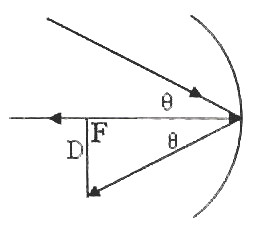
In the figure θ is the angle subtended by the sun at the pole of the mirror. The real image of the sun is obtained at the focus of the mirror and this image also subtends the same angle θ at the pole of the mirror. Since the real image of the sun is obtained at the focus of the mirror, we have D/50 = 0.5×π/180 where D is the diameter of the image of the sun. [Note that the focal length of the mirror is 50cm and we have converted the angle of 0.5° in to radian].
From the above equation we obtain D = 0.44 cm (approximately) = 4.4mm.
The following question also is simple, but be careful while applying the signs in accordance with the Cartesian convention.
An erect image three times the size of a real object is formed with a concave mirror of radius of curvature 36cm. The distance of the object from the mirror is
(a) 24cm (b) 20cm (c) 16cm (d) 12cm (e) 8cm
Evidently, the signs of ‘f’ and ‘u’ are negative. Since the image is erect, it must be formed behind the mirror (virtual image) and the sign of ‘v’ is positive. Further, the image is magnified 3 times so that v=3u. Substituting these in the equation, 1/f = 1/u + 1/v, we have –1/18 = –1/u +1/3u from which u =12 cm.

Monday, January 22, 2007

Two Questions on Spherical Mirrors

Multiple Choice Questions on Spherical Mirrors
The following question pertains to the formation of a real image when a real object is kept in front of a concave mirror:
A bright rod of length 12 cm lies along the axis (parallel to the axis) of a concave mirror of radius of curvature 30 cm, the nearer end of the rod being at 30 cm from the mirror. The size of the image of the rod will be
(a) 20cm (b) 30.5cm (c) 40cm (d) 50.4cm (e) 60cm
The law of distances for a mirror is 1/f = 1/u + 1/v.
According to the Cartesian sign convention (see the post dated 22nd November 2006), the sign of the focal length (f) of a concave mirror is negative. The sign of the object distance ‘u’ also is negative since it has to be measured (from the pole), opposite to the direction of propagation of the incident ray.
Since the radius of curvature is 30cm, the focal length is 15cm. The image of the nearer end of the rod will be at a distance ‘v’ given by
– 1/15 = – 1/18 + 1/v. Note that we are not bothered about the sign of ‘v’ since it is an unknown quantity whose sign has to come out from the solution. We obtain v = – 90cm. The negative sign just means that this distance is measured opposite to the direction of propagation of the incident ray.
The distance of the image of the farther end of the rod can be obtained by putting u = – 30cm. In this case you will obtain the image distance as –30cm. [You can get it immediately without writing any equation if you remember that in the cse of a real object at 2f, the image is real and it will coincide with the object].
So, the size of the image is 90 – 30 = 60cm.
[Since you know that a concave mirror will form a real image when a real object is placed at a distance more than the focal length, u,v and f are all negative so that you could have worked out the above problem by treating all quantities as positive. But this method can be adopted only in special situations. Treating the known quantities with their proper signs is always the fool proof method].
Now, consider the following question which appeared in Kerala Engineering 2003 question paper:
An infinitely long rod lies along the axis of a concave mirror of focal length ‘f’. The nearer end is at a distance x > f from the mirror. Then the length of the image of the rod is
(a) f2/(x+f) (b) f2 /x (c) xf/(x–f) (d) xf/(x+f) (e) f2 /(x–f)
We have 1/f = 1/u + 1/v. The focal length ‘f’ and the object distance u = x are negative. Since ‘v’ is unknown we don’t bother about its sign and write, –1/f = –1/x + 1/v and obtain v = fx/(f–x). [This is a negative quantity since f is less than x as given in the question]. This gives the distance of the image of the nearer end of the rod. The distance of the image of the farther end of the rod is obtained by putting u = ∞ in the above equation. You will get the image distance as – f.
The length of the image of the rod is – f – [fx/(f–x)] = –f2 /(f–x) = f2 /(x–f).

Friday, January 19, 2007

Questions on Electrostatics

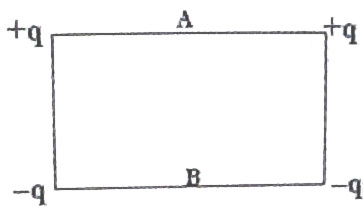
Charges +q, +q, –q and –q coulomb are arranged at the corners of an imaginary rectangle of sides 6m and 4m, as shown in the adjoining figure. A and B are the mid points of the longer sides. The potential difference between A and B is (in volts)
(a) 2.4×10⁶q (b) 4.8×10⁶q (c) 2.4×10⁹q (d) 4.8×10⁹q (e) 9.6×10⁹q
The potential at A due to the charges +q and +q is 2×(1/4πε0)(q/3) and the potential at the same point due to the charges –q and –q is 2×(1/4πε0))(–q/5). The resultant potential at A is 2×(1/4πε0)[(q/3)–(q/5)] = 2×(1/4πε0) (2q/15)= (1/4πε0) (4q/15).
Similarly, the resultant potential at B is 2×(1/4πε0)[(q/5) – (q/3)] =
2×(1/4πε0) (–2q/15) = (1/4πε0)(–4q/15).
The potential difference between points A and B is (1/4πε0))[(4q/15) – (–4q/15)] = (1/4πε0)×(8q/15). You should remember that 1/4πε0= 9×10⁹. Therefore, the P.D. is 9×109×(8/15)q = 4.8×10⁹q volts.
The following question appeared in Punjab CEET 2003 question paper:
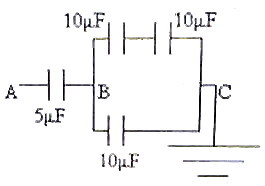
As shown in figure, if the point C is earthed and the point A is given a potential of 2000 volt, then the potential at B will be
(a) 400 V (b) 500 V (c) 1000 V (d) 1300 V

The effective capacitance between the points B and C is 15 μF because 10μF and 10μF in series in the upper branch make 5μF and this is in parallel with 10μF in the lower branch. So, in effect 2000 V is applied across the series combination of 5μF and 15μF connected between A and C. Since the potential difference across capacitors connected in series is inversely proportional to the capacitance, the applied P.D. of 2000 volts get divided in the ratio 3: 1 across 5μF and 15μF [1500 V : 500V]. The potential at B with respect to the grounded point C is therefore 500V.
Now consider the following question which appeared in IIT 2002 question paper:
Two identical capacitors have the same capacitance C. One of them is charged to potential V1 and the other to potential V2. The negative ends of the capacitors are connected together. When the positive ends are also connected, the decrease in energy of the combined system is
(a) ¼ C(V12 – V22) (b) ¼ C(V12 + V22) (c) ¼ C(V1 – V2)2 (d) ¼ C(V1 + V2)2
The initial energy of the system is ½ CV12 + ½ CV22 = ½ C(V12+V22).
On connecting the capacitors (in parallel), the net capacitance of the system is 2C and the net voltage across the combination is ½ (V1+V2). [The total charge is C(V1+V2) so that the net voltage is C(V1+V2)/ 2C = (V1+V2)/2].
Therefore, final energy of the system is(½) × 2C[(V1+V2)/2]2 = ¼ C(V12+V22 +2V1V2).
On subtracting the final energy from the initial energy, we obtain the decrease in energy as ¼ C(V1–V2)2, given by option (c).
You will find more multiple choice questions on Electrostatics with solution in the post dated 9th October 2006.

Thursday, January 11, 2007

Multiple Choice Questions on Wave Optics

Consider the following MCQ which is meant for gauging your grasp of the principle of superposition of waves:Two laser beams of the same wave length and intensities 9I and I are superposed. The minimum and maximum intensities of the resultant beam are:
(a) 8I and 10I (b) 0 and 10I (c) 4I and 16I (d) 0 and 16I (e) 4I and 10I
Since the intensity is directly proportional to the square of the amplitude, the minimum and maximum intensities are[√(9I) – √I]2 and [√(9I) + √I]2 respectively, which are [2√I]2 and [4√I]2. So, the correct option is 4I and 16I.
Diffraction at single slit deserves your special attention since questions involving it are often seen in Medical and Engineering entrance test papers. Here is a question which appeared in Kerala Engineering Entrance 2006 question paper:
The width of a single slit if the first minimum is observed at an angle 2º with a light of wave length 6980 Ǻ is
(a) 0.2 mm (b) 2×10⁻⁵ mm (c) 2×105 mm (d) 2 mm (e) 0.02 mm

The angular position of the first minimum is λ/a. Therefore, λ/a = 2×(π/180), on converting the angle in degrees to the angle in radian. This gives a = 180 λ/2π
= 180×6980×10–10/2π = 0.02×10⁻³ m = 0.02 mm.
Here is a question which may easily mislead you:
In a double slit experiment, the separation between the slits is 1 mm and the distance between the double slit and the screen is 1m. If the slits are illuminated by monochromatic light of wave length 6000 Ǻ, what is the separation between the 2nd dark bands on either side of the central band?
(a) 0.9 mm (b) 1.2 mm (c) 1.8 mm (d) 3 mm (e) 4.2 mm
As you know, the central band in Young’s double slit experiment is bright. The distance from the centre of this bright band to the centre of the first dark band (on one side) is half a band (fringe) width. The distance from the centre of the first dark band to the centre of the second dark band is one band width. So, the distance between the centre of the central band and the second dark band on one side is one and a half times the band width. The distance between the second dark bands on either side is therefore three times the band width.
Now, band width, β = λD/d where λ is the wave length of light used, D is the distance of the screen from the double slit and ‘d’ is the separation between the two slits. The answer to the question is 3β = 3 λD/d =3×6000×10–10×1/(1×10–3) = 1.8×10⁻³ m = 1.8 mm.
The following MCQ appeared in AIEEE 2004 question paper:The maximum number of possible interference maxima for slit separation equal to twice the wave length in Young’s double slit experiment is
(a) infinite (b) five (c) three (d) zero
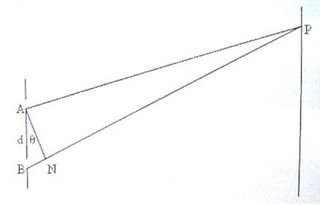
If ‘d’ is the slit separation (AB in fig.), the path difference between the waves reaching a point P on the screen is BP – AP = dsinθ and the condition to produce the nth maximum (bright fringe) at P is
d sinθ = nλ = nd/2.
Therefore, n = 2 sinθ. Since ‘n’ must be an integer, the allowed values are 2,1,0, –1 and –2 because the values of sinθ lie between +1 and –1. So, there can be, at the most, 5 bands only (including the central band.
Now, consider the following MCQ involving interference of light reflected from a thin film:
A transparent film of refractive index 1.5 is viewed in reflected monochromatic light of wave length 6000 Ǻ. If the angle of refraction in to the film is 60º, what is the smallest thickness of the film to make it appear dark?
(a) 4×10⁻⁴ mm (b) 5×10⁻⁴ mm (c) 6×10⁻⁴ mm (d) 7×10⁻⁴ mm (e) 8×10⁻⁴ mm
In the reflected system, the condition for darkness is 2μtcosr = nλ where μ is the refractive index, ‘t’ is the thickness (of the film), ‘r’ is the angle of refraction in to the film, ‘n’ is the order of the interference band and λ is the wave length of the light used.
Since the minimum thickness is required, n =1 so that 2μtcosr = λ from which t = λ/2μcosr = 6000×10–10/(2×1.5×0.5) = 4×10⁻⁷m = 4×10⁻⁴ mm.
(Note that the condition for darkness in the reflected system is 2μtcosr = nλ [and not (2n+1)λ/2] because of the phase change of π (equivalent to a path change λ/2) when reflection occurs at a denser medium for light traveling through a rarer medium).
The following MCQ which appeared in IIT 2001 entrance test paper is worth noting:
Two beams of light having intnsities I and 4I interfere to produce a fringe pattern on a screen. The phase difference between the beams is π/2 at point A and π at point B. Then the difference between the resultant intensities at A and B is
(a) 2I (b) 4I (c) 5I (d) 7I
Since the wave amplitudes are added vectorially to produce the resultant intensity at any point, the resultant intensity at A = I + 4I + 2√I×√(4I)cos(π/2) = 5I. [Note that the amplitude is directly proportional to the square root of intensity].
Similarly, resultant intensity at B = I + 4I + 2√I×√(4I)cosπ = I.
The difference between the rresultant intensities is 5I–I = 4I.
Now consider the following question which involves the measurement of refractive index using interference fringe shift:
When a thin sheet of transparent material of thickness 4×10⁻³ mm is placed in the path of one of the interfering beams in Young’s double slit experiment, it is found that the central bright fringe shifts through a distance equal to four fringes. What is the refractive index of the transparent material? (Wave length of light used is 5893 Ǻ).
(a) 1.378 (b) 1.432 (c) 1.523 (d) 1.546 (e) 1.589
Before introducing the transparent sheet, the path difference between the beams arriving at the centre of the fringe system is zero. When the sheet of thickness ‘t’ is introduced with its plane normal to one of the beams, a path difference equal to μt – t = (μ–1)t is produced. [Note that a path length ‘t’ in a medium of refractive index μ is equivalent to a path length μt in air because of the shrinkage of the waves].
Therefore we have (μ–1)t = nλ so that μ = (nλ/t) +1 = (4×5893×10–10)/(4×10–6) + 1 = 1.5893.

Monday, January 01, 2007

Additional Multiple Choice Questions on Simple Harmonic Motion

The following post is in continuation of the post ‘Multiple Choice Questions on Simple Harmonic Motion’, dated 19th October 2006:
Let us consider the following MCQ which appeared in Kerala Engineering Entrance 2005 question paper:
A particle starts SHM from its mean position. Its amplitude is ‘a’ and total energy is ‘E’. At one instant its kinetic energy is 3E/4. Its displacement at that instant is
(a) a/√2 (b) a/2 (c) a/√(3/2) (d) a/√3 (e) a
The equation of the simple harmonic motion is y = A sinωt with usual notations. The total energy is (½) m ω2a2 and the kinetic energy is (½)m ω2(a2 –y2).
Therefore we have (½) m ω2a2 = E and
(½)m ω2( a2 –y2) = 3E/4.
Dividing the second equation by the first, 1 – y2/a2 = ¾, from which y = a/2.
The following question will be interesting to you:
Two discs A and B of masses m and 2m respectively are connected by a light spring and placed on a table (Fig.) so that the disc B is on the table and the disc A is resting on the spring. If the frequency of oscillation of the spring on slightly depressing and releasing the disc A, is ‘f’, the frequency of oscillation on suddenly removing the table is (a) f/2 (b) f/√2 (c) f (d) √(2/3) f (e) √(3/2) f
When disc B is resting on the table, disc A functions as the oscillating mass in a spring-mass system and the period of oscillation, as usual, is given by T = 2π√(m/k) where ‘k’ is the spring constant. The frequency of oscillation is f = (1/2π)√(k/m).
When the table is removed, the system falls freely and both discs are free to oscillate. The reduced mass (μ) of the vibrating system is given by μ = m×2m/(m+2m) = (2/3)m.
The frequency of vibration in this case is obtained by replacing ‘m’ in the above expression for frequency by (2/3)m so that the new frequency is (1/2π)√[k/(2/3)m] = (1/2π)√(k/m) ×√(3/2) = f ×√(3/2) [Option (e)].
Now, consider the following question:
The kinetic energy and potential energy of a simple harmonic motion (of amplitude ‘A’ ) will be equal when the displacement is
(a) A/√2 (b) A√2 (c) A/2 (d) A/3 (e) A/√3
Equating the kinetic energy to the potential energy, we have ½ m ω2( A2 –y2) = ½ m ω2y2, from which ( A2 –y2) = y2. Therefore, y = A/√2.
Consider the following MCQ:
Two light springs of force constants k1 and k2, loaded with equal masses undergo vertical oscillations. If the maximum velocities of the masses are the same, the ratio of the amplitudes of oscillations is
(a) k1 /k2 (b) 1 (c) k1 2 /k2 2 (d) k2 /k1 (e) √(k2 /k1 )
If A1 and A2 are the amplitudes of oscillations of the first and the second system respectively and ω1 and ω2 their angular frequencies, we have ω1 A1 = ω2 A2 , since the maximum velocities are equal. Therefore, A1 /A2 = ω21 .
But ω = √(k/m) for linear simple harmonic motion so that A1 /A2 = √(k2 /m2 )/ √(k1 /m1 ) = √(k2 /k1 ) since the masses are equal.
[Even if you don’t remember the relation, ω = √(k/m), you can work out this since the maximum potential energy (and maximum kinetic energy) of an oscillating spring is ½kA2 . Since the maximum velocities are equal (as specified in the question), the maximum kinetic energies are equal so that we have, ½k1 A1 2 =½k2 A2 2 , from which A1 /A2 = √(k2 /k1 )].

Tuesday, December 26, 2006

Additional MCQ on Bohr Model of Hydrogen Atom

The following questions are in continuation of the post dated August 26, 2006 (Questions on Bohr Atom Model):
(1) Suppose the energy required to remove all the three electrons from a lithium atom in the ground state is ‘E’ electron volt. What will be the energy required (in electron volt) to remove two electrons from the lithium atom in the ground state?
(a) 2E/3 (b) E – 13.6 (c) E – 27.2 (d) E – 40.8 (e) E – 122.4
The energy of the electron in a hydrogen like atom in the ground state is – 13.6Z2 electron volt. Therefore, after removing two electrons from the lithium (Z=3) atom, the third electron has energy equal to – 13.6×32 eV = 122.4 eV. The energy needed to remove two electrons from the lithium atom in the ground state is therefore equal to (E –122.4) eV.
(2) How many revolutions does the electron in the hydrogen atom in the ground state make per second? (h = 6.63×10⁻³⁴ Js, mass of electron = 9.11×10⁻³¹ kg, Bohr radius = 0.53 A.U.)
(a) 6.55×10⁻¹⁵ (b) 3.28×10⁻¹⁵ (c) 3.28×10⁻¹⁶ (d) 1.64×10⁻¹⁵ (e) 9.11×10⁻¹⁵
The angular momentum (Iω) of the electron is an integral multiple of h/2π. Therefore, Iω = nh/2π, from which, for the first orbit (n=1), ω = h/2πI = h/2πme r2 . The orbital frequency of the electron is given by f = ω/2π = h/4π2m r2 = 6.55×10⁻¹⁵ per second, on substituting for h, m and r.
(3) The ionisation energy of the hydrogen atom is 13.6 eV. If hydrogen atoms in the ground state absorb quanta of energy 12.75 eV, how many discrete spectral lines will be emitted as per Bohr’s theory?
(a) 1 (b) 2 (c) 4 (d) 6 (e) zero
On absorbing 12.75 eV, the energy of the electron in the hydrogen atom will become (–13.6 + 12.75) eV which is – 0.85 eV. This is an allowed state (with n=4) for the electron, since the energy in the 4th orbit is – 13.6/n2 = – 13.6/42 = 0.85 eV. From the 4th orbit, the electron can undrego three transitions to the lower orbits (4→3, 4→2, 4→1). From the third orbit, the electron can undergo two transitions (3→2 and 2→1). The electron in the second orbit can undergo one transition (2→1). So, altogether 6 transitions are possible, giving rise to 6 discrete spectral lines [Option (d)].
You can work it out as n(n–1)/2 = 4(4–1)/2 =6.
(4) The electron in a hydrogen atom makes a transition from an excited state to the ground state. Which of the following siatements is true?
(a) Its kinetic energy increases and its potential and total energies decrease.
(b)Its kinetic energy decreases, potential energy increases and its total energy remains the same.
(c) Its kinetic and total energies decrease and its potential energy increases.
(d) Its kinetic, potential and total energies decrease.
This question appeared in IIT 2000 entrance test paper. The correct option is (a). You should note that the kinetic energy is positive while the potential energy and total energy are negative. Further, the kinetic energy and total energy are numerically equal and the numerical value is equal to half the potential energy.
The total energy is –13.6 Z2/n2. In lower orbits (with smaller n), the potential energy is smaller since it has a larger negative value. The total energy also is therefore smaller. But, the kinetic energy is greater since it has a larger positive value.
(5) If the binding energy of the electron in a hgydrogen atom is 13.6 eV, the energy required to remove the electron from the first excited state of Li++ is
(a) 122.4 eV (b) 30.6 eV (c) 13.6 eV (d) 3.4 eV
Questions of this type often appear in entrance test papers.
Since Li++ is a hydrogen like system with a single electron revolving round a nucleus of proton number Z = 3, the energy of the electron in orbit of quantum number n is
E = –13.6 Z2/n2 eV.
The energy in the first excited state (second orbit) is – 13.6×9/4 eV = – 30.6 eV. The energy to be supplied to the electron to remove it from the first excited state is therefore + 30.6 eV [Option (b)].
(6) The wave lengths involved in the spectrum of deuterium (1D2) are slightly different from that of hydrogen spectrum, because
(a) the attraction between the electron and the nucleus is different in the two cases
(b) the size of the two nuclei are different
(c) the nuclear forces are different in the two cases
(d) the masses of the two nuclei are different.
This MCQ appeared in AIEEE 2003 questionn paper. The answer to this will not be easy if you stick on to the elementary theory of the Bohr model in which the energy (En) of the electron of quantum number n (nth orbit) is given by
En = – me4/8ε0n2h2 where m is the mass of the electron, e is its charge, ε0 is the permittivity of free space and h is Planck’s constant.
In the elementary theory we take ‘m’ as the mass of the electron on the assumption that the nucleus has a very large mass compared to the mass of the electron and hence the electron is moving round with the nucleus at the centre. The real situation is that both the electron and the nucleus are moving along circular paths with the centre of mass as the common centre. Instead of the actual mss of the electron, the reduced mass of the electron and the nucleus is to be substituted in the expression for energy. The modified form of the expression is
En = – μ e4/8ε0 n2h2 where μ is the reduced mass of electron and the nucleus, given by
μ = Mme/(M+me), M and me being the masses of the nucleus and the electron respectively. [Generally, for a hydrogen like system with proton number Z, the expression for energy is En = – μ Z2e4/8ε0n2h2 ].
The nucleus of deuterium contains a proton and a neutron and has very nearly twice the mass of the hydrogen nucleus (proton). So, the reduced mass and the energy levels of deuterium are slightly greater than those of hydrogen and this is the reason for the difference in wave length. [The wave lengths are slightly shorter].The correct option is (d).
************************************************************************
An important point you should remember in the light of the above discussion is the drastic change in the energy levels and the spectrum of positronium compared to hydrogen. Positronium is a highly unstable neutral atom with an electron revolving round a positron. [ You can as well say, a positron revolving round an electron!]. The concept of reduced mass is absolutely necessary in this case since the positron has the same mass as that of the electron so that the reduced mass of positronium is mm/(m+m) = m/2 where ‘m’ is the mass of positron as well as the electron.
Now consider the following MCQ:
A positronium atom undergoes a transition from the state n = 4 to n = 2. The energy of the photon emitted in this process is
(a) 1.275 eV (b) 2.55 eV (c) 3.4 eV (d) 5.1 eV (e) 13.6 eV
The expression for energy of positronium is En = – μ e4/8ε0n2h2 where μ is the reduced mass of positron and electron, given by μ = mm/(m+m) = m/2. Therefore, the mass of the electron (m) used in the expression for the energy of a hydrogen atom (Bohr’s theory) is to be replaced by m/2. All energy levels are therefore reduced to half of the hydrogen levels. Since the energies for states n=4 and n=2 for hydrogen are –13.6/16 eV(=
0.85 eV) and –13.6/4 eV (= –3.4 eV) respectively, the energy of the photon emitted in the case of hydrogen is [(–0.85) – (3.4)] eV = 2.55 eV. In the case of positronium, the energy will be half of this. So, the answer is 2.55/2 eV = 1.275 eV.

Sunday, December 24, 2006

Graduate Record Examinations (GRE) -- Physics Test

Many of you might have already noted that the posts here are useful for preparing for the GRE Physics Test which consists of about 100 multiple choice questions with 5 options. The needs of the GRE Physics Test takers will be considered while discussing questions here. You may make use of the facility for comments for communications in this context.

Wednesday, December 20, 2006

Birla Institute of Technology & Science (BITS)-- BITSAT-2007 Online Tests

The BITSAT-2007 Online tests (for admission to the academic year 2007-08) will be conducted during 7th May - 10th June 2007. These tests are for admitting students to the Integrated First Degree Programmes of BITS, Pilani, Rajasthan, at Pilani Campus and Goa Campus. You will find details here

Tuesday, December 19, 2006

Multiple Choice Questions from Nuclear Physics

Questions in Nuclear Physics at the level expected of you are simple and interesting. You should be careful not to omit questions from this section. Consider the following MCQ which appeared in Kerala Medical Entrance 2000 test paper:
A radioactive isotope has a half life T years. The time after which its activity is reduced to 6.25% of its original activity is
(a) 2T years (b) 4T years (c) 6T years (d) 8T years (e) 16T years
Since the activity of a sample is directly proportional to the number of nuclei present at the instant, we can express the activity ‘A’ after ‘n’ half lives in terms of the initial activity ‘A0’ as,
A = A0/2n.
[The well known radioactive decay law is, N = N0e-λt where N0 is the initial number of nuclei, N is the number remaining undecayed after time ‘t’ and λ is the decay constant. This equation, modified in terms of half life can be written as N = N0/2n where N is number of nuclei remaining undecayed after ‘n’ half life periods. Since the activity, A = dN/dt = -λN, it follows that the activity also can be expressed in the same manner as we express N. Therfore, A = A0/2n].
Therefore, we have, 6.25 = 100/2n, taking initial activity as 100. This yields n = 4, which means that 4 half lives have been elapsed to reduce the activity to 6.25% of the initial activity. The time required is therefore 4T, given in option (b).
Let us discuss another MCQ:
Out of 10 mg of a radio active sample, 1.25 mg remains undecayed after 6 hours. The mean life of the sample in hours is
(a) 0.693 (b) 2/0.693 (c) 4/0.693 (d) 0.693/4 (e) 0.693/2
We have, N = N0/2n so that 1.25 = 10/2n, from which 2n = 8 and n = 3. So, 3 half life periods is 6 hours so that the half life of the sample is 2 hours.
Mean life, T = 1/λ = Thalf /0.693 = 2/0.693 [Option (b)].
Let us consider one more question involving radio activity:
The half life of a radioactive sample is 3.02 days. After how many days 10% of the sample will remain undecayed?
(a) 10 (b) 12.5 (c) 15 (d) 20 (e) 25
Using the relation, N = N0/2n where ‘n’ is the number of half life periods in which the sample decays from N0 to N, we have, 10 = 100/2n. From this, 2n = 10. Taking logarithms, n log 2 = log 10.
You can work this out even if you don’t have a calculator or logarithm tables since you definitely remember that log 2 is 0.3010. Therfore, n = 1/0.3010 = 3.32.
So you require 3.32 half lives or, 3.32×3.02 days = 10 days for the sample to decay to 10%.
Now consider the following question:
The density ‘d’ of nuclear matter varies with nucleon number ‘A’ as
(a) d α A-1 (b) d α A-2 (c) d α A (d) da A2 (e) d α A0
The correct option is (e).
The mass of a nucleus is directly proportional to the number (A) of the nucleons. The volume of the nucleus is (4/3)πR3 where R is the nuclear radius. But, R = 1.1×10⁻¹⁵A. So, the volume of the nucleus also is directly proportional to the nucleon number A. Since density is the ratio of mass to volume, it follows that the density of nuclear matter is independent of the nucleon number A.* * * * * * * * * * * * * * * * * * * * * * * * * * * * * * * * * * * * * * * * * * * *
You can easily show that the density of nuclear matter is of the order of 1017 kg/m3 as follows:
Mass of nucleus = 1.67×10⁻²⁷×A since the mass of a nucleon is approximately 1.67×10⁻²⁷ kg
Volume of nucleus = (4/3)πR3 where R is the nuclear radius.
But, R = 1.1×10⁻¹⁵A metre so that density of nuclear matter,
d = (1.67×10⁻²⁷×A) /[(4/3)π×(1.1×10-15 × A)3. This works out to approximately 3×10¹⁷ kg/m3.
The following simple MCQ appeared in AIEEE 2004 question paper:
A nucleus disintegrates into two nuclear parts which have their velocities in the ratio 2:1. The ratio of their nuclear sizes will be
(a) 2:1 (b) 1:2 (c) 3½:1 (d) 1:3½
Since the momenta of the parts have to be equal in magnitude in accordance with the law of consevation of momentum, we have, m1v1 = m2v2 so that m1 /m2 = v2/v1 =1/2. The masses being directly proportional to the volumes, and the volumes being directly proportional to the cube of the radii, the radii (sizes) are directly proportional to the cube root of the masses. So, the answer is 1:2.
* * * * * * * * * * * * * * * * * * * * * * * * * * * * * * * * * * * * * * * * *
Suppose a radioactve mother nucleus emits a β-particle. Are the mother and daughter nuclei isotones or isobars?
When a nucleus emits a β-particle, a neutron in the nucleus becomes a proton and hence the neutron number is changed. So the mother and daughter are not isotones. The mass number is not changed but the proton number (atomic number) is changed. So they are isobars.
* * * * * * * * * * * * * * * * * * * * * * * * * * * * * * * * * * * * * * * * * * *
Take note of the following question on calculation of the activity of a sample:
Half life of radium (88Ra 226 ) is 1620 years. What is the activity of 2gram of radium? (a) 3.6×10¹⁰ Bq (b) 7.2×10¹⁰ Bq (c) 1.44×10¹¹ Bq (d) 2.88×10¹¹ Bq (e) 5.76×10¹¹ BqNote that becquerel (Bq) is the unit of radioactivity in SI and is equal to one disintegration per second.
Number of nuclei (or, atoms) in 2 gram of radium is (2/226)×NA = (2/226)×6.025×1023 = 5.33×10²¹. [NA is the Avogadro number, 6.025×10²³].
Activity = λN = (0.693/Thalf)×N = [0.693/(1620×3.16×107)] × (5.33×10²¹).
Note that we have converted the half life in years into seconds. [ 1 year = 365.25×24×60×60 seconds = 3.16×10⁷ s].
The activity works out to 7.2×10¹⁰ becquerel.
Now consider the following MCQ which involves Einstein’s mass- energy relation:
How much mass has to be converted into energy to produce electric power of 100 MW for one hour? (Assume that the conversion efficiency is 100%).
(a) 1mg (b) 2 mg (c) 4 mg (d) 20 mg (e) 40mg
At the rate of 100 MW, total energy produced for 1 hour is, P×t = (100×106) ×(60×60) joule = 3.6×10¹¹ J
[We have converted megawatt into watts and hour into seconds].
Since this is equal to mc2 in accordance with Einstein’s mass energy relation, we have,
m = (3.6×10¹¹)/(3×108)2 = 4×10⁻⁶ kg = 4 mg.
Here is a question involving relativistic increase of mass:
The rest mass of a proton is ‘m0’. Its linear momentum when it moves with half the speed of light ‘c’ in free space is
(a) 3m0c/4 (b) m0c/2 (c) m0c (d) 2m0c/√3 (e) m0c/√3
The mass of the proton while moving with velocity ‘v’ is given by
m = m0/√[1- v2/c2] so that when v = c/2, m = m0/√[1- ¼] = 2m0/√3.
The momentum of the proton is mc/2 = m0c/√3.

Tuesday, December 12, 2006

Multiple Choice Questions from Electronics

Questions in Electronics are simple at the Higher Secondary/Plus two level. Many of you might be interested in Electronics and your attitude towards this subject will make it seem to be simpler!
Consider the following MCQ which appeared in AIEEE 2003 question paper:
The difference in the variation of resistance with temperature in a metal and a semiconductor arises essentially due to the difference in the
(a) variation in the scattering mechanism with temperature (b) crystal structure (c) variation in the number of charge carriers with temperature (d) type of bonding
The correct option is (c). On raising the temperature of a semiconductor, more charge carriers are produced by the breaking of the covalent bonds, unlike in the case of a metal. Therefore, as you might have noted, semiconductors have negative temperature coefficient of resistance.
Now, consider the following question:
In an npn power transistor, the collector current is 20 mA. If 98% of the electrons injected in to the base region reach the collector, the base current in mA is nearly
(a) 2 mA (b) 1 mA (c) 0.5 mA (d) 0.4 mA (e) 0.2 mA
Since 98% of the electrons reach the collector, the collector current is 98% of the emitter current and the base current is 2% of the emitter current. As the collector current is nearly equal to the emitter current, the base current is 2% of the collector current. Therefore, base current = 20×2/100 = 0.4 mA [Option (d)].
The following question involving the common base current transfer ratio (current gain) α also is simple:
The current gain α of a transistor is 0.995. If the change in emitter current is 10 mA, the change in base current is
(a) 50 μA (b) 100 μA (c) 500 μA (d) 25 μA (e) 5 μA
We have ∆IB = ∆IE-∆IC where ∆IB, ∆IE and ∆IC represent the changes in the base current, emitter current and the collector current respectively.
Since α = ∆IC/∆IE, we have, ∆IC = α∆IE = 0.995 ×10 = 9.95 mA.
Therefore, change in base current, ∆IB = 10 – 9.95 = 0.05 mA = 50 μA
The following question is designed to check whether you have grasped the method of transistor biasing in the simplest possible practical circuit:
In the common emitter amplifier circuit shown, the transistor has a current gain β equal to 400. The collector load resistor RL = RC =3kΩ. If the collector-to-emitter voltage under no-signal (quiescent) condition is to be equal to half of the supply voltage VCC, what should be the value of the base biasing resistor RB? (Neglect the base to emitter voltage drop)

(a) 2.4 MΩ (b) 1.2 MΩ (c) 120 kΩ (d) 6 MΩ (e) 600 kΩ
In the circuit, the supply voltage used is 12 volts and half of it (6V) should appear between the collector and emitter. The remaining half (6V) should appear across the 3 kΩ collector load resistor, on account of the collector current flowing through it.
Therefore, collector current, IC = 6V/3kΩ = 2 mA. [Note that we have substituted the resistance in kilo ohm itself to obtain the collector current in milliampere].
We have IB = IC/β = 2 mA/400 = 0.005 mA = 5 μA.
Therefore, 5 μA should flow through the base biasing resistor RB. Since the base to emitter voltage drop is allowed to be neglected in the question, the voltage across RB is the full supply voltage, 12V. [If you cannot neglect the base to emitter voltage, you will have 11.3 volts instead, in the case of a silicon transistor, since you will have to subtract the forward voltage of 0.7 volts].Therefore, RB = 12V/5μA = 2.4 MΩ [Option (a)].
[Note that we substituted the current in microampere itself to obtain the resistance in megohm (mega ohm).
Now,
what is the function of the capacitors on the input side and the output side of the amplifier circuit shown above?
Note that they are meant for preventing the direct biasing voltages from reaching the signal source and the load and for allowing the varying signal voltages to pass through.
Let us consider another question:
In a common emitter amplifier circuit drawing a quiescent collector current of 1 mA, the input resistance of the transistor is 1.2 kΩ and the collector load resistance is 3 kΩ. If the common emitter current gain of the transistor is 400, what is the voltage gain of the amplifier?
(a) 500 (b) 600 (c) 700 (d) 800 (e) 1000
The quiescent collector current of 1 mA given in this question is just a distraction.
The voltage gain (or, voltage amplification, Av) of a common emitter amplifier is given by Av = βRL/Ri where RL is the load resistance and Ri is the input resistance of the amplifier. Therefore, voltage gain = 400×3/1.2 = 1000. [Note that we have substituted the resistance value in kilohm (kilo ohm) itself since we have a ratio of resistances in the expression].
Consider now the following three questions which appeared in Kerala Engineering Entrance 2006 test paper:
(1) If α and β are the current gains in the CB and CE configurations respectively of the transistor circuit, then (β – α)/αβ =
(a) ∞ (b) 1 (c) 2 (d) 0.5 (e) zero
We have, β = α/(1- α). Therefore, the given ratio, (β – α)/αβ = [α/(1- α) – α]/αβ = [1/(1- α) -1]/β = [1-(1- α)]/(1-α)β = α/(1- α)β = β/β =1. Therefore, the correct option is (b).
(2) The number densities of electrons and holes in pure germanium at room temperature are equal and its value is 3×10¹⁶ per m3. On doping with aluminium the hole density increases to 4.5×10²² per m3. Then the electron density in doped germanium is
(a) 2×10¹⁰m-3 (b) 5×10⁹m-3 (c) 4.5×10⁹m-3 (d) 3×10⁹m-3 (e) 4×10¹⁰m-3
This is a very simple question based on the law of mass action, NeNh = Ni2 , where Ne and Nh are the number densities (number per unit volume) of the electrons and holes respectively in the doped semiconductor and Ni is the number density of electrons as well as holes in the intrinsic (pure) semiconductor.
Therefore, Ne = Ni2/Nh = (9×1032)/(4.5×1022) = 2×10¹⁰ m-3.
(3) The input resistance of a CE amplifier is 333 Ω and the load resistance is 5 kΩ. A change of base current by 15 μA results in the change of collector current by 1 mA. The voltage gain of the amplifier is
(a) 550 (b) 51 (c) 101 (d) 501 (e) 1001
The current gain of the transistor used, in the common emitter configuration is β = ∆IC/∆IB = (1000 μA)/(15 μA) = 1000/15. [Note that we have converted the collector current into micro ampere since the base current is in micro ampere].
The voltage gain of the amplifier is βRL /Ri = (1000/15) ×(5000/333) = 1001.
Here is a question which appeared in IIT 1998 entrance test paper:
In a p-n junction diode not connected to any circuit,
(a) the potential is the same everywhere
(b) the p-type side is at higher potential than the n-type side
(c) there is an electric field at the junction directed from the n-type side to the p-type side
(d) there is an electric field at the junction directed from the p-type side to the n-type side.
Even if no voltages are applied to a junction diode, the n-side is at a higher potential (of a few hundred millivolts, the exact value depending on the type of the semiconductor) compared to the p-side. This results due to the diffusion of electrons from the n-side to the p-side and similarly, the diffusion of holes from the p-side to the n-side. The n-side is therefore left with a net positive charge and the p-side is left with a net negative charge. This inherent reverse bias across the junction therefore produces an inherent electric field at the junction, directed from the n-type side to the p-type side[Option (c)].