Monday, October 23, 2006

Magnetic Force on Moving Charges


"You may never know what results come of your actions, but if you do nothing, there will be no results."
– Mahatma Gandhi
 

Most of you might be remembering the expression for the magnetic force ‘F’ on a charge ‘q’ moving with velocity ‘v’ in a magnetic field of flux density ‘B’:
F = qvB sinθ where θ is the angle between v and B. Retain the order qvB. It helps you to remember this expression in its vector form:
F = qv×B
The vector form gives you the magnitude (qvB sinθ) of the force and its direction which is along the direction of the cross product vector v×B. You should remember that the direction of v is the direction of motion of a positive charge. If you have a negatively charged particle such as an electron, you should reverse the direction of v to get the direction of the force.
If there is an electric field (E) also in the region, the net force on the charge is given by
F = q(v×B + E).
This is the Lorentz force equation.
Let us consider the following MCQ which appeared in the IIT-JEE Screening 2003 question paper:
For a positively charged particle moving in XY plane initially along the X-axis, there is a sudden change in its path due to the presence of electric and/or magnetic fields beyond P. The curved path is shown in the XY plane and is found to be non-circular.Which one of the following
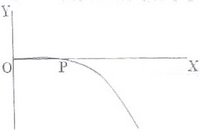
combinations is possible? (i,j,k are unit
vectors along X,Y,Z directions)
(a) E = 0; B =bi + c
(b) E = ai; B =ck + ai
(c) E = 0; B =cj + bk(d) E = ai; B =ck + bj
As the curved path is confined to the XY plane,
the component of magnetic field effective in
deflecting the particle is the Z-component only.
The other component should be the X-component since the X-component cannot deflect the charged particle proceeding along the X-direction. There has to be an electric field since the path of the particle is non-circular. All these conditions are satisfied by option (b).
Now consider the following multiple choice questions:
(1)An electron is projected horizontally from south to north in a uniform horizontal magnetic field acting from west to east. The direction along which it will be deflected by this magnetic field is
(a) vertically upwards 

(b) vertically downwards 
(c) northwards 
(d) southwards 
(e) eastwards
Since the electron is negatively charged, the direction of its velocity is to be reversed for finding the direction of the cross product vector v
×B. The correct option therefore is (a). You can use Fleming’s left hand rule (motor rule) also for finding the direction of the magnetic force. But, when you apply the rule, remember that the direction of the conventional current is that of positive charge.
(2) An electron enters a uniform magnetic field of flux density B=2i+6j-√8 k with a velocity V=i+3j-√2 k where i,j and k are unit vectors along the X, Y and Z directions respectively. Then
(a) both speed and path will change 

(b) speed alone will change 
(c) the path will become circular 
(d) the path will become helical (e) neither speed nor path will change
The vectors B and V are parallel as the components of B are twice the components of V. So the magnetic force on the electron is zero and the correct option is (e).
Generally, in problems of the above type, you will have to find the angle between the vectors V and B using cosθ = V.B/ VB. In the present case we have, cosθ = (2+18+4)/ √(12×48) = 1 so that θ= zero. If in a similar problem, the value of θ works out to be 90˚(if cos
θ works out to be zero), the correct option would be (c). If the value of θ were neither zero nor 90˚, the path would be helical and the correct option would be (d).
(3) Doubly ionized atoms X and Y of two different elements are accelerated through the same potential difference. On entering a uniform magnetic field, they describe circular paths of radii R1 and R2. The masses of X and Y are in the ratio
(a) R1/R2 (b) √(R1/R2) (c) √(R2/R1) (d) (R2/R1)2 (e) (R1/R2)2

Since both atoms are doubly ionized, they have the same charge ‘q’ and since they are accelerated by the same potential difference ‘V’, they have the same kinetic energy, qV. If m1 and m2 are the masses and v1 and v2 are the velocities of X and Y respectively, we have, ½ m1v12 = ½ m2v22 from which m1/m2 = v22/v12 = [qBR2/m2]2/ [qBR1/m1]2, on substituting for the velocities from the centripetal force equation, mv2/R = qvB.
Therefore, m1/m2 = (R1/R2)2, given by option (e).

Thursday, October 19, 2006

Multiple Choice Questions on Simple Harmonic Motion (SHM)

The essential formulae you have to remember in simple harmonic motion are the following:
(1) Equation of simple harmonic motion: y = Asinωt if initial phase and displacement are zero. Here ‘y’ is the displacement, ‘ω’ is the angular frequency and A is the amplitude.
y = Acosωt also represents simple harmonic motion but it has a phase lead of π/2 compared to the above one.
If there is an initial phase of Φ the equation is y = Asin(ωt + Φ).
y = Asinωt + Bcosωt represents the general simple harmonic motion of amplitude √(A2 + B2) and initial phase tan-1(B/A).
(2)
The differential equation of simple harmonic motion is d2y/dt2 = -ω2y
Note that ω =√(k/m) where ‘k’ is the force constant (force per unit displacement) and ‘m’ is the mass of the particle executing the SHM.
(3) Velocity of the particle in SHM, v = ω√(A2y2)
Maximum velocity, vmax = ωA
(4) Acceleration of the particle in SHM, a = - ω2y
Maximum acceleration, amax = ω2A
(5) Kinetic Energy of the particle in SHM, K.E. = ½ m ω2( A2 –y2)
Maximum Kinetic energy =
½ m ω2A2
Potential Energy of the particle in SHM, P.E. = ½ m ω2y2
Maximum Potential Energy = ½ m ω2A2
Total Energy in any position = ½ m ω2A2
Note that the kinetic energy and potential energy are maximum respectively in the mean position and the extreme position. The sum of the kinetic and potential energies which is the total energy is a constant in all positions. Remember this:
Maximum K.E. = Maximum P.E. = Total Energy = ½ m ω2A2
(6) Period
of SHM = 2π√(Inertia factor/ Spring factor)
In cases of linear motion as in the case of a spring-mass system or a simple pendulum, period, T = 2π √(m/k) where ‘m’ is the mass and ‘k’ is the force per unit displacement.
In the case of angular motion, as in the case of a torsion pendulum,
T = 2π √(I/c) where I is the moment of inertia and ‘c’ is the torque (couple) per unit angular displacement.
You may encounter questions requiring calculation of the period of seemingly difficult simple harmonic oscillators. Understand that the question will become simple once you are able to find out the force constant in linear motion and torque constant in angular motion. Angular cases will be rare in Medical and Engineering Entrance test papers. Let us now discuss some typical questions.
The following simple question appeared in the AIIMS 1998 test paper:
If a simple pendulum oscillates with an amplitude 50 mm and time period 2s, then its maximum velocity is
(a) 0.1 m/s (b) 0.15 m/s (c) 0.8 m/s (d) 0.16 m/s
Maximum velocity vmax = ωA where ‘ω’ is the angular frequency and ‘A’ is the amplitude. Therefore vmax = (2π/T)A = (2π/2)×50×10-3 = 0.157 m/s [Option (b)].
The following question appeared in Kerala Engineering Entrance 2005 test paper:
A particle executes linear simple harmonic motion with an amplitude of 2 cm. When the particle is at 1 cm from the mean position, the magnitude of its velocity is equal to that of its acceleration. Then its time period in seconds is
(a) 1/ 2π√3 (b) 2π√3 (c) 2π/√3 (d) √3/2π (e) √3/π
The magnitudes of the velocity and acceleration of the particle when its displacement is ‘y’ are ω√(A2 –y2) and ω2y respectively. Equating them, ω√(A2 –y2) = ω2y, from which ω = [√(A2 –y2)]/y = √(4 –1) = √3. Period T = 2π/ω = 2π/√3.
Suppose you place a sphere of mass ‘m’ and radius ‘r’ inside a smooth, heavy hemispherical bowl of radius of 37r placed on a horizontal table. If the sphere is given a small displacement, what is its period of oscillation?
(a) 2π√(m/37rg) (b) 2π√(m/rg) (c) 12π√(r/g) (d) 2π√(r/g) (e) 2π√(37r/g)
The arrangement depicted in this question is similar to that of a simple pendulum. Instead of the usual string, you have a concave surface to confine the bob (sphere) to its path along the arc of a circle. The usual expression for the period, T = 2π√(L/g) holds here also, where the length L = 36r since the length of the pendulum is measured from the centre of gravity of the bob. The point of ‘suspension’ is evidently at the centre of the hemispherical bowl. The correct option is 12π√(r/g) given in (c).
What will be the period of oscillation of a simple pendulum of length 100 cm in a spaceship in a geostationary orbit?
Well, in any satellite orbiting the earth (in any orbit), the condition of weightlessness exists (effective g = 0), the pendulum does not oscillate and the period therefore is infinite.
Consider the following question:
A simple pendulum is arranged using a small metallic bob of mass ‘m’and a light rubber cord of length ‘L’ (on suspending the bob), area of cross section ‘A’ and Young’s modulus ‘Y’. [One should use inextensible cord only for simple pendulum!]. When this unconventional pendulum is at rest in its mean position, the bob is pulled slightly down and is released. Then, the period of the vertical oscillation of the bob is (assuming that the size of the bob is negligible compared to the length of the cord)
(a) 2π√2L/g (b) 2π√(mL/YA) (c) 2π√ (m/YAL) (d) 2π√ (L/g) (e) 2π√ (mY/AL)
The period as usual is given by T = 2π√(m/k). Here ‘m’ is the same as the mass of the bob. The force constant can be found by writing the expression for Young’s modulus (since it arises from the elastic force in the cord): Y = FL/A(δL) where δL is the increase in the length of the cord on pulling the bob down with a force F. Therefore, the force constant, F/(δL) = YA/L. On substituting this value, the period is 2π√(mL/YA).

The following MCQ on simple harmonic motion may generate a little confusion in some of you:
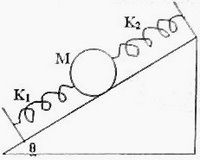
A sphere of mass M is arranged on a smooth inclined plane of angle θ, in between two springs of spring constants K1 and K2 . The springs are joined to rigid supports on the inclined plane and to the sphere (Fig). When the sphere is displaced slightly, it executes simple harmonic motion. What is the period of this motion?
(a) 2π[Mgsinθ/(K1-K2)]½ (b) 2π[M/{K1K2/(K1+K2)}]½ (c) 2π[Mgsinθ/(K1+K2)]½ (d) 2π[M/(K1+K2)]½ (e) 2π[(K1+K2)/M]½

You should note that gravity has no effect on the period of oscillation of a spring-mass system since the restoring force is supplied by the elastic force in the spring. (It can oscillate with the same period in gravity free regions also). So, whether you place the system on an inclined plane or a horizontal plane, the period is the same and is determined by the effective spring constant and the attached mass only. The effective spring constant is K1 + K2 since both the springs try to enhance the opposition to the displacement of the mass. The period of oscillation, as usual is given by, T = 2π√(Inertia factor/Spring factor) = 2π√[M/(K1 + K2)], given in option (d).
The following two questions (MCQ) appeared in Kerala Engineering Entrance 2006 test paper:
(1)The instantaneous displacement of a simple harmonic oscillator is given by y = A cos(ωt + π/4). Its speed will be maximum at the time
(a) 2π/ω (b) ω/2π (c) ω/π (d) π/4ω (e) π/ω
This question was omitted by a fairly bright student who got selected with a good rank. The question setter used the term speed (and not velocity) to make things very specific and to avoid the possible confusion regarding the sign. So what he meant is the maximum magnitude of velocity. The velocity is the time derivative of displacement: v = dy/dt = -Aω(sin ωt + π/4). Its maximum magnitude equal to Aω is obtained when ωt = π/4, from which t = π/4ω.
(2) A particle of mass 5 g is executing simple harmonic motion with an amplitude 0.3 m and time period π/5 s. The maximum value of the force acting on the particle is
(a) 5 N (b) 4 N (c) 0.5 N (d) 0.3 N (e) 0.15 N
If you remember the basic expression for period in the form, T = 2π√(m/k) where ‘k’ is the force constant, the solution becomes quite easy. From this, k = 4π2m/T2 = 4π2 ×5×10-3/(π/5)2 = 0.5. Since ‘k’ is the force for unit displacement, the maximum force is k times the maximum displacement (amplitude). Therefore maximum force = kA = 0.5×0.3 = 0.15N.
[If you remember that ω = √(k/m) you can arrive at the answer since T = 2π/ω].

Sunday, October 15, 2006

All India Pre-Medical/Pre-Dental Entrance Examination (AIPMT) 2007

Central Board of Secondary Education (CBSE), Delhi has announced the dates pertaining to the All India Pre-Medical/Pre-Dental Entrance Examination (AIPMT) 2007 for admission to 15% of the total seats for Medical/Dental Courses in all Medical/Dental colleges run by the Union of India, State Governments and Municipal or other local authorities in India except in the States of ANDHRA PRADESH AND JAMMU & KASHMIR. The dates of the Examination are:
(1) Preliminary Examination : 1st April 2007 (Sunday)
(2) Final Examination : 13th May 2007 (Sunday)
The Information Bulletin and Application Form costing Rs.400/- for General Category candidates and Rs.200/- for SC/ST candidates inclusive of examination fee can be obtained against Cash Payment from designated branches of Canara Bank and Regional Offices of CBSE up to 18-11-2006. Designated branches of Canara Bank in Kerala are:
KOTTAYAM : P.B. No.122, K.K.Road, Kottayam-686 001
QUILANDY : Fasila Buidling, Main Road, Quilandy-673 305
TRIVANDRUM : Ist Floor, Ibrahim Co. Bldg., Challai, Trivandrum-695 023
TRIVANDRUM : Plot no.2, PTP Nagar Trivandrum-695 038
TRIVANDRUM : TC No.25/1647, Devaswom Board Bldg. M.G. Road, Trivandrum-695 001
ERNAKULAM : Shenoy’s Chamber, Shanmugam Road, Ernakulam, Cochin-682 031
CALICUT : 9/367-A, Cherooty Road, Calicut-673 001
TRICHUR : Trichur Main Ramaray Building, Round South, Trichur-680001
QUILON : Maheshwari Mansion, Tamarakulam, Quilon-691 001
PALGHAT : Market Road, Big Bazar, 20/68, Ist floor,Palghat-678 014.

The Information Bulletin and Application Form can also be obtained by Speed Post/Registered Post by sending a written request with a Bank Draft/Demand Draft for Rs.450/- for General Category and Rs.250/- for SC/ST Category payable to the Secretary, Central Board of Secondary Education, Delhi along with a Self Addressed Envelope of size 12” x 10”. The request must reach the Deputy Secretary (AIPMT), CBSE, 2, Community Centre, Preet Vihar, Delhi-110 092 on or before 10-11-2006. The request should be super scribed as “Request for Information Bulletin and Application Form for AIPMT, 2007”.
Completed Application Form is to be dispatched by Registered Post/Speed Post only. Last Date for receipt of completed Application Forms in CBSE is 20-11-2006. You can obtain complete information at www.cbse.nic.in

Saturday, October 14, 2006

M.C.Q. on Circular Motion, Moment of Inertia & Rigid Body Rotation

The section on rotational motion may appear to be uninteresting to some of you, but your attitude is to be corrected. Once you understand the basic principles, this section becomes interesting and easy to score high marks. Let us begin with a M.C.Q. meant for checking your understanding of basic principles:
A small pendulum bob of mass ‘m’ is tied to one end of a light inextensible string and is revolved in a vertical circle of radius ‘r’. If T is the tension in the string and ‘v’ is the speed of the stone at the highest point, the net force on the stone at the highest point is
(a) mg+T (b) T-mg (c) mg (d) mg + T + mv2/r (e) mg – T +mv2/r

Even though this is a simple question, you are likely to pick out the wrong answer if you have not understood the basic things. The net force is the centripetal force acting on the bob and is equal to mg + T. You should note that at the highest point both the tension and the gravitational pull are towards the centre of the circle and they add up to produce the net force.
If you were asked to find out the net force at the lowest point of the circle, your answer would be (T-mg) because T acts towards the centre (upwards) and mg as usual acts downwards.
Suppose the speed of the bob at the highest point were just sufficient to keep the bob moving along the circle. Then T would be zero. The speed v1 of the bob will be given by mv1 2 /r = mg since the centripetal force is then supplied by the gravitational pull alone. This critical speed at the top of the circle is therefore v1 = √(rg). What will be the speed of the bob at the bottom of the vertical circle if the bob were just to move along the circular path? The kinetic energy of the bob at the bottom is higher by mg×2r because it loses gravitational potential energy when it falls from top to bottom. The total kinetic energy at he bottom is ½ mv12 + mg×2r = ½ mgr + 2mgr = (5/2) mgr. If v2 is the speed of the bob at the bottom, we have ½ mv22 = (5/2) mgr. The critical speed at the bottom of the circle is
v2 = √(5rg). You should remember this: If a body is to move in a vertical circle it should have a minimum horizontal speed of √(5rg) at the bottom of the circle. So if you arrange a simple pendulum and push the bob to have a horizontal speed of √(5rg), the bob will just move along a vertical circle.
When the bob is moving along a vertical circle, the difference between the tensions in the sting when the bob is at the top and bottom of the circle is 6mg. You may prove this by way of a simple exercise for you.
Now consider the following mcq which will be quite easy for you now:
A small steel sphere is suspended using light inextensible string to form a simple pendulum. This bob is initially at rest. What is the minimum speed with which another identical steel sphere should hit the pendulum bob so that the bob just moves along a vertical circle? Treat the collision as elastic.
(a) √(rg) (b) √(2rg) (c) √(2.5rg) (d) √[(5/4)rg] (e) √(5rg)
The correct option is the last one: √(5rg). Since the spheres are identical, the sphere which is moving will come to rest at the instant of hitting the pendulum bob, transferring entire kinetic energy to the bob and the bob will move forward with the same speed. Since the critical speed (at the bottom) for the motion along a vertical circle is √(5rg), this is the minimum speed of the moving sphere.
Consider another multiple choice question:
A stone of mass ‘m’ is projected with a velocity ‘u’ making an angle of 45˚with the horizontal. The magnitude of the angular momentum of the projectile about an axis perpendicular to the plane of projection and passing through the point of projection is
(a) mu2/√2g (b) mu3/4√2 g (c) mu3/√2 g (d) mu2/2g (e) zero
The maximum height ‘H’ reached by the projectile is (u2sin2θ)/2g with usual notations. The velocity of the projectile at the maximum height is ucosθ, which is the horizontal component of its velocity that remains unaltered through out its motion. The magnitude of the angular momentum of the projectile at the highest point is = magnitude of linear momentum×lever arm = mucosθ×H = mucosθ × u2sin2θ/2g = mu3cos45×(sin245)/2g = mu3/4√2 g [Option (b)].
Let us now disuss the following questions which appeared in Kerala Engineering Entrance 2001 test paper:
(1) If ‘I’ is the moment of inertia and ‘E’ is the kinetic energy of rotation of a body, then its angular momentum will be
(a) √(EI) (b) 2EI (c) E/I (d) √(2EI) (e) EI
Since the rotational kinetic energy E = ½ I ω2 we can write E = ½ I2 ω2/I from which the angular momentum Iω = √(2EI).
It will be convenient If you remember the expression for rotational kinetic energy as E = L2/2I where L is the angular momentum. This equation is similar to that for translational kinetic energy in the form E = p2/2m where ‘p’ is the linear momentum.
(2) A circular thin disc of mass 2 kg has a diameter 0.2 m. Calculate the moment of inertia about an axis passing through the edge and perpendicular to the plane of the disc (in kgm
2).
(a) 0.01 (b) 0.03 (c) 0.02 (d) 3 (e) 2
The moment of inertia of the disc about its central axis, perpendicular to its plane is MR2/2. Therefore the moment of inertia about a parallel axis passing through its edge, on applying the parallel axis theorem is MR2/2 + MR2 = (3/2)MR2 = (3/2) ×2×(0.1)2 = 0.03 kgm2.
(3) A torque of 50 Nm acting on a wheel at rest rotates it through 200 radians in 5 seconds. Calculate the angular acceleration produced (in rad/sec2)
(a) 8 (b) 4 (c) 16 (d) 12 (e) 10
The torque given in the question is not required for working it out. It just serves the purpose of a distraction. Just as you remember the equation, s = ut + ½ at2 in linear motion, you should remember its angular counter part as θ = ω0t + ½ αt2 where θ is the angular displacement, ω0 is the initial angular velocity (which is zero in the problem), and α is the angular acceleration. Substituting the values given, we have, 200 = 0 + ½×α×25 from which α = 16 rad/sec2.
The following M.C.Q. appeared in the All India Pre-Medical/Dental Entrance Exam.(C.B.S.E.)-2004 question paper:
A round disc of moment of inertia I2 about its axis perpendicular to its plane and passing through its centre is placed over another disc of moment of inertia I1 rotating with an angular velocity ‘ω’ about the same axis. The final angular velocity of the combination of discs is
(a) I2ω/(I1 + I2) (b) ω (c) I1ω/(I1+ I2) (d) (I1 + I2)ω/I1
This is a simple question, the answer of which is based on the law of conservation of angular momentum. The initial angular momentum of the system is I1 ω. The final angular momentum is (I1 + I2)ω' where ω' is the final angular velocity of the combination of the discs. On equating the initial and final angular momenta, we obtain, ω' = I1ω/(I1 + I2).
The following question has appeared in different forms in Medical and Engineering Entrance tests:
If the earth suddenly shrinks to one-eighths its present volume without changing its mass and spherical shape, the duration of the day will
(a) decrease by 6 hours (b) increase by 6 hours (c) decrease by 12 hours (d) decrease by 18 hours (e) remain unchanged

When the volume of a sphere becomes one-eighths, its radius becomes half. The angular momentum of the earth is conserved in spite of the shrinkage so that we have I1ω1= I2ω2 where I1and I2 are the moments of inertia and ω1 and ω2 are the angular velocities of the earth before and after the shrinkage respectively. Substituting for I1 [= (2/5)MR2] and I2 [= (2/5)M (R2/4)] we obtain ω2 = 4ω1. Since the angular velocity changes to 4 times the initial value, the spin period of the earth (T= 2π/ω) changes to one-fourth of the initial value. So, the duration of the day will become 24/4 = 6 hours. The duration therefore decreases by 18 hours.
Generally, if the radius of the earth becomes ‘n’ times the present value, the duration of the day becomes 24n2 hours.
Let us now consider the following interesting question which appeared in the IIT Screening 2000 question paper:
A long horizontal rod has a bead which can slide along its length, and initially placed at a distance ‘L’ from one end A of the rod. The rod is set in angular motion about A with constant angular acceleration ‘α’. If the coefficient of friction between the rod and the bead is ‘μ’, and gravity is neglected, then the time after which the bead starts slipping is
(a) √(μ/α) (b) (μ/α) (c) 1/√(μα) (d) infinitesimal
The bead gets pressed against the rod because of the tangential acceleration of the rod at the location of the bead. The force with which the bead presses against the rod is F = ma = mLα. where ‘m’ is the mass of the bead and ‘a’ is the tangential acceleration which is equal to Lα. The frictional force therefore is μmLα. It is the centrifugal force which tries to push the bead outwards. Just when the slipping begins, we have μmLα = mv2/L. Initially ‘v’ is zero and as time elapses, its value increases in accordance with the equation, v = 0 + at = Lαt where ‘t’ is the time at which slipping begins. Substituting this value of ‘v’ in the above condition for slipping, we obtain μ = αt2 from which t = √(μ/α).

Wednesday, October 11, 2006

Two Kerala Entrance 2006 Questions on Electrostatics


Fig.1


The following mcq appeared in the Kerala Engineering Entrance
Test 2006 question paper:
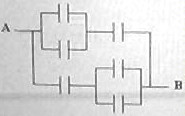
A network of six capacitors, each of value C, is made as shown in Fig 1. The quivalencapacitance between the points A and B is
(a) C/4 (b) 3C/4 (d) 3C/2 (d) 3C (e) 4C/3
The network shown in Fig 1 is redrawn in the second figure shown side by side with Fig1. You can easily understand that the network has two identical branches, each containing a parallel combination of two capacitors in series with a single capacitor.The parallel combined value 2C in series with C makes a net value 2C.C/(2C+C) = 2C/3. The parallel combined value of the two branches is the equivalent capacitance between A and B and is equal to 4C/3 [Option (e)].
The following mcq appeared in the Kerala Medical Entrance Test 2006 question paper:
The total electrical flux leaving a spherical surface of radius ‘r’ metre enclosing an electric dipole of charge ‘q’ is
(a) zero (b) q/ε0 (c) 8π
r2q/ε0 (d) 2q/ε0 (e) 4π r2q/ε0

This is a very simple question which you will occasionally get. Since the closed surface contains a dipole, the electric flux leaving the surface is zero. Note that the outward flux due to the positive charge of the dipole is balanced by the inward flux due to the negative charge of the dipole.

Monday, October 09, 2006

Multiple Choice Questions on Electrostatics:

The following M.C.Q. appearered in the question paper of A.I.E.E.E.2004 (It may appear to be time consuming on the first reading, but it is simple):Two spherical conductors B and C having equal radii and carrying equal charges on them repel each other with a force F when kept apart at some distance. A third spherical conductor A having the same radius as that of B but uncharged is brought in contact with B, then brought in contact with C and finally removed away from both. The new force of repulsion between B and C is
(a) F/4 (b) 3F/4 (c) F/8 (d) 3F/8
If Q is the initial charge on B and C and ‘r’ is the distance between their centres, the initial repulsive force between B and C is F= (1/4πε0)(Q2/ r2). When the uncharged sphere A is brought in contact with B, they share the charge Q and each will have a charge Q/2 since they are identical spheres. When the sphere A is then brought in contact with C they will share the total charge Q + Q/2 = 3Q/2 equally and each will have a charge 3Q/4. On removing the sphere A we have sphere B with charge Q/2 and the sphere C with charge 3Q/4. The new repulsive force between B and C is evidently (1/4πε0)(Q/2)(3Q/4)/r2 = (1/4πε0)3Q2/8r2 = 3F/8 [Option (d)].
Take a special note of the following M.C.Q. which often finds a place in entrance test papers:
A charge ‘q’ is placed at the centre of the line joining two equal point charges, each equal to +Q. This system of three charges will be in equilibrium if 'q' is equal to
(a) +Q (b) +Q/2 (c) –Q/2 (d) +Q/4 (e) –Q/4

+Q____ q_____+Q

The force on the charge ‘q’ placed at the centre will be zero irrespective of the sign of ‘q’. For the system to be in equilibrium, the net force on the charge +Q should be zero. Therefore, (1/4πε0)[Q2 /d2 + Qq/(d/2)2] = 0 where ‘d’ is the separation between the charges Q&Q. From this we get q = -Q/4 [Option (e)].The following M.C.Q is quite simple because of the symmetry in the arrangement of charges. Similar questions can be seen in entrance test papers:Equal charges of value -Q each are arranged at the eight vertices of a non-conducting skeleton cube of side ‘a’. If a point charge +Q is placed at the centre of the cube, the electrostatic force exerted by the eight negative charges on the positive charge at the centre is
(a) Q2/3πε0a2 (b) 4Q2/3πε0a2 (c) 8Q2/3πε0a2 (d) 16Q2/3πε0a2 (e) zero

The net electrostatic force on the charge Q at the centre is zero since the force on Q due to each negative charge is balanced by the force due to the negative charge at the diagonally opposite corner of the cube.
The following M.C.Q. which appeared in the A.I.E.E.E.2004 question paper is worth noting:

Four charges equal to –Q are placed at the four corners of a square and a charge ‘q’ is at the centre.If the system is in equilibrium, the value of ‘q’ is
(a) –Q(1+2√2)/4 (b) Q(1+2√2)/4 (c) –Q(1+2√2)/2 (d) Q(1+2√2)/2
The system will be in equilibrium if the attractive force on the charge –Q at a corner due to the central charge ‘q’ is balanced by the net repulsive force on the same charge –Q due to the remaining three charges (-Q each) at the remaining three corners. Hence we have (if ‘a’ is the side of the square),
(1/4πε0) [Qq/(√2 a/2)2] = (1/4πε0) [Q2/(√2 a)2] + √2 × [(1/4πε0) ×(Q2/a2)].
The term on LHS is the attractive force between –Q and q which are separated by the distance half of √2 a. The first term on RHS is the repulsive force between –Q and the diagonally opposite charge –Q (which are separated by √2 a). The second term on RHS is the net repulsive force between –Q and the remaining two charges (-Q each).
Hence we obtain 4q = Q + Q(1+2√2) from which q = Q(1+2√2)/4 [Option (b)].

The following question was asked at the Kerala Medical Entrance test of 2006:Three identical charges each of 2μC are placed at the vertices of a triangle ABC. If AB+AC=12cm and AB.AC=32cm2, the potential energy of the charge at A is
(a) 1.53J (b) 5.31J (c) 3.15J (d) 1.35J (e) 3.51J

The electrostatic potential energy of the charge at A ia (1/4πε0)(Q.Q/AB + Q.Q/AC) since the charges are of the same value, Q=2μC. Since AB.AC=32, AB = 32/AC. Substituting this in the equation, AB + AC = 12, we obtain 32/AC + AC = 12. Rearranging, (AC)2 – 12AC + 32 = 0, which yields AC = 8 or 4. Since AB.AC = 32 cm2, if AC = 8 cm, AB = 4 cm and vice versa.
Therefore potential energy = (1/4πε0)[(4×10-12)/(4×10-2) +(4×10-12)/(8×10-2)] joule.
Since 1/4πε0 =9×10⁹, the potential energy works out to 1.35 J, given in option (d).
Now consider the following M.C.Q.:
Two isolated copper spheres of radii 3cm and 6cm carry equal positive charges of 30 units each. If they are connected by a thin copper wire and then the wire is removed, what will be the charge on the smaller sphere?
(a) 60 units (b) 40 units (c) 30 units (d) 20 units (e) 10 units
The total charge (Q1+Q2) in the system is 60 units. Since the connecting wire is thin, its capacitance can be neglected. Even though the potentials of the spheres are different initially, their potentials will become the same when they are connected by the copper wire.
The capacitance of a spherical conductor being 4πε0 r, the charges on the spheres will be directly proportional to their radii, since Q = CV and V is the same. Therefore we have Q1/Q2 = 3/6 = 1/2 and Q1+Q2 = 60. So, Q1 = 60×1/3 = 20 units. The potential of the spheres will change after removing the connecting wire; but the charges on them will not change. So, the correct option is (d).
Let us discuss another M.C.Q.:
An infinite number of charges each equal to –q coulomb are placed on a straight line at x = 1m, 2m, 4m, 8m,16m,…….. What will be the potential at x = 0 due to these charges?
(a) infinite (b) 2q/4πε0 (c) –q/4πε0 (d) –2q/4πε0 (e) zero
The potential is certainly negative since a negative charge will produce negative potential only. You should supply the sign of the charge in the expression for the net potential. The potential at x = 0 is given by, V = (-q/4πε0)(1+ ½ + ¼ + 1/8 + 1/16 + ………). Since the infinite series yields a value equal to 2, the answer is –2q/4πε0.
Very simple questions are often likely to mislead even very bright students. Be careful. Here is a very simple question:Nine negative charges, each of magnitude Q are arranged symmetrically along the circumference of a circle of radius R. The electric field at the centre of the circle is
(a) (1/4πε0) Q/R2 (b) (1/4πε0) (9Q/R2) (c) -(1/4πε0) (9Q/R2)
(d) -(1/4πε0) (9Q/R2) cos(2π/9) (e) zero
When you place a positive test charge at the centre of the circle, it will experience zero net force since it is pulled equally by the nine charges arranged symmetrically all around. Therefore, the electric field at the centre is zero.
You will find all the posts on Electrostatics in this site by clicking on the label ‘electrostatics’ below this post.

Thursday, October 05, 2006

Multiple Choice Questions (MCQ) on electromagnetic induction

Questions based on electromagnetic induction are simple and interesting. Usually you will get questions from this section in any Medical and Engineering Entrance Test. Consider the following two questions:
(1) Lenz’s law is a consequence of the law of conservation of
(a) linear momentum (b) charge (c) angular momentum (d) energy (e) none of the above

According to Lenz’s law, the induced current will always oppose the change which causes it. Indeed, the induced current has to oppose the change because, otherwise the change which causes the current will persist and the current will continue to flow once it is started. You will then have a supply of energy (in the form of electric current) without any external agency doing any work. This will then violate the law of conservation of energy, which is impossible. So, Lenses law holds good in accordance with the law of conservation of energy. Option (d) is the correct answer.
(2) The electrical entity inductance can be compared to the mechanical entity
(a) energy (b) impulse (c) momentum (d) torque (e) inertia

The correct option is (e). Inertia in Mechanics is the property by which a body (or, a mechanical system) tries to oppose any change in its state of rest or of uniform motion. Inductance is the property by which an electric circuit tries to oppose any change of current flowing in it. So, inductance and inertia are comparable.
The above two questions high light two basic points. Now consider the following:
A bar magnet is released into a copper ring which is directly below it. What about the acceleration of the magnet? Greater than ‘g’ or equal to ‘g’ or less than ‘g’?
The acceleration is less than ‘g’ since the falling magnet will generate an induced current in the copper ring and the induced current will oppose the motion of the magnet.
Now, consider the following M.C.Q.:
A jet plane is flying horizontally at a speed of 1800 km/hour. What is the potential difference developed between the tips of its wings if the wing span is 25m? Earth’s magnetic field at the location is 0.4 gauss and the angle of dip is 30˚.
(a) 25mV (b) 250mV (c) 500mV (d) 2.5V (e) 5V
The motional emf developed between the tips of the wings is given by V = BvLv where Bv is the vertical component of the earth’s magnetic flux density, L is the distance between the tips of the wings (wing span) and ‘v’ is the velocity. [Note that this emf is produced because of the cutting of the vertical field lines and this is why we use the vertical component of the field]. We have Bv = Bsin30 = 0.4×10⁻⁴×½ = 0.2×10⁻⁴ tesla. Also, L = 25m and v = 500m/s. The emf then works out to be 0.25V = 250mV. [Note that gauss is the cgs unit of magnetic flux densitywhich is often used. One tesla = 104 gauss].
Let us consider another question involving Faraday’s disc, the first electric generator:
A circular copper disc 10cm in diameter rotates 1800 times per minute about a central axis at right angles to the plane of the disc. A uniform magnetic field of 1 tesla is applied perpendicular to the plane of the disc. The voltage induced between the centre and the edge of the disc is
(a) 0.235V (b) 0. 47V (c) 2.35V (d)4.7V (e) zero

The motional emf induced when a conductor moves perpendicular to a magnetic field is the product of the area swept per second (by the conductor) and the magnetic field. Therefore, in the present case, induced voltage = area swept per secong by a radius × B = n πr2B = (1800/60) × π ×(0.05)2 ×1= 0.2356V. The correct option therefore is (a).
Let us modify this question as follows:
A copper rod 10cm long rotates 1800 times per minute about an axis passing through one end at right angles to the rod. A uniform magnetic field of 1 tesla is applied perpendicular to the plane of rotation. The voltage induced between the ends of the rod is
(a) 0.235V (b) 0. 942V (c) 2.35V (d)4.7V (e) zero
This mcq is similar to the previous one. The voltage induced will be four times the previous value since the area swept is four times. The correct option is (b).
Now let us modify the above ‘rod problem’ as follows:
An aluminium rod 10 cm long rotates 1800 times per minute about an axis passing through its centre at right angles to it. A uniform magnetic field of 1 tesla is applied perpendicular to the plane of rotation. The voltage induced between the ends of the rod is
(a) 0.235V (b) 0. 47V (c) 2.35V (d)4.7V (e) zero
This is a simple question but there is chance of committing a mistake! The correct option is neither (a) nor (b). The potential at the ends (with respect to the mid point of the rod) will be the same (0.235V) so that the potential difference between the ends will be zero [Option (e)].
You should note that the motional emf is generated because of the shifting of mobile charge carriers due to the Lorentz force.
The following two questions (mcq) appeared in the Kerala Engineering Entrance test paper of 2006:
(1) A copper disc of radius 0.1m is rotated about its centre with 20 revolutions per second in a uniform magnetic field of 0.1T with its plane perpendicular to the field. The emf induced across the radius of the disc is
(a) π /20 volt (b) π /10 volt (c) 20π milli volt (d) 10π milli volt (e) 2π milli volt
The emf induced = n πr2B = 20π(0.1)2 ×0.1 = 0.02 π volt = 20π milli volt [Option (c)].
(2) A varying magnetic flux linking a coil is given by Φ = Xt2. If at time t=3s, the emf induced is 9V, then the value of X is
(a) 0.66 Wb.s-2 (b) 1.5 Wb.s-2 (c) -0.66 Wb.s-2 (d) -1.5 Wb.s-2 (e) -0.33 Wb.s-2
The induced emf = -dΦ/dt. Therefore, -2Xt = 9 when t=3s so that -6X = 9, from which X = -1.5. The correct option is (d).

Wednesday, September 27, 2006

Kerala Engineering Entrance test-2006 – Two Questions

The following two questions were omitted by a fairly bright student who appeared for Kerala Engineering Entrance test (I wonder what is so unattractive about these questions!):
(1) The momentum of a body is increased by 25%. The kinetic energy is increased by about
(a) 25% (b) 5% (c) 56% (d) 38% (e) 65%
The kinetic energy of a body is given by E = p2/2m. Therefore, when the momentum ‘p’ is increased by 25%, the kinetic energy E is increased by about 56%. (Note that 1.252 = 1.5625).
(2) If the potential energy of a gas molecule is U = M/r6 – N/r12, M and N being positive constants, then the potential energy at equilibrium must be
(a) zero (b) M2/4N (c) N2/4M (d) MN2/4 (e) NM2/4

You know that the molecule will be in equilibrium if its potential energy U is a minimum. For this, dU/dr = 0. Therefore, -6Mr-7 + 12Nr-13 = 0 from which r6 = 2N/M. Therefore, r12 = 4N2/M2. Substituting these values in the expression (given in the question) for U, the potential energy at equilibrium is M/(2N/M) – N/(4N2/M2) = M2/2N – M2/4N = M2/4N [Option (b)].

Tuesday, September 26, 2006

Clear Your Doubts

If you have any genuine doubt to be cleared, on topics in Physics which will be useful to students desirous of appearing for Medical and Engineering entrance tests, you may express it through the option for ‘comments’ provided below each post. If you have a Blogger user name, you can log in using that. If you do not have a Blogger user name you can easily get one . [For obtaining a free Blogger account, click on ‘comments’ below any post and in the window that opens up click on ‘sign up here’ which appears above the word verification characters. You will be taken through the very easy steps for obtaining your free Blogger account (user name)]. Even if you do not have a Blogger user name, you can post your comment using the provision for ‘other’ or ‘anonymous’.

Sunday, September 24, 2006

Will this confuse the students?

I think the following question which appeared in a Medical Entrance question paper will confuse the students:
If the kinetic energy of the particle is increased by 16 times, the percentage change in the de Broglie wave length of the particle is
(a) 25% (b) 75% (c) 60% (d) 50% (e) 30%
The answer given to this question is 75%. In multiple choice questions, the most suitable choice need be picked out and indeed the answer then is 75%. The answer will be exactly 75% if you mean that the final kinetic energy of the particle is 16 times the initial kinetic energy, as shown below:
Kinetic energy, E = p2/2m where ‘p’ is the linear momentum and ‘m’ is the mass. If E is increased to 16 times the initial value, ‘p’ is increased to 4 times the initial value. Since de Broglie wave length λ = h/p where ‘h’ is Planck’s constant, the final wave length will be λ/4. The percentage change in the wave length is therefore 75%.
If the kinetic energy is increased by 16 times as stated in the question, the final kinetic energy will be 17 times the initial kinetic energy and the final momentum will be 4.123 times the initial momentum. The final wave length will be 0.243 times the initial wave length and the percentage change in the wave length will be 75.5%.
In the present question, the answers are almost the same. But suppose the words ‘increased by 16 times’ were replaced by ‘increased by 4 times’. The difference between the answers will be significant. If you mean that the final energy is 4 times, you should modify the words as ‘increased to 4 times’ or ‘made 4 times’. I thought of posting this because I have seen this type of confusing wording in many instances.

Friday, September 22, 2006

Two Questions on Properties of liquids

The weight of a floating body is equal to the weight of the displaced liquid. Question setters often find this law of floatation handy while setting Medical and Engineering test papers. Consider the following question:
A piece of wood having volume ‘V’ and density ‘d’ floats at the interface of two immiscible liquids of densities ‘ρ’ and ‘σ’ respectively. If ρ > d > σ, the ratio of the volumes of the parts of the wooden piece in the rarer and denser liquids is
(a) (ρ-d)/ (d-σ) (b) (d-σ)/(ρ-d) (c) (ρ-d)/(d-σ) (d) (ρ+d)/(ρ+σ) (e) (d-σ)/(ρ+σ)

Equating the weight of the wooden piece to the weight of the displaced liquids, we have,
Vdg = vσg + (V-v)ρg where ‘v’ is the volume of the part of the wooden piece in the rarer liquid (of density ‘ρ’). Rearranging this equation, we have,
v(ρ-σ) = V(ρ-d) so that v/V = (ρ-d)/ (ρ-σ).
Therefore, v/(V-v) = (ρ-d)/(d-σ)
The correct option is (a).
Now consider the following M.C.Q. which appeared in the Kerala Medical Entrance test paper of 2006:
Blood is flowing at the rate of 200cm3/s in a capillary of cross sectional area 0.5m2. The velocity of flow in mm/s is
(a) 0.1 (b) 0.2 (c) 0.3 (d) 0.4 (e) 0.5
This is a very simple question. From the equation of continuity (av = constant), we have,
0.5 v = 200×10-6 so that v = 4×10⁻⁴m/s = 0.4mm/s [option (d)].

Tuesday, September 19, 2006

Properties of Fluids

In any Medical and Engineering entrance test paper you will find a few questions based on the properties of fluids. Let us discuss some typical questions. The following simple question is taken from the A.F.M.C.2004 test paper:
Application of Bernoulli’s theorem can be seen in
(a) dynamic lift of aeroplane (b) hydraulic press (c) helicopter (d) none of these

The correct option is (a). The shape of the aeroplane wings is such that when it moves forward, the air molecules at the top of the wings have a greater velocity (relative to the wings) compared to the air molecules at the bottom. Therefore, in accordance with Bernoulli’s principle, the pressure at the top of the wings is less than that at the bottom. This results in a dynamic lift of the wings which balances the weight of the plane.
Let us now consider another question involving Bernoulli’s principle:

Water is flowing steadily through two horizontal pipes of radii 3cm and 6cm connected in series. The speed of water in the first pipe is 2m/s and the pressure of water in it is 2×10⁴ pascal. The pressure of water in the second pipe will be nearly
(a) 2×10⁴ pascal (b) 2.2×10⁴ pascal (c) 2.4×10⁴ pascal (d) 2.6×10⁴ pascal (e) 3×10⁴ pascal

The speed v2 of water in the second pipe is given (from the equation of continuity, a1v1 = a2v2 ) by v2 = 2×a1/a2 = 2×1/4 = 0.5 m/s. (The ratio of cross section areas is ¼ since the radius of the second pipe is twice that of the first).
As per Bernoulli’s principle, we have P1 + (ρv12 )/2 + ρgh = P2 + (ρv22)/2 + ρgh with usual notations. Therefore, P2 = P1 + ρ(v12- v22)/2 =2×10⁴ + 1000(22 – 0.52)/2 = 2.1875×10⁴ pascal. The correct option therefore is (b).
The following question involving surface tension may appear to be difficult for some of you. See how simple it is:
Two soap bubbles of radii ‘R’ and ‘r’ (R > r) are touching each other. The radius of curvature of the common surface at the region of contact is
(a) (R+r)/2 (b) R – r (c) (R – r)/2 (d) Rr/(R+r) (e) Rr/(R-r)
At the contact region, the radius of curvature (R') of the soap film is governed by the net excess of pressure 4T/r – 4T/R where T is the surface tension. Therefore, we have 4T/r – 4T/R = 4T/R' from which R' = Rr/R-r [option (e)].
Consider now the following M.C.Q.:

Two rain drops are falling through air with the same terminal velocity of 8cm/s. If they coalesce, the terminal velocity of the combined single drop will be (in cm/s)
(a) 8/√2 (b) 16 (c) 8×41/3 (d) 8×21/3 (e) 8√
2
On equating the apparent weight of a rain drop to the viscous force (air resistance) opposing the downward motion of the drop, we have, 4/3πr3(ρ-σ)g = 6πrηv, with usual notations. Therefore, the velocity, v α r2…………(1)
Since the drops have the same terminal velocity, it follows that they have the same radius. The radius (r1 ) of the single large drop (when the two drops coalesce) is given by
2× 4/3πr3 = 4/3 πr13. Therefore, r1=21/3 r.
The velocity of the combined single drop, v1 α [21/3 r]2 -------------- (2)
From equations (1)&(2), v1= 41/3v = 41/3 × 8, since v=8cm/s. The correct option therefore is (c).

Wednesday, September 13, 2006

Molecular speeds

The root mean square velocity ‘c’ of a gas molecule is given by the following relations:
(1) c = √(3kT/m)
(2) c = √(3RT/M)
(3) c = √(3P/ρ)
The first relation gives the r.m.s. speed in terms of Boltzman’s constant ‘k’ and the molecular mass ‘m’. The second one gives the r.m.s. speed in terms of universal gas constant ‘R’ and the molar mass ‘M’. The third one gives the r.m.s. speed in terms of the pressure and density of the gas.
Note that the r.m.s. speed is directly proportional to the square root of the absolute temperature of the gas and also that the r.m.s. speed of the molecules of a given gas is constant at a constant temperature. At constant temperature, even if you change the pressure, the r.m.s. speed is unchanged (as given by the third relation) since the density ‘ρ’ is directly proportional to the pressure ‘P’.
The gas molecules obey Maxwell’s distribution law and the most probable velocity is given by cmp = √(2kT/m) = √(2RT/M) = √(2P/ρ).
Now, consider the following M.C.Q.:
Nitrogen gas molecules have r.m.s.speed ‘v’ at -23˚C. Their r.m.s speed at 477˚C will be
(a) 4.55v (b) 20.7v (c) 9v (d) 1.732v (e) 1.414v
Note that the temperatures are given in degree Celsius. Convert them to the Kelvin scale to obtain 250K and 750K. The rise in the temperature is 3 times. Since the r.m.s. speed is directly proportional to the the square root of the absolute temperature, the final speed is √3 times the initial speed. So, the answer is 1.732v.
If you want to write this in a mathematical step, you have v/v' = √(250/750) from which you obtain the final r.m.s. speed v'.
Now, let us discuss the folowing question:
Root mean square speed of oxygen gas molecules at a certain temperature is 11.2 km/s. The gas is cooled so that the pressure is halved without any change in its density. The final value of the root mean square speed is
(a) 11.2 km/s (b) 7.9km/s (c) 6.4km/s (d) 5.6 km/s (e) 2.8km/s
As the density is unchanged, the volume of the gas is constant. Applying Charles law (P/T = P'/T'), we have P/T = (P/2)/T' from which T' = T/2.
(You can dispense with these steps and simply argue that the temperature must be halved when the pressure is halved at constant volume). Since the RMS speed is directly proportional to the square root of the absolute temperature, the final speed is 11.2×1/√2 = 7.9 km/s.
You can arrive at the answer in no time if you remember the expression for pressure ‘P’ in the form, P = ⅓ρc2. Since the density ‘ρ’ is unchanged, the RMS speed ‘c’ should become 1/√2 times the initial value when the pressure becomes half the initial value.
Let us consider another question:
At what temperature will the molecules of nitrogen have the same r.m.s. speed as the molecules of oxygen at 27˚C?
(a) -10.5˚C (b) -34.5˚C (c) -262.5˚C (d) 262.5˚C (e) 23.62˚C
Since the r.m.s. speed is given by c = √(3RT/M) we have √(3RTn/Mn) =√(3RTo/Mn) where the suffix ‘n’ and suffix ‘o’ refer to nitrogen and oxygen respectively.
Therefore, Tn/28 = 300/32. Note that the molar mass of nitrogen is 28 and that of oxygen is32 and we have substituted the temperature in Kelvin. This yields the value 262.5K as the temperature of nitrogen molecules. The value in Celsius scale is -10.5˚C.
Consider now the following simple question which is often found in test papers:
If ‘v’ and ‘c’ are respectively the velocity of sound in a gas and the r.m.s. speed of the gas molecules at a particular temperature and γ is the ratio of specific heats, then
(a) v = c (b) v = √γc (c) v = c√(γ/3) (d) v = √(γc/3) (e) v = √(3γ/c)
The correct option is (c) since we have v = √(γP/ρ) [Newton-Laplace equation] and c = √(3P/ρ). Therefore, v/c = √(γ/3) from which v = c√(γ/3).
To conclude this post, let me ask you a simple question: Do you know why the moon does not possess an atmosphere? Many of you might be knowing the reason: The escape velocity on the moon’s surface is 2.4 km/s only (compared to 11.2 km/s for the earth) because of the smaller values of acceleration due to gravity and the radius in the case of the moon, compared to the values in the case of the earth. [Remember v=√(2gR)]. Molecular speeds on the moon can attain values significant compared to 2.4 km/s and hence gas molecules can escape into the outer space.

Tuesday, September 12, 2006

Photons and electrons

Let us discuss some questions involving photons and electrons. The following question high lights one basic difference between photons and electrons:
The kinetic energies of an electron and a photon are in the ratio 9:4. Their momenta are in the ratio
(a) 9:4 (b) 3:2 (c) 1:3 (d) 4:3 (e) 3:4
The kinetic energy of an electron (or any such particles of matter) is directly proportional to the square of its momentum (since E = p2 /2m with usual notations) where as the kinetic energy of a photon is directly proportional to its momentum (since E = mc2 = mc.c = pc). The ratio of the momenta of the electron and the photon is therefore √9: 4 = 3:4 [Option (e)].
You will encounter many situations in which you will be required to calculate the velocity of a particle of charge ‘q’ and mass ‘m’ accelerated by a voltage ‘V’. The equation you have to use is ½ mv2 = qV from which the velocity, v = √(2qV/m).
A special case is that of the electron, which you will encounter quite often. When you substitute the mass and the charge of the electron, the velocity is given (approximately) by v = 6×10⁵√V. Remember this relation. You can save the valuable time you will have to spend on certain calculations. For instance, consider the following M.C.Q.:

An electron at rest is accelerated by 2500 volts. Its final velocity is approximately (in m/s)
(a) 3×10⁶ (b) 3×10⁷ (c) 2.5×10⁸ (d) 2.5×10⁶ (e) ) 1.5×10⁸

If you use the relation, v = 6×10⁵√V , you will get the correct option (b) in no time.
[You should note that we have not considered the relativistic increase in the mass of the electron in the above approximate equation. If the accelerating voltage is higher, the relativistic increase in the mass is significant and the above equation cannot be used. Even in the above problem, the velocity of the electron is 10% of the velocity of light and the relativistic increase in the mass begins to be exhibited].
Now consider the following question:
A laser source has output power of 300 mW at a wave length of 6630Ǻ. The number of photons emitted from this laser source every minute is
(a) 6×10¹⁹ (b) 6×10¹⁸ (c) 6×10¹⁷ (d) 6×10¹⁶ (e) 6×10¹⁴
If the number of photons emitted per second is ‘n’, we have nhν = nhc/λ = 300×10-3 so that n = 0.3 λ/hc where ‘h’ is Planck’s constant, ‘c’ is the speed of light and ‘λ’ is the wave length. The number of photons emitted per minute is 60n = (60×0.3×6630×10-10)/(6.63×10-34×3×108) = 6×10¹⁹ [Option (a)].
Energy and Wave Length of a Photon
There are many situations in which you will have to find the energy of a photon in electron volt if its wave length in Angstrom Units (A.U.) is given and vice versa. For instance, suppose you are asked to find out the minimum wave length of X-rays that can be obtained from an X-ray tube operating with an anode voltage of 20kV. Since the X-ray photon of minimum wave length will have the entire energy of 20000 electron volt (of the electron striking the target in the X-ray tube), you can write,20000 e = hc/λ where ‘e’ is the electronic charge, ‘h’ is Planck’s constant, ‘c’ is the speed of light in free space and λ is the wave length in metre.Instead of using the above equation for calculating λ, you may remember that in the case of a photon,λE = 12400 where λ is in Angstrom and the energy E is in electron volt.The answer to our present problem therefore is,
λ = 12400/20000 = 0.62 A.U.
Do you know why germanium and silicon are unsuitable for making light-emitting diodes?
The band gap for producing visible light should be at least 12400/7000 electron volt (since the maximum wave length of visible light is roughly 7000 Angstrom). This works out to be nearly 1.8eV, which is greater than the band gap of Ge and Si.

Saturday, September 09, 2006

Multiple Choice Questions on Magnetism

The following question which appeared in the Kerala Engineering Entrance test paper of 2006 has been popular among question setters for long:
A magnetized wire of magnetic moment M and length L is bent in the form of a semicircle of radius ‘r’. The new magnetic moment is
(a) M (b) M/2π (c) M/π (d) 2M/π (e) zero
The pole strength of the magnet, p = M/L. The pole strength of the magnet is unchanged, but the moment is changed since the poles come closer on bending the wire, thereby changing the magnetic length of the magnet from L to L'
We have L' = 2r = 2L/π so that the new magnetic moment = pL' = (M/L) ×(2L/π) = 2M/π [Option (d)].
Consider now the following M.C.Q.:
In a hydrogen atom the electron is making 6.6×10¹⁵ revolutions per second around the nucleus in an orbit of radius 0.528 Å. The equivalent magnetic dipole moment is approximately ( in Am2)
(a)10-10 (b) 10-15 (c) 10-23 (d) 10-25 (e) 10-17

The orbiting electron is equivalent to a circular current loop, whose magnetic dipole moment is given by M = IA where I is the equivalent current and A is the area of the loop. Therefore, M = (q/T)×(πr2) = qf πr2 where q is the electronic charge, T is the orbital period, r is the orbital radius and f is the frequency of revolution of the electron.
Thus M = 1.6×10-19×6.6×1015×π×(5.28×10⁻¹⁰)2 . This yields a value nearly 10-23 [Option (c)].
Let us now consider the following question:
Two short magnets of dipole moments M and 2M are arranged on the table so that the axial line of the weaker magnet and the equatorial line of the stronger magnet are coinciding. If the separation between the magnets is 2d, what is the magnetic flux density midway between these magnets? Ignore the earth’s magnetic field.
(a) μ0M/4πd3 (b) 3μ0M/4πd3 (c) (μ0M/4πd3)
3 (d) (μ0M/4πd3)5 (e) (μ0M/4πd3
)8
At the point midway between the magnets, the axial field (μ0/4π)(2M/d3) of the magnet of moment M and the equatorial field (μ0/4π)(2M/d3) of the magnet of moment 2M are acting at right angles so that the net field there is √2×(μ0/4π)(2M/d3) = μ0M/4πd3)√8. The correct option therefore is (e).

Wednesday, September 06, 2006

Work Done in Lifting a Body

When you lift a body of mass ‘m’ from the earth’s surface through a small height ‘h’, the work ‘W’ done by you against gravitational force, as you know, is given by W = mgh. This expression gives you the correct value only if ‘h’ is negligibly small compared to the radius ‘R’ of the earth.
If the height ‘h’ is comparable to the radius ‘R’ of the earth, the expression gets modified as W = mgh/[1+(h/R)].
If h = nR the above expression can be written as W = mgRn/(n+1).
In all these expressions, ‘g’ is the surface value of acceleration due to gravity.
Let us consider the following multiple choice questions:
(1)The work done in lifting a body of mass ‘m’ from the earth’s surface, through a height ‘h’ is mgR/3 where ‘g’ is the acceleration due to gravity on the earth’s surface and ‘R’ is the radius of the earth. Then ‘h’ is equal to
(a) R (b) R/2 (c) R/3 (d) R/4 (e) R/6

We have W = mgh/[1+(h/R)] so that mgR/3 = mgh/[1+(h/R)]. This gives h = R/2 [option (b)].
(2) A body of mass ‘m’ is projected at an angle of 45˚ from the moon’s surface by giving it kinetic energy equal to mgR where ‘R’ is the radius of the moon and ‘g’ is the acceleration due to gravity on the moon’s surface. Then
(a)the final potential energy of the body will be zero (b) the final kinetic energy of the body will be positive (c) the body will reach a height equal R (d) the body will reach a height between R and 2R (e) the body will reach a height between 2R and 4R.
The potential energy of the body on the moon’s surface is –GMm/R = -mgR, on substituting g = GM/R2. When the body is given kinetic energy equal to mgR, its total energy becomes zero and it escapes into the outer space where its potential energy and kinetic energy are zero. The correct option therefore is (a).
You can find more multiple choice questions (with solution) of similar type here

ONAM GREETINGS

Friday, September 01, 2006

Questions on Kinetic Theory of Gases

The important relations you should remember in kinetic theory of gases are the following:
(1) Pressure exerted by a gas, P = (1/3) nmc2 = (1/3)ρc2 = nkT where ‘n’ is the number of molecules per unit volume, ‘m’ is the molecular mass, ‘c’ is the r.m.s. speed of the molecule ‘ρ’ is the density of the gas, ‘k’ is Boltzman’s constant and T is the absolute temperature.
(2) R.M.S. speed of molecule, c = √(3P/ρ) = √(3RT/M) = √(3kT/m).
Remember all the three expressions for r.m.s.speed. The second one gives the r.m.s.speed in terms of molar mass M and the universal gas constant R. The third one gives the r.m.s. speed in terms of molecular mass ‘m’ and Boltzman’s constant ‘k’.
(3) Average translational kinetic energy of any type of gas molecule is (3/2)kT since translational motion along three directions only are possible in our three dimensional space.
(4) If the molecule has ‘n’ degrees of freedom, the average kinetic energy per molecule is (n/2 )kT.
The following points are worth noting in the present context:
(i) A mono atomic gas molecule has 3 degrees of freedom and has translational kinetic energy only [equal to (3/2)kT ].
(ii) A diatomic molecule has 5 degrees of freedom (three translational and two rotational). In this case, the total average kinetic energy per molecule is (5/2 )kT.
(iii) Tri-atomic and polyatomic molecules have 6 degrees of freedom (three translational and three rotational). The total average kinetic energy per molecule is ( 6/2 )kT = 3kT.
The K.E. per mole in all the above cases is N times (N is the Avogadro number). Since Nk=R, the average K.E. per mole is (3/2 )RT for mono atomic, (5/2 )RT for diatomic and 3RT for triatomic and polyatomic gas molecules.
Note that the molar heat capacity at constant volume (CV) is obtained by putting T=1(corresponding to a temperature rise of 1K) in the above expressions. The values are therefore (3/2 )R for mono atomic gas, (5/2)R for diatomic gas and 3R for triatomic and polyatomic gases.
The molar heat capacity of a gas at constant pressure (CP) is given by CP = CV + R. Therefore, the values are (5/2)R for mono atomic gas, (7/2)R for diatomic gas and 4R for triatomic and polyatomic gases.
It will be useful to remember the relation connecting the ratio of specific heats ‘γ’ and the number of degrees of freedom ‘f’:
γ = 1+ (2/f)
Note: In the above discussion, the vibrational modes of the molecules have been ignored. Even though the above values are in agreement with the values obtained from experiment in the case of several gases, there are discrepancies in the case of certain diatomic gases and several polyatomic gases. The vibrational modes also are therefore to be taken into account in more rigorous treatment.
Let us now consider the following question:
The average translational kinetic energy of a helium gas molecule (molar mass 4) at a particular temperature is 0.05electron volt. The average translational kinetic energy of an oxygen molecule (molar mass 32) at the same temperature will be
(a) 0.4eV (b) 0.08eV (c) 0.2eV (d) 0.05eV (e) 0.1eV
Don’t be concerned about the type of the gas and the molar mass. The translational kinetic energy of all types of molecules is the same at a given temperature. The correct option therefore is (d).
The following question appeared in the Kerala Engineering Entrance Test paper of 2002:
An electron tube was sealed off during manufacture at a pressure of 1.2×10⁻⁷ mm of mercury at 27˚C. Its volume is 100cm3. The number of molecules that remain in the tube is
(a) 2×10¹⁶ (b) 3×10¹⁵ (c) 3.86×10¹¹ (d) 5×10 11 (e) 2.5×10¹²
You may do this problem by using one of the following relations:
(1) P = nkT (2) PV = rT where ‘r’ is the gas constant for the mass of gas in the electron tube.
If you use the first relation, you should remember the value of Boltzman’s constant ‘k’, which is 1.38×10⁻²³ . Since k = R/N you can substitute the values of the universal gas constant R (= 8.31 J/mol/K ) and the Avogadro number N (= 6.02×10²³ ), which you should definitely remember, to get ‘k’. The number of molecules per unit volume therefore is,
n = P/(kT) = hdg/(kT)
The number of molecules in the electron tube is n×V = hdgV/(kT)
= (1.2×10-10×13600×9.8×100×10-6 ) / (1.38×10-23 ×300) = 3.86×10¹¹ [Option (c)].
If you use the second relation you will write PV = n’RT where n’ is the number of moles of gas in the tube. Therefore, n’ = PV/(RT).
The number of molecules in the tube = n’N = PVN/(RT) = hdgVN/(RT).
Note that this is the same relation as we obtained in the first method since k = R/N.
If you are not very quick in arithmetical manipulations, don’t attempt questions like this during your initial trial.
Consider now the following M.C.Q.:
1.2 mole of helium gas (mono atomic), 0.4 mole of nitrogen (diatomic) and 0.4 mole of oxygen (diatomic) are contained in a vessel of volume 10 litre at a temperature of 27˚C. The pressure of this mixture of gases is (in Nm-2)
(a) 5×10⁵ (b) 106 (c) 2.5×10⁵ (d) 2.5×10⁶ (e) 5×10⁶
Some of you may have certain doubts regarding this simple question. Your doubts are added when you see the distractions ‘mono atomic’ and ‘diatomic’. But your doubts will be cleared the moment you remember the expression for pressure in the form, P = nkT. Here ‘n’ is the number of molecules per unit volume, ‘k’ is the Boltzman constant and T is the absolute temperature. The type of the gas does not come into the picture and you require the number density ‘n’ only for substituting in the expression for P. Since the mixture contains 2 moles (1.2+0.4+0.4), the total number of molecules in the mixture is 2N where N is Avogadro number. The number of molecules per unit volume (n) therefore is 2N/(10×10-3 ) = N/(5×10-3). Therefore, P = NkT/(5×10-3). But, k = R/N so that P = RT/(5×10-3) = 8.3×300/(5×10-3) = 5×10⁵Nm-2.
Let us consider another question:
Oxygen and hydrogen gases are at the same temperature T. The kinetic energy of an oxygen molecule will be
(a) 32 times the kinetic energy of a hydrogen molecule (b) 16 times the kinetic energy of a hydrogen molecule (c) twice the kinetic energy of a hydrogen molecule (d) 4 times the kinetic energy of a hydrogen molecule (e) the same as that of the hydrogen molecule.

The correct option is (e). The kinetic energy (total) of a gas molecule is (n/2)kT where ‘n’ is the number of degrees of freedom. Oxygen and hydrogen are diatomic and they have the same degrees of freedom (n=5) and hence the same kinetic energy at a given temperature.
Certain simple questions may confuse you if you are in a hurry and you may give wrong answers! Here is one such question:
To decrease the volume of an ideal gas by 10% at constant temperature, the pressure should be increased by
(a) 5% (b) 8.91% (c) 10% (d) 11.1% (e) 12.25%

Don’t pick out option (c) in a hurry. We have PV = P’×0.9V so that P’ = P/0.9 = 1.111P. The increase in pressure is 11.1% [option (d)].
Let us discuss one more question:
When a gas contained in a closed vessel is heated through 1˚C, the pressure of the gas increases by 0.2%. the final temperature of the gas is
(a) 200K (b) 361K (c) 500K (d) 501K (e) 601K
We have, P/T = 1.002P/(T+1) since the volume is constant. Solving this we obtain T = 500K. The final temperature is T+1 = 501K.