Showing posts with label AIIMS. Show all posts

Monday, November 26, 2007

Two All India Institute of Medical Sciences (AIIMS) Questions on Optics

The following questions which appeared in All India Institute of Medical Sciences (AIIMS) 2005 entrance question paper for admitting students to the MBBS Degree course are simple as usual. They are meant for checking your knowledge and understanding of fundamentals.

(1) The apparent depth of water in a cylindrical water tank of diameter 2R cm is reducing at the rate of x cm/minute when water is being drained out at a constant rate. The amount of water drained in c.c. per minute is (n1= refractive index of air, n2 = refractive index of water)

(a) x π R2 n1/n2 (b) x π R2 n2/n1 (c) 2 π R n1/n2 (d) π R2x

Since the refractive index is the ratio of real depth to the apparent depth, we have

Real depth = Apparent depth × refractive index.

Therefore, the rate at which the real depth is decreasing = xn2/n1 cm per minute.

The amount of water drained in c.c. per minute is therefore equal to x π R2 n2/n1, given in option (b).

(2) A telescope has an objective lens of focal length 200 cm and an eye piece with focal length 2 cm. If the telescope is used to see a 50 m tall building at a distance of 2 km, what is the length of the image of the building formed by the objective lens?

(a) 5 cm (b) 10 cm (c) 1 cm (d) 2cm

At the first glance this question may seem to be one involving the magnification produced by a telescope; but, this is quite simple since you are asked to consider the objective only.

The objective will produce the image of the building at the focus (which is at 2 m from the lens) and hence from the expression for magnification (M) we have

M = Distance of image/ Distance of object = Height of image/ Height of object

so that 2/ 2000 = x/50 where ‘x’ is the height of image in metre.

Therefore, x = 2×50/2000 = 0.05 m = 5 cm.

Sunday, March 04, 2007

Charged Particles in Magnetic and Electric Fields

Here is a multiple choice question which appeared in AIEEE 2002 question paper:
If an electron and a proton having same momenta enter perpendicular to a magnetic field, then
(a) curved path of electron and proton will be same (ignoring the sense of revolution)
(b) they will move undeflected
(c) curved path of electron is more curved than that of the proton
(d) path of proton is more curved

The radius of the circular path of the electron is obtained by equating the magnetic force to the centripetal force: qvB = mv²/r. The radius ‘r’ is therefore given by r = mv/qB. The radius is therefore directly proportional to the momentum (mv) and inversely proportional to the charge (q) of the particle.
The momenta are given as equal in the problem. Since the proton and the electron have the same charge magnitudes and are moving in the same magnetic field B, they will follow paths of the same radius[Option (a)].
You might have noted that the path of a charged particle in an electric field is generally parabolic. This is because of the fact that in a uniform electric field, the electric force on the particle has the same direction everywhere. The motion is similar to the projectile motion in a gravitational field. Now, consider the following question:
A particle of charge ‘+q’ and mass ‘m’ is projected with a velocity ‘v’at an angle ‘θ’ with respect to the horizontal, in an electric field ‘E’ which is directed vertically downwards. If there are no gravitational or magnetic fields, the horizontal range of the particle is
(a) (v²sin2θ)/E (b) (v²sin2θ)/qE (c) (mv²sin2θ)/E (d) (mv²sin2θ)/qE (e) (qmv²sin2θ)/E
In the case of the motion of a projectile in a gravitational field, the expression for horizontal range is R = (v² sin2θ)/g. In the present case, the gravitaional acceleration ‘g’ is replaced by the acceleration produced by the electric field.
Acceleration produced by the electric field = Force/ Mass = qE/m. The correct option therefore is (d).
The following MCQ appeared in AIIMS 2004 question paper:
The cyclotron frequency of an electron gyrating in a magnetic field of 1 T is approximately
(a) 28 MHz (b) 280 MHz (c) 2.8 GHz (d) 28 GHz
The cyclotron frequency is the frequency with which a charged particle describes circular path in a magnetic field and is given by f =qB/2πm with usual notations. [You can get it this way: qvB = mrω² where ω is the angular frequency. Substituting v = ωr in this, we get ω = qB/m. Frquency f = ω/2π =qB/2πm].
Substituting for the mass and charge of the electron, we have
f = (1.6×10–19 ×1)/ (2π×9.1×10–31 ) = 28×109 Hz = 28 GHz.

Sunday, November 12, 2006

Additional MCQ on Refraction at Plane Surfaces

In continuation of the post dated 11th November 2006, here is another MCQ which appeared in the Kerala Medical Entrance 2005 test paper:
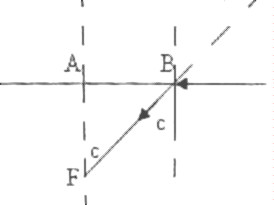
A fish looking from within water sees the outside world through a circular horizon. If the fish is √7 m below the surface of water, what will be the radius of the circular horizon?
(a) 3m (b) 3/√7m (c) √7m (d) 3√7m (e) 4m
Note that refractive index of water is not given. You are expected to remember it. Most of you know it as 1.33. On many occasions it will be useful to remember the value as 4/3. As you can see from the figure, the fish at F can see the outside world through a cone of semi angle equal to the critical angle ‘c’ of water because the rays of light at grazing incidence are refracted in to water at critical angle ‘c’. The circular horizon meant in the question has radius AB which is equal to √7 tan c. We have sin c = 1/n = 1/(4/3) =3/4. To obtain tan c, you may imagine a right angled triangle having opposite side 3 and hypotenuse 4 to obtain the adjacent side √7 so that you get tan c = 3/√7.
Since the radius of the circular horizon is √7 tan c,
you get the answer as 3m.
The following MCQ appeared in AIIMS 1995 test paper:
Angle of a prism is ‘A’ and its one surface is silvered. Light rays falling at an angle of incidence 2A on first surface return back through the same path after suffering reflection at the second silvered surface. Refractive index of the material is
(a) 2sinA (b) 2cosA (c) 1/2cosA (d) tanA
Since the ray retraces its path on falling (at D) on the silvered face AC of the prism, it follows that it is incident normally on this face. The angle of refraction (r) at the first face is shown in the figure. From the triangle NAD, angle DNA = 90-A. Therefore, r = A. The refractive index of the material of the prism is therefore given by n = sini/sinr = sin(2A)/ sinA = 2sinA cosA/sinA = 2cosA.
The following MCQ appeared in E.A.M.C.E.T. (Medical) Andhra Pradesh-2003 question paper:
A prism of refractive index μ and angle A is placed in the minimum deviation position. If the angle of minimum deviation is A, then the value of A in terms of μ is
(a) sin-1(μ/2) (b) sin-1 √[(μ-1)/2] (c) 2cos-1(μ/2) (d) cos-1(μ/2)
In the minimum deviation position, we have μ = sin[(A+D)/2] / sin(A/2) where D is the minimum deviation. Putting D = A, as given in the question, we obtain μ = sinA/sin(A/2) = [2sin(A/2)cos(A/2)]/sin(A/2) = 2cos(A/2). Therefore, cos(A/2) = μ/2, from which A = 2cos-1 (μ/2).
Here is an interesting question. It is simple, but you may have many doubts on the method of solving it:
One face A of a glass slab of thickness ‘t’ is silvered. An ink mark is made on the opposite face B. If you look through the face B, what is the distance between the ink mark and its image formed by reflection at the silvered face? (Refractive index of glass is μ).
(a) 2t (b) t + (t/μ) (c) t(1+μ) (d) 2μt (e) 2t/μ
You can work it out from first principles using laws of reflection and refraction and of course geometry and trigonometry and get the correct option which is (e). But you will waste a lot of time in the process. Better, do it as follows:
When you look through the face B, the silvered face A (which is at the real distance ‘t’ from B which carries the ink spot) will appear to be at the apparent distance t/μ from B (and the ink spot). The reflected image of the ink spot is at the same distance t/μ behind the apparent silvered face. So, the distance between the ink spot and its reflected image will be (t/μ + t/μ) = 2t/μ.

Thursday, October 19, 2006

Multiple Choice Questions on Simple Harmonic Motion (SHM)

The essential formulae you have to remember in simple harmonic motion are the following:
(1) Equation of simple harmonic motion: y = Asinωt if initial phase and displacement are zero. Here ‘y’ is the displacement, ‘ω’ is the angular frequency and A is the amplitude.
y = Acosωt also represents simple harmonic motion but it has a phase lead of π/2 compared to the above one.
If there is an initial phase of Φ the equation is y = Asin(ωt + Φ).
y = Asinωt + Bcosωt represents the general simple harmonic motion of amplitude √(A2 + B2) and initial phase tan-1(B/A).
(2)
The differential equation of simple harmonic motion is d2y/dt2 = -ω2y
Note that ω =√(k/m) where ‘k’ is the force constant (force per unit displacement) and ‘m’ is the mass of the particle executing the SHM.
(3) Velocity of the particle in SHM, v = ω√(A2y2)
Maximum velocity, vmax = ωA
(4) Acceleration of the particle in SHM, a = - ω2y
Maximum acceleration, amax = ω2A
(5) Kinetic Energy of the particle in SHM, K.E. = ½ m ω2( A2 –y2)
Maximum Kinetic energy =
½ m ω2A2
Potential Energy of the particle in SHM, P.E. = ½ m ω2y2
Maximum Potential Energy = ½ m ω2A2
Total Energy in any position = ½ m ω2A2
Note that the kinetic energy and potential energy are maximum respectively in the mean position and the extreme position. The sum of the kinetic and potential energies which is the total energy is a constant in all positions. Remember this:
Maximum K.E. = Maximum P.E. = Total Energy = ½ m ω2A2
(6) Period
of SHM = 2π√(Inertia factor/ Spring factor)
In cases of linear motion as in the case of a spring-mass system or a simple pendulum, period, T = 2π √(m/k) where ‘m’ is the mass and ‘k’ is the force per unit displacement.
In the case of angular motion, as in the case of a torsion pendulum,
T = 2π √(I/c) where I is the moment of inertia and ‘c’ is the torque (couple) per unit angular displacement.
You may encounter questions requiring calculation of the period of seemingly difficult simple harmonic oscillators. Understand that the question will become simple once you are able to find out the force constant in linear motion and torque constant in angular motion. Angular cases will be rare in Medical and Engineering Entrance test papers. Let us now discuss some typical questions.
The following simple question appeared in the AIIMS 1998 test paper:
If a simple pendulum oscillates with an amplitude 50 mm and time period 2s, then its maximum velocity is
(a) 0.1 m/s (b) 0.15 m/s (c) 0.8 m/s (d) 0.16 m/s
Maximum velocity vmax = ωA where ‘ω’ is the angular frequency and ‘A’ is the amplitude. Therefore vmax = (2π/T)A = (2π/2)×50×10-3 = 0.157 m/s [Option (b)].
The following question appeared in Kerala Engineering Entrance 2005 test paper:
A particle executes linear simple harmonic motion with an amplitude of 2 cm. When the particle is at 1 cm from the mean position, the magnitude of its velocity is equal to that of its acceleration. Then its time period in seconds is
(a) 1/ 2π√3 (b) 2π√3 (c) 2π/√3 (d) √3/2π (e) √3/π
The magnitudes of the velocity and acceleration of the particle when its displacement is ‘y’ are ω√(A2 –y2) and ω2y respectively. Equating them, ω√(A2 –y2) = ω2y, from which ω = [√(A2 –y2)]/y = √(4 –1) = √3. Period T = 2π/ω = 2π/√3.
Suppose you place a sphere of mass ‘m’ and radius ‘r’ inside a smooth, heavy hemispherical bowl of radius of 37r placed on a horizontal table. If the sphere is given a small displacement, what is its period of oscillation?
(a) 2π√(m/37rg) (b) 2π√(m/rg) (c) 12π√(r/g) (d) 2π√(r/g) (e) 2π√(37r/g)
The arrangement depicted in this question is similar to that of a simple pendulum. Instead of the usual string, you have a concave surface to confine the bob (sphere) to its path along the arc of a circle. The usual expression for the period, T = 2π√(L/g) holds here also, where the length L = 36r since the length of the pendulum is measured from the centre of gravity of the bob. The point of ‘suspension’ is evidently at the centre of the hemispherical bowl. The correct option is 12π√(r/g) given in (c).
What will be the period of oscillation of a simple pendulum of length 100 cm in a spaceship in a geostationary orbit?
Well, in any satellite orbiting the earth (in any orbit), the condition of weightlessness exists (effective g = 0), the pendulum does not oscillate and the period therefore is infinite.
Consider the following question:
A simple pendulum is arranged using a small metallic bob of mass ‘m’and a light rubber cord of length ‘L’ (on suspending the bob), area of cross section ‘A’ and Young’s modulus ‘Y’. [One should use inextensible cord only for simple pendulum!]. When this unconventional pendulum is at rest in its mean position, the bob is pulled slightly down and is released. Then, the period of the vertical oscillation of the bob is (assuming that the size of the bob is negligible compared to the length of the cord)
(a) 2π√2L/g (b) 2π√(mL/YA) (c) 2π√ (m/YAL) (d) 2π√ (L/g) (e) 2π√ (mY/AL)
The period as usual is given by T = 2π√(m/k). Here ‘m’ is the same as the mass of the bob. The force constant can be found by writing the expression for Young’s modulus (since it arises from the elastic force in the cord): Y = FL/A(δL) where δL is the increase in the length of the cord on pulling the bob down with a force F. Therefore, the force constant, F/(δL) = YA/L. On substituting this value, the period is 2π√(mL/YA).

The following MCQ on simple harmonic motion may generate a little confusion in some of you:
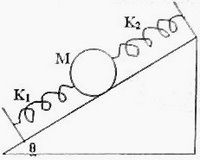
A sphere of mass M is arranged on a smooth inclined plane of angle θ, in between two springs of spring constants K1 and K2 . The springs are joined to rigid supports on the inclined plane and to the sphere (Fig). When the sphere is displaced slightly, it executes simple harmonic motion. What is the period of this motion?
(a) 2π[Mgsinθ/(K1-K2)]½ (b) 2π[M/{K1K2/(K1+K2)}]½ (c) 2π[Mgsinθ/(K1+K2)]½ (d) 2π[M/(K1+K2)]½ (e) 2π[(K1+K2)/M]½

You should note that gravity has no effect on the period of oscillation of a spring-mass system since the restoring force is supplied by the elastic force in the spring. (It can oscillate with the same period in gravity free regions also). So, whether you place the system on an inclined plane or a horizontal plane, the period is the same and is determined by the effective spring constant and the attached mass only. The effective spring constant is K1 + K2 since both the springs try to enhance the opposition to the displacement of the mass. The period of oscillation, as usual is given by, T = 2π√(Inertia factor/Spring factor) = 2π√[M/(K1 + K2)], given in option (d).
The following two questions (MCQ) appeared in Kerala Engineering Entrance 2006 test paper:
(1)The instantaneous displacement of a simple harmonic oscillator is given by y = A cos(ωt + π/4). Its speed will be maximum at the time
(a) 2π/ω (b) ω/2π (c) ω/π (d) π/4ω (e) π/ω
This question was omitted by a fairly bright student who got selected with a good rank. The question setter used the term speed (and not velocity) to make things very specific and to avoid the possible confusion regarding the sign. So what he meant is the maximum magnitude of velocity. The velocity is the time derivative of displacement: v = dy/dt = -Aω(sin ωt + π/4). Its maximum magnitude equal to Aω is obtained when ωt = π/4, from which t = π/4ω.
(2) A particle of mass 5 g is executing simple harmonic motion with an amplitude 0.3 m and time period π/5 s. The maximum value of the force acting on the particle is
(a) 5 N (b) 4 N (c) 0.5 N (d) 0.3 N (e) 0.15 N
If you remember the basic expression for period in the form, T = 2π√(m/k) where ‘k’ is the force constant, the solution becomes quite easy. From this, k = 4π2m/T2 = 4π2 ×5×10-3/(π/5)2 = 0.5. Since ‘k’ is the force for unit displacement, the maximum force is k times the maximum displacement (amplitude). Therefore maximum force = kA = 0.5×0.3 = 0.15N.
[If you remember that ω = √(k/m) you can arrive at the answer since T = 2π/ω].