Showing posts with label refraction. Show all posts

Sunday, August 21, 2011

Geometric Optics - IIT-JEE 2011 Questions on Refraction

“You can chain me, you can torture me, you can even destroy this body, but you will never imprison my mind.”

– Mahatma Gandhi


Today we will discuss two questions from optics which appeared in IIT-JEE 2011 question paper. The first one is single correct answer type multiple choice question where as the second one is integer answer type in which the answer is a single digit integer ranging from 0 to 9.

(1) A light ray traveling in glass medium is incident on glass air interface at an angle of incidence θ. The reflected (R) and transmitted (T) intensities, both as function of θ, are plotted. The correct sketch is

You can easily rule out sketches (A) and (B) since they indicate 100% transmitted intensity at angle of incidence (θ) of 0º.

[Even at normal incidence (θ = 0) the entire incident light is not transmitted. A small portion is reflected back].

Sketch (C) is the correct option since it indicates total reflection (total internal reflection) at an angle of incidence equal to the critical angle for the glass air interface. The entire light is totally reflected abruptly and the transmitted intensity drops abruptly to zero.

[The gradual change in intensity indicated in sketch (D) is ruled out].

(2) Water (with refractive index = 4/3 ) in a tank is 18 cm deep. Oil of refractive index 7/4 lies on water making a convex surface of radius of curvature, 'R’ = 6 cm as shown. Consider oil to act as a thin lens. An object ‘S’ is placed 24 cm above water surface. The location of its image is at ‘x’ cm above the bottom of the tank. Then 'x' is

The law of distances in the case of refraction at an interface between two media of refractive indices n1 and n2 is

n2/v – n1/u = (n2 – n1)/R where ‘v’ is the image distance, ‘u’ is the object distance and ‘R’ is the radius of curvature of the refracting surface. In the case of the refraction at the air-oil interface we have n2 = 7/4, n1 = 1, u = 24 cm and R = 6 cm. so that

7/4v – 1/(24) = [(7/4) –1]/6

[Note that we have applied the Cartesian sign convention which you can find here].

Therefore, 7/4v = 3/24 – 1/24 = 1/12

This gives v = 21 cm.

The image formed (at 21 cm from the oil surface) by the refraction at the air-oil interface will act as a virtual object for the refraction at the oil-water interface so that u = 21 cm (positive according to Cartesian sign convention). In this case n2 = 4/3, n1 = 7/4 and R = .

[The radius of curvature is infinity since the oil-water interface is plane].

Therefore we have

4/3v1 – 7/(4×21) = [(4/3) – (7/4)]/ where v1 is the distance of the final image (from the water surface).

Or, 4/3v1 – 7/(4×21) = 0

This gives v1 = 16 cm.

The water column in the tank has a height of 18 cm. Therefore the final image is 2 cm above the bottom of the tank.

Therefore, x = 2


Friday, March 20, 2009

Geometric Optics- Multiple Choice Questions involving Refraction at Plane Surfaces

I am neither especially clever nor especially gifted. I am only very, very curious.

– Albert Einstein


The following question at the first glance may appear to be a difficult one to many of you; but, you will realise how easy it is when you apply basic points you studied in geometric optics:

A glass jar has the plane inner surface PQ of its bottom silvered and contains water (of refractive index n = 4/3) column of height t = 6 cm. A small light emitting diode (LED) is arranged at O at a height d = 8 cm from the water surface AB (Fig.). The silvered bottom of the jar acts as a plane mirror. At what distance from the free surface (AB) of water will this plane mirror form the image of the light emitting diode?

(a) 11 cm

(b) 14 cm

(c) 17 cm

(d) 18 cm

(e) 20 cm

When you look into the plane mirror (silvered surface) PQ from the position O of the LED, the plane mirror will appear to be located at P1Q1 (fig.) at a distance t/n from the free surface of water (because of normal refraction at the water surface). The distance of the LED from this refracted image P1Q1 of the plane mirror is therefore equal to (d + t/n) as shown in the adjoining figure.

The image of the LED must be formed at O1 which is at the same distance (d + t/n) from the effective plane mirror P1Q1.

As is clear from the adjoining figure, the distance of the image O1 from the free surface (AB) of water is (d + t/n) + t/n which is equal to (d + 2t/n) = 8 + 2×6/(4/3) = 17 cm.

The following question appeared in EAMCET (Engineering) 2003 question paper:

One of the refracting surfaces of a prism of refractive index √2 is silvered. The angle of the prism is equal to the critical angle of a medium of refractive index 2. A ray of light incident on the unsilvered surface passes through the prism and retraces its path after reflection at the silvered face. Then the angle of incidence on the unsilvered surface is

(a) 0º

(b) 30º

(c) 45º

(d) 60º

The angle A of the prism (as mentioned in the question) is given by n = 1/sin A where n = 2.

[Remember n = 1/sin C where n is the refractive index and C is the critical angle].

Therefore, sin A = ½ so that A = 30º

Since the ray retraces its path after reflection at the silvered face, it is incident normally at the silvered face (at the point N in the figure). With reference to the figure, angle QNA in the triangle QNA is 90º.

Since the angle A is 30º it follows that angle AQN = 60º so that the angle of refraction (r) at Q is 30º.

The angle of incidence (i) at the unsilvered face is given by

n = sin i/sin r from which sin i = n sin r = √2 sin 30º.

This gives sin i =1/√2 so that i = 45º.

You may search for ‘optics’ using the ‘search blog’ facility at the top left of this page to find all related posts on this site.

A useful post on the equations to be remembered in Geometric Optics can be found here.

Thursday, October 30, 2008

Geometrical Optics- Questions (MCQ) on Refraction at Prisms

Questions involving the refraction produced by prisms often find place in Medical, Engineering and other Degree Entrance Exam question papers. Here are two questions in this section:

(1) The face AC of a glass prism of angle 30º is silvered. A ray of light incident at an angle of 60º on face AB retraces its path on getting reflected from the silvered face AC. If the face AC is not silvered, the deviation that can be produced by the prism will be

(a) 0º

(b) 30º

(c) 45º

(d) 60º

(e) 90º

The deviation (d) produced by a prism is given by

d = i1 + i2 A where i1 and i2 are respectively the angle of incidence and the angle of emergence and A is the angle of the prism. Here we have i1 = 60º, i2 = 0º (since the ray falling normally will proceed undeviated from the face AC if it is not silvered) and A = 60º.

Therefore, d = 30º.

(2) In the above question, what is the refractive index of the material of the prism?

(a) 1.732

(b) 1.652

(c) 1.667

(d) 1.5

(e) 1.414

In the triangle ADN angle AND is 60º since angle DAN = 30º and angle DNA = 90º. Therefore, the angle of refraction at D is 30º. The refractive index of the material of the lens (n) is given by

n = sin i1/ sinr1 = sin 60º/ sin 30º = √3 = 1.732

(3) Two thin (small angled) prisms are combined to produce dispersion without deviation. One prism has angle 5º and refractive index 1.56. If the other prism has refractive index 1.7, what is its angle?

(a) 3º

(b) 4º

(c) 5º

(d) 6º

(e)

Since the deviation (d) produced by a small angled prism of angle A and refractive index n is given by

d = (n – 1)A, the condition for dispersion without deviation on combining two prisms of angles A1 and A2 with refractive indices n1 and n2 respectively is

(n1 – 1)A1 = (n2 – 1)A2

Therefore, 0.56×5 = 0.7×A2 so that A2 = 4º

On this site you will find many questions (with solution) on refraction at plane surfaces as well as at curved surfaces. To access all of them type in ‘refraction’ in the search box at the top left side of this page and click on the adjacent ‘search blog’ box.

Monday, November 26, 2007

Two All India Institute of Medical Sciences (AIIMS) Questions on Optics

The following questions which appeared in All India Institute of Medical Sciences (AIIMS) 2005 entrance question paper for admitting students to the MBBS Degree course are simple as usual. They are meant for checking your knowledge and understanding of fundamentals.

(1) The apparent depth of water in a cylindrical water tank of diameter 2R cm is reducing at the rate of x cm/minute when water is being drained out at a constant rate. The amount of water drained in c.c. per minute is (n1= refractive index of air, n2 = refractive index of water)

(a) x π R2 n1/n2 (b) x π R2 n2/n1 (c) 2 π R n1/n2 (d) π R2x

Since the refractive index is the ratio of real depth to the apparent depth, we have

Real depth = Apparent depth × refractive index.

Therefore, the rate at which the real depth is decreasing = xn2/n1 cm per minute.

The amount of water drained in c.c. per minute is therefore equal to x π R2 n2/n1, given in option (b).

(2) A telescope has an objective lens of focal length 200 cm and an eye piece with focal length 2 cm. If the telescope is used to see a 50 m tall building at a distance of 2 km, what is the length of the image of the building formed by the objective lens?

(a) 5 cm (b) 10 cm (c) 1 cm (d) 2cm

At the first glance this question may seem to be one involving the magnification produced by a telescope; but, this is quite simple since you are asked to consider the objective only.

The objective will produce the image of the building at the focus (which is at 2 m from the lens) and hence from the expression for magnification (M) we have

M = Distance of image/ Distance of object = Height of image/ Height of object

so that 2/ 2000 = x/50 where ‘x’ is the height of image in metre.

Therefore, x = 2×50/2000 = 0.05 m = 5 cm.

Sunday, November 12, 2006

Additional MCQ on Refraction at Plane Surfaces

In continuation of the post dated 11th November 2006, here is another MCQ which appeared in the Kerala Medical Entrance 2005 test paper:
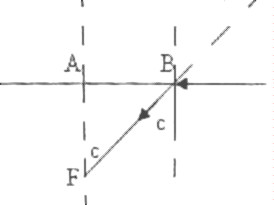
A fish looking from within water sees the outside world through a circular horizon. If the fish is √7 m below the surface of water, what will be the radius of the circular horizon?
(a) 3m (b) 3/√7m (c) √7m (d) 3√7m (e) 4m
Note that refractive index of water is not given. You are expected to remember it. Most of you know it as 1.33. On many occasions it will be useful to remember the value as 4/3. As you can see from the figure, the fish at F can see the outside world through a cone of semi angle equal to the critical angle ‘c’ of water because the rays of light at grazing incidence are refracted in to water at critical angle ‘c’. The circular horizon meant in the question has radius AB which is equal to √7 tan c. We have sin c = 1/n = 1/(4/3) =3/4. To obtain tan c, you may imagine a right angled triangle having opposite side 3 and hypotenuse 4 to obtain the adjacent side √7 so that you get tan c = 3/√7.
Since the radius of the circular horizon is √7 tan c,
you get the answer as 3m.
The following MCQ appeared in AIIMS 1995 test paper:
Angle of a prism is ‘A’ and its one surface is silvered. Light rays falling at an angle of incidence 2A on first surface return back through the same path after suffering reflection at the second silvered surface. Refractive index of the material is
(a) 2sinA (b) 2cosA (c) 1/2cosA (d) tanA
Since the ray retraces its path on falling (at D) on the silvered face AC of the prism, it follows that it is incident normally on this face. The angle of refraction (r) at the first face is shown in the figure. From the triangle NAD, angle DNA = 90-A. Therefore, r = A. The refractive index of the material of the prism is therefore given by n = sini/sinr = sin(2A)/ sinA = 2sinA cosA/sinA = 2cosA.
The following MCQ appeared in E.A.M.C.E.T. (Medical) Andhra Pradesh-2003 question paper:
A prism of refractive index μ and angle A is placed in the minimum deviation position. If the angle of minimum deviation is A, then the value of A in terms of μ is
(a) sin-1(μ/2) (b) sin-1 √[(μ-1)/2] (c) 2cos-1(μ/2) (d) cos-1(μ/2)
In the minimum deviation position, we have μ = sin[(A+D)/2] / sin(A/2) where D is the minimum deviation. Putting D = A, as given in the question, we obtain μ = sinA/sin(A/2) = [2sin(A/2)cos(A/2)]/sin(A/2) = 2cos(A/2). Therefore, cos(A/2) = μ/2, from which A = 2cos-1 (μ/2).
Here is an interesting question. It is simple, but you may have many doubts on the method of solving it:
One face A of a glass slab of thickness ‘t’ is silvered. An ink mark is made on the opposite face B. If you look through the face B, what is the distance between the ink mark and its image formed by reflection at the silvered face? (Refractive index of glass is μ).
(a) 2t (b) t + (t/μ) (c) t(1+μ) (d) 2μt (e) 2t/μ
You can work it out from first principles using laws of reflection and refraction and of course geometry and trigonometry and get the correct option which is (e). But you will waste a lot of time in the process. Better, do it as follows:
When you look through the face B, the silvered face A (which is at the real distance ‘t’ from B which carries the ink spot) will appear to be at the apparent distance t/μ from B (and the ink spot). The reflected image of the ink spot is at the same distance t/μ behind the apparent silvered face. So, the distance between the ink spot and its reflected image will be (t/μ + t/μ) = 2t/μ.

Saturday, November 11, 2006

Questions on Refraction at Plane Surfaces

Questions on reflection and refraction at plane surfaces are interesting to answer, but those involving spherical surfaces may pose some problems to you. Let us discuss some questions involving reflection and refraction at plane surfaces. (We will discuss questions involving spherical surfaces later).
The following MCQ comes under normal refraction:
A transparent cube of edge 9cm contains a small air bubble which appears to be at a distance of 4 cm when viewed normally through one face and at a distance of
2 cm when viewed normally through the opposite face. The refractive index of the material of the cube is
(a) 1.4 (b) 1.45 (c) 1.5 (d) 1.55 (e) 1.6

Here 4 cm and 2 cm are the apparent distances of the air bubble on looking through the two faces. If ‘d’ is the real distance, we can write the refractive index (n) as n = d/4 = (9-d)/2. [We have written n = (Real distance)/(Apparent distance) for the two cases]. From this, d = 6 cm so that n = 6/4 = 1.5.
Suppose there are many layers of thickness t1, t2, t3 etc of different immiscible liquids of refractive indices n1 , n2, n3 etc in a vessel. What will be the apparent depth? You can work it out using Snell’s law. The total apparent depth turns out to be equal to the sum of the individual apparent depths:
Total apparent depth = (t1/n1) + (t2/n2) + (t3/n3) +…etc.
Now consider the following MCQ:
A jar is half filled with a liquid of refractive index μ and the other half is filled with another immiscible liquid of refractive index 1.2μ. The apparent depth of the jar is then two thirds the actual depth. Then, the refractive index of the rarer liquid is
(a) 1.6 (b) 1.575 (c) 1.55 (d) 1.475 (e) 1.375
If the thickness of the liquid layers are ‘t’ each, the actual depth of the jar is 2t. The apparent depth as given in the question is (2/3)×2t =4t/3 so that we can write,
4t/3 = t/μ + t/1.2μ from which μ = 1.375.
Here is a simple question which appeared in Kerala Medical Entrance
2005 test paper:
A glass slab of thickness 3 cm and refractive index 3/2 is placed on ink mark on a piece of paper. For a person looking at the mark from a distance 5 cm above it, the distance of the mark will appear to be
(a) 3 cm (b) 4 cm (c) 4.5 cm (d) 5 cm (e) 3.5 cm
If he looks from a point just above the glass slab, the ink mark will appear to be at 3/n = 3/(3/2) = 2 cm. Since he is looking from a distance of 5-3= 2 cm from the top of the slab, the ink mark will appear to be at 2 + 2 = 4cm.
Have you ever seen the setting sun while you are under water (while swimming)? Here is a question:
A diver under water sees the setting sun at an angle of nearly
(a) 41º with respect to the horizontal (b) 49º with respect to the horizontal (c) 42º with the vertical (d) 45º with the horizontal (e) 37º with the horizontal.
The correct option is (a) since the critical angle for water is nearly 49º and this angle is with respect to the vertical in the present case. The angle with the horizontal is therefore 41º.
It will be convenient if you remember the critical angle of water and glass. In many problems you will encounter crown glass of refractive index 1.5. Its critical angle is 41.8º, which is roughly 42º. Critical angle for water is 48.75º, which is roughly 49º. You will come across many questions involving refractive index value of √2. This value has sanctity only for setting questions! It will be convenient to remember the critical angle of 45º for a substance having refractive index of √2. [Note that critical angle and refractive index of any medium is with respect to free space (or, air) unless specified otherwise].
Now, note this question which has been appearing in many test papers:
A plane glass slab is kept over various coloured letters. The letter which appears least raised is
(a) blue (b) violet (c) green (d) red (e) all are equally raised
Basically, you are asked to state which colour will produce the least apparent shift. The apparent shift = (Real distance - apparent distance) = t – (t/n). Since the refractive index (n) is the minimum for red, the least apparent shift is for red. So, red letters will appear least raised. [Since the refractive index is the maximum for violet, letters of violet colour will appear most raised].
Now consider the following MCQ involving the minimum deviation produced by a prism:
When light rays are incident at an angle of 60º on one face of a glass prism, minimum deviation occurs. If the angle of minimum deviation also is 60º, what is the refractive index of the material of the prism?
(a) √3 (b) √3/2 (c) 1.5 (d) √2 (e) 1.6
Under the condition of minimum deviation, the angle of incidence (i1) and the angle of emergence (i2) are equal (each equal to i). Since i1+i2-A = d where‘d’ is the deviation, we have 2i – A = D when the deviation is the minimum (D). Therefore, 120º - A = 60º, from which A = 60º. The refractive index is given by n = sin [( A+D)/2]
/ sin (A/2) = (sin60)/sin30 = (√3 /2)/(1/2) = √3.