Links to Questions
Sunday, May 05, 2013
JEE Main 2013 Questions on Geometric Optics
Wednesday, June 23, 2010
IIT-JEE 2010 Multiple Choice Questions on Optics
Today we will discuss two multiple choice questions on optics, which were included in the IIT-JEE 2010 question paper. The first question is single correct choice type mcq where as the second one is multiple correct choice type mcq.
(1) A biconvex lens of focal length 15 cm is in front of a plane mirror. The distance between the lens and the mirror is 10 cm. A small object is kept at a distance of 30 cm from the lens. The final image is
(A) virtual and at a distance of 16 cm from the mirror
(B) real and at distance of 16 cm from the mirror
(C) virtual and at a distance of 20 cm from the mirror
(D) real and at a distance of 20 cm from the mirror
The lens has focal length f = 15 cm and the object O is placed at distance 30 cm which is equal to 2f. Therefore a real image I1 will be formed at distance 2f (= 30 cm) on the other side of the lens, if the mirror is absent.
Since the image I1 is at 20 cm from the plane mirror, a real image I2 would be formed (by the reflection of the rays at the plane mirror) at distance 20 cm from the mirror. But the returning rays are further refracted by the lens and the final image is formed at I3. The image I2 serves as the object for the lens for the formation of the final image I3.
As is clear from the figure, the object distance u3 for the formation of the final image is 10 cm. Therefore we have
1/v3 – 1/10 = 1/15
[We have used the law of distances 1/v – 1/u = 1/f, in accordance with the Cartesian sign convention]
Therefore, 1/v3 = 1/15 + 1/10
This gives v3 = 6 cm.
The image is real and its distance from the plane mirror is (6+10) cm = 16 cm [Option (b)].
(2) A ray OP of monochromatic light is incident on the face AB of prism ABCD near the vertex B at an incident angle of 60º (see figure). If the refractive index of the material of the prism is √3 , which of the following is (are) correct ?
(A) The ray gets totally internally reflected at face CD
(B) The ray comes out through face AD
(C) The angle between the incident ray and the emergent ray is 90º
(D) The angle between the incident ray and the emergent ray is 120º
When the angle of incidence (at P) is 60º, the angle of refraction r is 30º since the refractive index n of the material of the prism is given by
n = sin i/sin r
Or, √3 = sin 60º/sin r so that sin r = (sin 60º)/√3 = ½ from which r = 30º
From the quadrilateral PABQ (fig.) it follows that angle PQB = 45º. Therefore the angle of incidence of the ray at the point Q is 45º. But this is greater than the critical angle for the interface.
[If θc is the critical angle for the interface, we have 1/sin θc = n =√3 so that sin θc = 1/√3. Since sin 45º = 1/√2 it follows that 45º > θc]
The ray incident at Q is therefore totally reflected and it is incident at an angle of 30º at the point R. The angle of refraction at R is 60º and hence the angle between the incident ray and the emergent ray is 90º.
Options A, B and C are therefore correct.
[If you know the action of the prism commonly used in the constant deviation spectrograph, you will be able to answer this question immediately].
Sunday, November 12, 2006
Additional MCQ on Refraction at Plane Surfaces
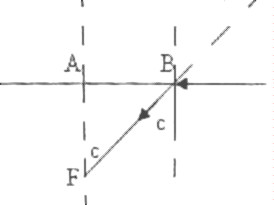
In continuation of the post dated 11th November 2006, here is another MCQ which appeared in the Kerala Medical Entrance 2005 test paper:A fish looking from within water sees the outside world through a circular horizon. If the fish is √7 m below the surface of water, what will be the radius of the circular horizon?
(a) 3m (b) 3/√7m (c) √7m (d) 3√7m (e) 4m
Note that refractive index of water is not given. You are expected to remember it. Most of you know it as 1.33. On many occasions it will be useful to remember the value as 4/3. As you can see from the figure, the fish at F can see the outside world through a cone of semi angle equal to the critical angle ‘c’ of water because the rays of light at grazing incidence are refracted in to water at critical angle ‘c’. The circular horizon meant in the question has radius AB which is equal to √7 tan c. We have sin c = 1/n = 1/(4/3) =3/4. To obtain tan c, you may imagine a right angled triangle having opposite side 3 and hypotenuse 4 to obtain the adjacent side √7 so that you get tan c = 3/√7.
Since the radius of the circular horizon is √7 tan c,
A prism of refractive index μ and angle A is placed in the minimum deviation position. If the angle of minimum deviation is A, then the value of A in terms of μ is
(a) sin-1(μ/2) (b) sin-1 √[(μ-1)/2] (c) 2cos-1(μ/2) (d) cos-1(μ/2)
In the minimum deviation position, we have μ = sin[(A+D)/2] / sin(A/2) where D is the minimum deviation. Putting D = A, as given in the question, we obtain μ = sinA/sin(A/2) = [2sin(A/2)cos(A/2)]/sin(A/2) = 2cos(A/2). Therefore, cos(A/2) = μ/2, from which A = 2cos-1 (μ/2).
One face A of a glass slab of thickness ‘t’ is silvered. An ink mark is made on the opposite face B. If you look through the face B, what is the distance between the ink mark and its image formed by reflection at the silvered face? (Refractive index of glass is μ).
(a) 2t (b) t + (t/μ) (c) t(1+μ) (d) 2μt (e) 2t/μ
You can work it out from first principles using laws of reflection and refraction and of course geometry and trigonometry and get the correct option which is (e). But you will waste a lot of time in the process. Better, do it as follows:
When you look through the face B, the silvered face A (which is at the real distance ‘t’ from B which carries the ink spot) will appear to be at the apparent distance t/μ from B (and the ink spot). The reflected image of the ink spot is at the same distance t/μ behind the apparent silvered face. So, the distance between the ink spot and its reflected image will be (t/μ + t/μ) = 2t/μ.
Saturday, November 11, 2006
Questions on Refraction at Plane Surfaces
The following MCQ comes under normal refraction:
A transparent cube of edge 9cm contains a small air bubble which appears to be at a distance of 4 cm when viewed normally through one face and at a distance of
2 cm when viewed normally through the opposite face. The refractive index of the material of the cube is
(a) 1.4 (b) 1.45 (c) 1.5 (d) 1.55 (e) 1.6
Here 4 cm and 2 cm are the apparent distances of the air bubble on looking through the two faces. If ‘d’ is the real distance, we can write the refractive index (n) as n = d/4 = (9-d)/2. [We have written n = (Real distance)/(Apparent distance) for the two cases]. From this, d = 6 cm so that n = 6/4 = 1.5.
Suppose there are many layers of thickness t1, t2, t3 etc of different immiscible liquids of refractive indices n1 , n2, n3 etc in a vessel. What will be the apparent depth? You can work it out using Snell’s law. The total apparent depth turns out to be equal to the sum of the individual apparent depths:
Total apparent depth = (t1/n1) + (t2/n2) + (t3/n3) +…etc.
Now consider the following MCQ:
A jar is half filled with a liquid of refractive index μ and the other half is filled with another immiscible liquid of refractive index 1.2μ. The apparent depth of the jar is then two thirds the actual depth. Then, the refractive index of the rarer liquid is
(a) 1.6 (b) 1.575 (c) 1.55 (d) 1.475 (e) 1.375
4t/3 = t/μ + t/1.2μ from which μ = 1.375.
Here is a simple question which appeared in Kerala Medical Entrance 2005 test paper:
A glass slab of thickness 3 cm and refractive index 3/2 is placed on ink mark on a piece of paper. For a person looking at the mark from a distance 5 cm above it, the distance of the mark will appear to be
(a) 3 cm (b) 4 cm (c) 4.5 cm (d) 5 cm (e) 3.5 cm
Have you ever seen the setting sun while you are under water (while swimming)? Here is a question:
A diver under water sees the setting sun at an angle of nearly
(a) 41º with respect to the horizontal (b) 49º with respect to the horizontal (c) 42º with the vertical (d) 45º with the horizontal (e) 37º with the horizontal.
The correct option is (a) since the critical angle for water is nearly 49º and this angle is with respect to the vertical in the present case. The angle with the horizontal is therefore 41º.
A plane glass slab is kept over various coloured letters. The letter which appears least raised is
(a) blue (b) violet (c) green (d) red (e) all are equally raised
Basically, you are asked to state which colour will produce the least apparent shift. The apparent shift = (Real distance - apparent distance) = t – (t/n). Since the refractive index (n) is the minimum for red, the least apparent shift is for red. So, red letters will appear least raised. [Since the refractive index is the maximum for violet, letters of violet colour will appear most raised].
Now consider the following MCQ involving the minimum deviation produced by a prism:
When light rays are incident at an angle of 60º on one face of a glass prism, minimum deviation occurs. If the angle of minimum deviation also is 60º, what is the refractive index of the material of the prism?
(a) √3 (b) √3/2 (c) 1.5 (d) √2 (e) 1.6
Under the condition of minimum deviation, the angle of incidence (i1) and the angle of emergence (i2) are equal (each equal to i). Since i1+i2-A = d where‘d’ is the deviation, we have 2i – A = D when the deviation is the minimum (D). Therefore, 120º - A = 60º, from which A = 60º. The refractive index is given by n = sin [( A+D)/2] / sin (A/2) = (sin60)/sin30 = (√3 /2)/(1/2) = √3.